Lesson 07 — Senses and Joy
Learners explore how their senses bring joy and comfort, name one favorite thing for each sense, and discover that different people delight in different sights, sounds, smells, tastes, and touches.
Objectives
Objectives
- D03.S1.K.01 Name the five senses and identify a body part used for each.
Essential question
Which things do my senses love, and how do they bring me joy?
Key vocabulary
Materials
Standard materials
- Crayons and paper · per learner For drawing a favorite sensory thing
- A "joy senses" chart · 1 A large paper with one section per sense to fill together
- Safe favorite objects (optional) · a few A soft cloth, a smooth stone, a scented leaf — things that feel good to sense
Low-tech / no-cost
- Voice and body Talk about favorites aloud; no paper or objects needed
- Memory Recall a favorite smell, taste, or sound and share it with words or gestures
Enriched / lab & device
- A recorded favorite sound · 1 Play a short, gentle sound (rain, birds, a song) for learners to enjoy together
- A scent strip set · 1 set Safe, mild scents (vanilla, mint, citrus) on paper strips to smell and compare
Works in different contexts
- large-group Fill the joy-senses chart together on a big paper, going one sense at a time so every voice can add a favorite
- self-directed A learner thinks of one favorite for each sense and records it in words or pictures, then shares it with someone
- outdoor-only Find a joyful thing for each sense outdoors — a warm patch of sun, a bird's song, a flower's smell — and share favorites in a circle
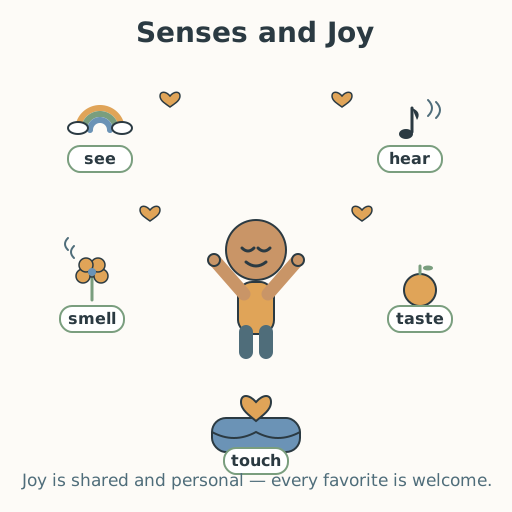
Lesson 7 — Senses and Joy
Summary
Learners turn their senses toward joy, naming one favorite thing for each sense — a beloved smell, taste, sound, sight, and touch — and discovering that delight is shared and yet different for everyone. They close by drawing or sharing their favorite.
Objectives
- Name the five senses and identify a body part used for each. (D03.S1.K.01)
Connection
Your senses don’t just tell you what is there — they also bring you joy and comfort. The smell of bread baking, a song that makes you dance, the warmth of a hug, the taste of a favorite fruit, a beautiful sunset. People everywhere find joy through their senses, and every person has different favorites — one child loves the sea’s roar, another the quiet of a snowy field. Sharing what delights us is a way we know each other.
Materials
- Crayons and paper
- A large “joy senses” chart with one section per sense
- A few safe favorite objects (optional)
Preparation
- Draw a large chart with five sections labeled with a picture: eye, ear, nose, tongue, hand.
- Gather a few safe objects that feel good to sense (a soft cloth, a smooth stone).
- Remind learners that favorites are personal and every answer is welcome.
Facilitator note
This lesson is written to the learner (“you”). As facilitator, keep the mood warm and free of judgment — there are no “wrong” favorites. Honor every body: a learner with low vision may find joy in touch and sound; a learner with limited hearing may love color and texture. This is also a values moment: the lesson teaches that joy is shared and personal at once, and that every way of sensing and delighting is worthy. No one’s favorites should be mocked or ranked.
Procedure
- Gather (5 min). Sit comfortably and take a slow breath. Think of one thing that makes you smile just by sensing it.
- Name the senses (5 min). Touch each sensing body part: eyes, ears, nose, tongue, hands. Today we ask: what does each one love?
- One favorite for each sense (15 min). Go around your group or think to yourself
and fill the chart:
- See: a color or sight you love.
- Hear: a sound that makes you happy.
- Smell: a smell that comforts you.
- Taste: a taste that makes you smile.
- Touch: a feeling on your skin that is soft, warm, or cozy. Add your favorites to the big chart, in words or pictures.
- Draw your favorite (10 min). Choose your most-loved one and draw it. If you cannot see, draw by feel or describe it aloud.
- Share (5 min). Tell a partner one favorite and listen to theirs. Did any of your favorites match? Were some different? Both are wonderful.
- Close (5 min). Notice how your body feels right now. Joy often feels warm and light. What is one sense you want to enjoy more today?
Differentiation
- Support: Offer one or two senses at a time; let learners answer with a gesture or a single word instead of a full sentence.
- Extension: Invite learners to share a favorite that belongs to their family or culture — a special song, food, or smell — and tell its story.
Assessment
- Formative (observation): Can the learner name a sense and share one favorite thing it brings them?
- Self: The learner identifies which sense brings them the most joy.
Home connection
Ask a grown-up what their favorite smell, sound, and taste are, and tell them yours. Notice how your favorites are alike and different — and enjoy one together.