Lesson 01 — Five Senses, Five Doors
Learners recall the five senses from earlier grades and match each one to the body part that does the sensing — eyes, ears, nose, tongue, and skin — then draw and label their own "five doors."
Objectives
Objectives
- D03.S1.02.01 Match each of the five senses to the body part that does the sensing and describe one thing each sense tells us.
Essential question
How do my five senses match the body parts that do the sensing?
Key vocabulary
Materials
Standard materials
- Senses matching cards · 1 set per pair Five sense cards (sight, hearing, smell, taste, touch) and five body-part cards (eyes, ears, nose, tongue, skin)
- A small mirror (optional) · per learner or pair To look at one's own eyes, ears, nose, and tongue
- Paper and crayons · per learner For drawing and labeling a "five doors" picture
Low-tech / no-cost
- Your own body Point to each body part — eyes, ears, nose, tongue, skin — with no cards or paper
- Voice Chant the five senses and their body parts aloud together
Enriched / lab & device
- Laminated senses matching cards · 1 set per pair Durable cards for repeated matching and sorting games all year
- Tablet or camera · 1 per group Photograph learners pointing to each sense door to build a class "sense doors" book
Works in different contexts
- large-group Hold each card up high and name the sense and its body part together before learners match in pairs
- self-directed A learner lays out the five senses, points to each body part on their own body, and matches the pairs alone
- outdoor-only Find each sense door outside — the eyes that see the sky, the ears that hear birds, the skin that feels the wind — and name them
- multi-age Older learners hold the body-part cards while younger learners call out the matching sense, then they switch
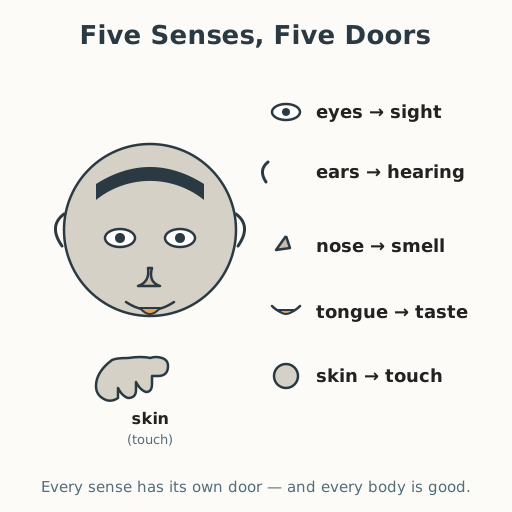
Lesson 1 — Five Senses, Five Doors
Summary
Learners meet the five senses as five “doors” the world comes in through. They match each sense — sight, hearing, smell, taste, and touch — to the body part that does the sensing, then draw and label their own five doors.
Objectives
- Match each of the five senses to the body part that does the sensing. (D03.S1.02.01)
Connection
You already know your body has parts — in Grade 1 you named your head, arms, legs, hands, and feet. Now think of the five doors your body opens to the world: your eyes are the doors for light, your ears for sound, your nose for smells, your tongue for flavors, and your skin for touch. Every door is a way the world comes in to you.
Materials
- Senses matching cards (sight, hearing, smell, taste, touch and eyes, ears, nose, tongue, skin)
- A small mirror (optional)
- Paper and crayons
Preparation
- Print or draw a matching card set: five sense cards and five body-part cards.
- Set out mirrors if using them.
- Prepare paper and crayons for the “five doors” drawing.
Facilitator note
This lesson is written to the learner (“you”) so it works in a classroom and for a self-directed learner. Prepare the cards and mirrors, then guide the matching game and drawing. This lesson spirals up from Kindergarten, where learners named the five senses, and from Grade 1, where they named body parts — today the two come together. Five is one useful map people use in many places, but it is not the only one: other knowledge traditions also name senses such as balance, movement, warm-and-cold, and the inner feeling of the body, and this unit honors those in Lessons 2–4. Today the five-door map is a starting place, not the whole truth. Honor every body: a learner may use a hearing aid, glasses, a communication device, or a friend to help point. Point to the matching card as you say each sense so learners who are deaf or hard of hearing can follow; the touching-and-pointing is already a tactile path for learners with low vision. There is no “correct” body to match to — every body has its own way, and every way is good.
Procedure
- Gather (5 min). Think back. Do you remember the five senses from when you were smaller? Say any you remember. Today we match each sense to the body part that does the sensing.
- Meet the five senses (10 min). Look at the sense cards and say them together: sight, hearing, smell, taste, touch. Each sense has a body-part “door”: sight uses the eyes, hearing the ears, smell the nose, taste the tongue, and touch the skin. Point to each door on your own body as you say it.
- Matching game (15 min). Lay the five sense cards in a row. Pick up a body-part card and put it next to its matching sense: eyes next to sight, ears next to hearing, nose next to smell, tongue next to taste, skin next to touch. If you have a mirror, look at your own eyes, ears, nose, and tongue.
- Draw your five doors (10 min). Draw your face and your hand. Label each door: eyes, ears, nose, tongue, skin. A friend may help you label, and pointing or telling counts just the same.
- Close (5 min). Say the five doors once more: eyes, ears, nose, tongue, skin. That is how the world comes in to you.
Differentiation
- Support: Introduce two senses at a time; hold up a body-part card and have the learner echo the sense and touch their own matching part.
- Extension: Ask learners to name a sixth thing their body can sense, like warm and cold, and point to where they feel it.
Assessment
- Formative (observation): Can the learner match each of the five senses to its body part and point to each on their own body?
- Artifact (portfolio): The labeled “five doors” drawing, kept in the learner’s portfolio.
Resources
- BBC Bitesize (KS1) — What are the senses?: https://www.bbc.co.uk/bitesize/topics/z6882hv/articles/zsbntrd
Home connection
Teach the five senses and their five doors to someone at home, and point to each body part together.