Lesson 01 — Words That Encourage
Learners practice giving sincere compliments and words of encouragement during an activity, and see that every language and family has its own way to cheer someone on.
Objectives
Objectives
- D02.S1.02.01 Give a sincere compliment or word of encouragement to a classmate during an activity.
Essential question
How do encouraging words help a friend keep going?
Key vocabulary
Materials
Standard materials
- Chart paper and markers · 1 sheet per group For a class "cheer wall"
- Soft turn marker · 1 A ball, stone, or beanbag passed around to show whose turn it is to speak
- Sentence-starter cards · 1 set Cards reading "You can do it!", "Nice try!", "I like how you...", and "Keep going!"
Low-tech / no-cost
- Voices and bodies Say and act out encouraging words; no paper, markers, or cards needed
- A found object Any small found object (a pebble, a seed pod) can be the turn marker
Enriched / lab & device
- Voice recorder · 1 per group Record learners saying an encouraging word in a home language to build a class cheer gallery
- Home-language cheer cards · 1 set Pre-printed cards inviting encouraging words in several languages to spark sharing
Works in different contexts
- large-group Pass the turn marker around a big circle; say each encouraging word together as a whole group before acting it out
- self-directed A learner works alone, writing or drawing three encouraging words they use and one from a home language, then says each aloud to a grown-up or into a recorder
- outdoor-only Gather in a circle outside; pass a found object and practice cheers while walking or sitting on the ground
- multi-age Older learners model an encouraging word in a home language; younger learners repeat it back
- level-grouped Group by comfort with speaking, not age; confident speakers model first, and every group practices the same words
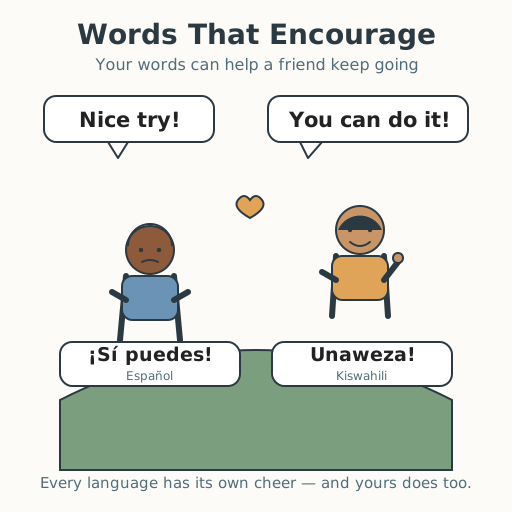
Lesson 1 — Words That Encourage
Summary
Learners discover that encouraging words help a friend keep going, tell the difference between a sincere compliment and empty praise, and practice giving real encouragement during an activity. They learn that every language has its own cheers.
Objectives
- Give a sincere compliment or word of encouragement to a classmate during an activity. (D02.S1.02.01)
Connection
Think of a time you tried something hard — a puzzle that would not fit, a word that would not come out, a jump you could not make yet. Then someone said, “You can do it,” or “Nice try,” and you tried one more time. Encouraging words help people keep going. All over the world — on a playing field, at a harvest, in a classroom — people cheer each other on, and every language has its own cheers. Today you will learn to give real encouragement that helps a friend keep going.
Materials
- Chart paper and markers
- A soft turn marker (ball, stone, or beanbag)
- Sentence-starter cards (“You can do it!”, “Nice try!”, “I like how you…”, “Keep going!”)
Preparation
- Arrange a circle for gathering.
- Hang a blank “cheer wall” chart where everyone can reach it.
Facilitator note
Encouragement is a skill children build by doing, not by being told to be nice (CASEL’s relationship-skills competency). The key idea to protect is sincere vs. empty: a compliment names something true and specific (“I like how you shared your crayons”), while empty praise is vague and rote (“good job” about nothing). Model the difference and invite learners to say what they are cheering for. Encourage never requires — and never ranks: a child is not “better” for giving more cheers, and no one is judged for cheering quietly. A learner who does not speak with their mouth gives encouragement with sign, a gesture, a smile, or a picture card — all count fully. Invite, never require, learners to share how they cheer at home; sign languages are languages too. Some learners may not feel safe sharing a home language, and saying “I cheer quietly at home” is fine. Read the procedure aloud; model each cheer with voice and body.
Procedure
- Gather (5 min). Sit in a circle. Think: when did someone’s words help you keep going? What did they say?
- Meet the cheers (10 min). Say — or sign — “You can do it!”, “Nice try!”, “I like how you…”, and “Keep going!” together. Act each one out: a fist in the air for “You can do it!”, a thumbs-up for “Nice try!”. Ask yourself: what cheers do we say in my family, in my language? Share one if you want to.
- Compliment circle (15 min). Pass the turn marker. When it comes to you, give one sincere encouragement to the person beside you — something true and specific about what they are doing or trying. Then it is their turn.
- Cheer wall (10 min). Draw or write one encouraging word — one from class and, if you like, one from home. Add it to the wall.
- Close (5 min). Remember: a real cheer names something true. Your words can help a friend keep going — in any language.
Differentiation
- Support: Offer a sentence starter (“I like how you…”) and model one cheer with a gesture. A learner who does not speak with their mouth uses sign or a picture cheer card as their way to encourage.
- Extension: Invite learners to teach the class one encouraging word in a home language and add it to the wall with a drawing of when they would use it.
Assessment
- Formative (observation): Does the learner give a sincere, specific encouragement to a classmate during the activity?
- Artifact (portfolio): The learner’s cheer-wall drawing or card.
Home connection
At home, cheer on a family member who is trying something hard — say what you are cheering for, and notice how it helps them keep going.