Lesson 08 — Two Kinds of Gathering: Online and Offline
Learners examine how online and offline communities differ and how people belong in each. They compare face-to-face belonging (body, voice, one place, now) with online belonging (words and images, across distance, often persistent and large), map the communities they belong to in each, and ask who can join each kind — noticing that access is not even for everyone.
Objectives
Objectives
- D02.S3.07.01 Examine how online and offline communities differ and how people belong in each.
Essential question
How do online and offline communities differ, and how do people belong in each?
Key vocabulary
Materials
Standard materials
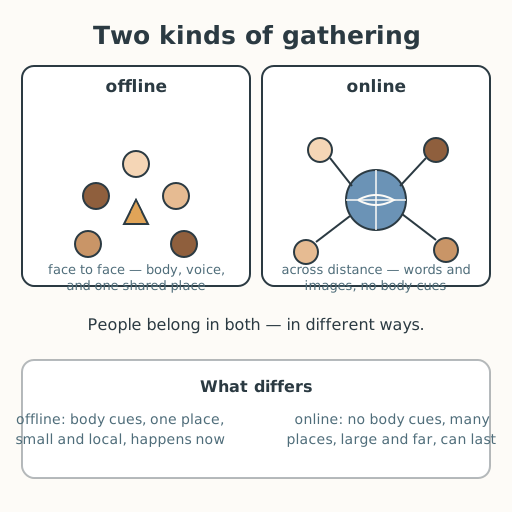
- Two kinds of gathering poster · 1 Two panels — a face-to-face circle and a network of connected people — with the differences labeled
- Belonging map page · 1 per learner A page with two columns, offline and online, to list the communities a learner belongs to and how they belong in each
- Pencils · per learner
Low-tech / no-cost
- Voice and body Act out an offline circle, then a "network" with lines of string between learners; no poster or page needed
- String or chalk Draw or stretch the connections of an online network on the ground
Enriched / lab & device
- A short, respectful clip or a live look at an online community · 1 To see how a real online community (a game guild, a study group, a hobby forum) builds belonging (verify the clip is appropriate)
- A world map · 1 To mark where the members of an online community might live, showing reach across distance
Works in different contexts
- large-group Build one human network with string across the room to feel "reach," then have pairs fill their belonging maps
- multi-age Younger learners name one offline and one online community; older learners name how belonging differs in each and where access is uneven
- self-directed A learner fills both columns of the belonging map and writes one sentence on how belonging differs in each
- level-grouped Learners ready to extend add "access" — that not everyone can join online, by cost, geography, or disability — and explain why it matters
- outdoor-only Use string stretched between learners standing apart to feel an online network's reach, then discuss what is gained and lost; no paper needed
Lesson 8 — Two Kinds of Gathering: Online and Offline
Summary
Learners examine how online and offline communities differ and how people belong in each. They compare face-to-face belonging (body, voice, one place, now) with online belonging (words and images, across distance, often persistent and large), map the communities they belong to in each, and ask who can join each kind — noticing that access is not even for everyone.
Objectives
- Examine how online and offline communities differ and how people belong in each. (D02.S3.07.01)
Connection
A community is a group you belong to and that partly belongs to you. You are in offline communities — a family, a class, a neighborhood, a team, a place of worship — where you sit in the same room and read faces, voices, and bodies. You may also be in online communities — a game with a guild, a study group, a hobby forum, a group chat — where you may never meet the others, and where what they know of you is mostly words and images. Both are real belonging, but they work differently: offline belonging is local and immediate; online belonging can reach across the whole planet and can last long after you log off. And not everyone can join each kind equally — the internet is not evenly available to everyone on Earth, which matters to who gets to belong where.
Materials
- Two kinds of gathering poster
- Belonging map page
- Pencils
Preparation
- Print or draw the two-kinds-of-gathering poster.
- Copy a belonging map page for each learner.
- Arrange pairs and space for a human network.
Facilitator note
This lesson is written to the learner (“you”). The idea to land is that online and
offline communities are both real ways to belong, but they differ — offline is local,
face-to-face, and immediate; online reaches across distance, runs on words and images, and
can persist — and access to the online kind is uneven across the world. Hold the
technology lens honestly (neither worship nor fear): online community is not “fake” and
offline is not automatically “better”; each fits different needs. Hold the egalitarian lens:
name plainly that internet access varies by cost, geography, and disability (World Bank,
Digital Dividends), so “everyone can join online” is not yet true. Do not require learners
to reveal which online spaces they use, and never ask for account names. Model one entry on
the belonging map as a worked example before independent work (Kirschner, Sweller & Clark,
2006). See docs/facilitation.md and docs/art-style.md.
Procedure
- Gather and recall (5 min). You have spent this unit on relationships between people. Now zoom out: where do those relationships live? Name one group you belong to. (A community is a group you belong to, and that partly belongs to you.)
- Meet the two kinds (10 min). Look at the poster. Offline: you share a place and a time; you read bodies and voices; it is small and local, and it happens now. Online: you share words and images; you may never meet; it can be large and far, and it can last — a post stays up long after you leave. Worked example: “In my class (offline) I belong by showing up and speaking; in a hobby group (online) I belong by posting and replying.”
- Feel the reach (10 min). Stand as a group. First, make a tight face-to-face circle — that is offline belonging. Then stretch string between learners standing far apart — that is online reach: you can belong to people who are not in the room. What is gained? What is lost?
- Map your belonging (15 min). On your page, list one or two communities in each column — offline and online — and beside each, one sentence on how you belong there. You may leave either column light; not everyone is online, and that is fine.
- Ask who can join (5 min). Discuss one question: who can not join an online community, and why (cost, no device, no connection, a disability that design ignored)? Belonging is not evenly open to everyone — noticing that is part of caring about it.
- Close (5 min). You belong in more than one way, and each way has strengths and limits. Tomorrow you will ask how these communities change over time.
Differentiation
- Support: Provide a list of example communities (family, class, team, group chat, game, forum) to choose from.
- Extension: Choose one online community and one offline community and write two differences in how a newcomer is welcomed into each.
Assessment
- Formative (observation): Can the learner name at least one offline and one online community and state one way belonging differs between them?
- Self-check: The learner checks their map lists at least one “how I belong” sentence for each community they named.
Home connection
Ask someone at home which communities they belong to in person and which online, and how belonging feels different in each — then share one thing you noticed about access.
Resources
- On the uneven spread of digital access (the digital divide): World Bank, World Development Report 2016: Digital Dividends, https://www.worldbank.org/en/publication/wdr2016
- On digital media and adolescent development: Common Sense Media Research Program, https://www.commonsensemedia.org/research
- On staying safe and kind online: UNICEF, “Keeping children safe online,” https://www.unicef.org/protection/violence-against-children-online
- On modeling a new skill before independent practice: Kirschner, Sweller & Clark (2006), https://doi.org/10.1207/s15326985ep4102_1