Lesson 10 — Mutual Aid: Why We Help
Learners meet mutual aid — helping one another, among equals, so everyone both gives and receives — through four living traditions from Kenya, Indonesia, the Andes, and North America. They plan or join a small, doable mutual-aid action for their own school or community, and reflect honestly on their motives for helping: care, duty, recognition, or a mix.
Objectives
Objectives
- D02.S4.07.01 Organize or join a mutual-aid action in their school or community.
- D02.S4.07.02 Reflect on the motives for helping, such as care, duty, or recognition.
Essential question
How do I organize or join a mutual-aid action — and what are my real motives for helping: care, duty, or recognition?
Key vocabulary
Materials
Standard materials
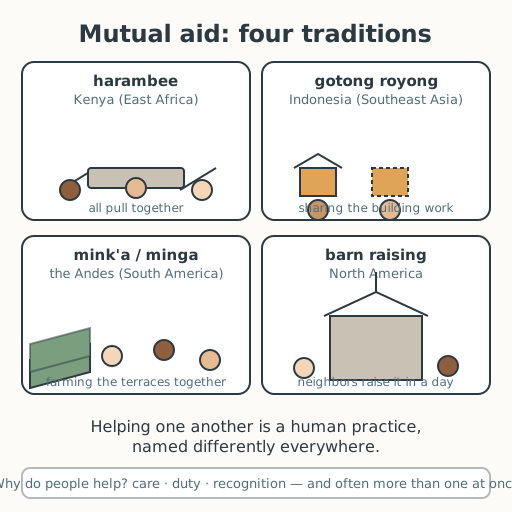
- Mutual aid traditions poster · 1 Four named traditions — harambee (Kenya), gotong royong (Indonesia), mink'a/minga (Andes), barn raising (North America) — with a motives note
- Plan-a-help page · 1 per learner A simple planner for a small, doable mutual-aid action: need, people, roles, steps, and a motives line
- Pencils · per learner
Low-tech / no-cost
- Voice and body Name and act out the four traditions; plan the action aloud; no poster or page needed
- Found objects Stones or sticks stand in for people and tasks as you plan the action on the ground
Enriched / lab & device
- A short, respectful clip of a real mutual-aid effort · 1 A community cleanup, a shared harvest, a study circle — to see mutual aid in motion (verify the clip is appropriate)
- Class 'motives' wall · 1 Learners post anonymous motive notes — one honest reason they help — building a shared, non-judged record
Works in different contexts
- large-group Choose one action as a whole group and divide roles; every learner signs up for a small part, then reflect on motives in pairs
- multi-age Older learners plan and assign roles; younger learners carry out a simple task and name one reason they wanted to help
- self-directed A learner plans a small action they can do alone or with one other person, and writes an honest motives note for each of care, duty, and recognition
- level-grouped Learners ready to extend distinguish mutual aid (help among equals, everyone gives and receives) from charity (one gives, one receives) and write the difference
- outdoor-only Plan and begin a real outdoor action — a shared cleanup or a path cleared together — and reflect on motives afterward; no paper needed
Lesson 10 — Mutual Aid: Why We Help
Summary
Learners meet mutual aid — helping one another, among equals, so everyone both gives and receives — through four living traditions from Kenya, Indonesia, the Andes, and North America. They plan or join a small, doable mutual-aid action for their own school or community, and reflect honestly on their motives for helping: care, duty, recognition, or a mix.
Objectives
- Organize or join a mutual-aid action in their school or community. (D02.S4.07.01)
- Reflect on the motives for helping, such as care, duty, or recognition. (D02.S4.07.02)
Connection
In Kenya, people speak of harambee — “all pull together” — when a community joins to build a school or help a family. In Indonesia, gotong royong names neighbors sharing the burden of building and gathering. In the Andes, mink’a (or minga) is the old practice of farming the terraces together so no one harvests alone. Across North America, a barn raising gathered neighbors to lift a family’s barn in a single day, the favor returning later to whoever helped. Different names, same thing: mutual aid — helping where everyone both gives and receives, no one above and no one below. And behind every act of help sits a motive: sometimes care (I help because I feel for you), sometimes duty (I help because it is right and owed), sometimes recognition (I help to be seen as good). Often it is more than one at once.
Materials
- Mutual aid traditions poster
- Plan-a-help page
- Pencils
Preparation
- Print or draw the mutual aid traditions poster.
- Copy a plan-a-help page for each learner.
- Arrange for the group to choose one small action together (or prepare several options).
Facilitator note
This lesson is written to the learner (“you”). The idea to land is that mutual aid is
helping among equals — everyone gives and receives — and it appears in living traditions
across the world; and that honest reflection on motives (care, duty, recognition) makes our
helping truer. Present the four traditions with respect as living practices, never as
curiosities or a ranking, and note that details vary by community and are best learned from
people who practice them (the poster is a starting point, not the last word). Honor the
egalitarian lens: mutual aid is not charity from above — it is solidarity among equals.
Keep motives non-judged: all three motives are human and common, and naming them honestly is
the skill (inquiry over creed — you are not grading anyone’s reasons). The action must be
small, safe, and genuinely doable — a shared cleanup, a study circle, a letter of thanks, a
classroom “help board” — with every learner offered a real part. Model the planner once as
a worked example before independent work (Kirschner, Sweller & Clark, 2006). See
docs/facilitation.md and docs/art-style.md.
Procedure
- Gather and recall (10 min). This unit began with boundaries and repair, moved through empathy and belonging, and now ends where care becomes action. Look at the poster: four traditions, one idea — mutual aid. In mutual aid, everyone both gives and receives; no one is only the helper and no one only the helped. (Retrieval: name the four traditions and their homes.)
- Meet the motives (10 min). Behind every act of help sits a motive. Care — I help because I feel for you. Duty — I help because it is right, because I owe it to my community. Recognition — I help because I want to be seen as good. Worked example, said aloud: “When I help a classmate carry books, it is partly care (I like them) and partly duty (we share a classroom). Sometimes I also just want to be thanked — that’s recognition.” All three are human; naming them honestly is the skill.
- Plan a small action (20 min). As a group, choose one small, doable mutual-aid action — a shared cleanup, a study circle, a “help board,” a thank-you letter to someone who serves the community. On your page, fill in: the need, the people, the roles (what each person gives and receives), and the steps. Sign up for a real part.
- Reflect on your motives (10 min). On your page, write one honest line for each: My care says ___. My duty says ___. My want of recognition says ___. There is no wrong answer. Then note which motive is strongest in you today, and what you want it to be.
- Close (5 min). Mutual aid is how care becomes shared action — everyone gives, everyone receives. You have now traveled the whole arc: from boundaries, through empathy, to acting together. Carry all of it with you, everywhere you belong.
Differentiation
- Support: Provide a pre-chosen action and a roles word bank; ask the learner to fill only the “need” and their own role, plus one motives line.
- Extension: Distinguish mutual aid from charity in one or two sentences (mutual aid is among equals, everyone gives and receives; charity flows one way), and note why the difference matters.
Assessment
- Formative (observation): Does the learner take a real part in the planned action and name what they will give and receive?
- Performance (portfolio): The completed plan-a-help page, kept as evidence of organizing or joining a mutual-aid action.
- Self-check: The learner checks their motives note names care, duty, and recognition honestly, without judging any as “bad.”
Home connection
Ask someone at home about a time the community helped together — a shared harvest, a cleanup, a fund for a family — and share the action your class is planning, and the part you chose.
Resources
- On mutual aid as a widespread human practice: Kropotkin, Mutual Aid: A Factor of Evolution (1902; the term’s canonical source — held here as a description of a practice, not a claim that helping is “good”).
- On named communal-help traditions (harambee, gotong royong, mink’a/minga, barn raising): the “Communal work” entry in the open encyclopedia; verify local details with community members.
- On cooperative structures and why cooperation helps groups thrive: Johnson & Johnson, social interdependence theory; and Slavin, Cooperative Learning.
- On modeling a new skill before independent practice: Kirschner, Sweller & Clark (2006), https://doi.org/10.1207/s15326985ep4102_1