Lesson 08 — The Trade-Offs: Cost, Materials, Function, and Environmental Impact
Learners discover that every design choice is a trade-off among cost, materials, function, and environmental impact — a water bottle can be cheap (plastic), durable (metal), or clean and recyclable (glass), but no single choice wins every column. They weigh real everyday objects side by side, name the trade-offs, and make a defended choice for a stated need, closing the unit with the designer's habit: choose on purpose, and know what you are trading.
Objectives
Objectives
- D07.S4.07.02 Explain how a design choice trades off cost, materials, function, and environmental impact.
Essential question
How does a design choice trade off cost, materials, function, and environmental impact — and how do I choose on purpose?
Key vocabulary
Materials
Standard materials
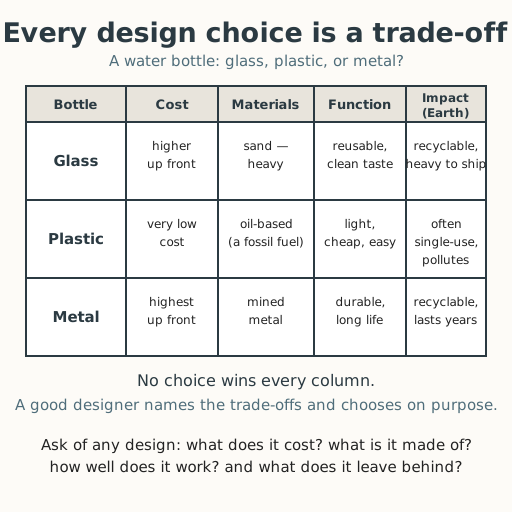
- Trade-offs poster · 1 The bottle comparison table — glass, plastic, and metal weighed across cost, materials, function, and environmental impact
- Trade-off worksheet · 1 per learner A four-column page — cost, materials, function, environmental impact — with a 'my choice and why' line at the bottom
- Everyday objects to compare · per group Two or three real objects that solve the same need — a plastic and a wooden spoon, a paper and a cloth bag — to weigh side by side
Low-tech / no-cost
- Found objects and hands Compare any two objects at hand — a stone and a stick, a gourd and a can — by feel, weight, and use; no poster or worksheet needed
- Voice and body Weigh the four factors aloud for a real choice from the learner's day — what to carry water in, what to wrap food in — naming each trade-off
Enriched / lab & device
- Life-cycle images or data · 1 set A simple life-cycle diagram or data card for an object — from raw material through making, use, and disposal — to discuss where impact hides
- A spreadsheet or table app · 1 per pair Build the four-column trade-off table digitally for several objects and sort to find the 'best' choice for a stated need
Works in different contexts
- large-group Weigh one shared choice together on the board, then have pairs fill the worksheet for a second object and share one trade-off each
- multi-age Younger learners name which object costs less or works better; older learners also weigh materials and environmental impact and defend a choice with a reason
- self-directed A learner fills the worksheet for one real choice of their own and writes a single sentence naming the trade-off they accepted and why
- level-grouped Learners ready to extend trace the full life cycle of one object — where materials come from, how it is made, used, and disposed of — and name the largest impact
- outdoor-only Compare natural and made materials found outside — a leaf wrap, a clay pot, a woven basket — and weigh cost, materials, function, and impact for each; no paper needed
Lesson 8 — The Trade-Offs: Cost, Materials, Function, and Environmental Impact
Summary
Learners discover that every design choice is a trade-off among cost, materials, function, and environmental impact — a water bottle can be cheap (plastic), durable (metal), or clean and recyclable (glass), but no single choice wins every column. They weigh real everyday objects side by side, name the trade-offs, and make a defended choice for a stated need, closing the unit with the designer’s habit: choose on purpose, and know what you are trading.
Objectives
- Explain how a design choice trades off cost, materials, function, and environmental impact. (D07.S4.07.02)
Connection
Pick up almost anything near you — a spoon, a bag, a bottle, a chair. Someone chose its material and its making, and every choice had a price. The cheapest option is often the one that lasts the shortest and ends up in the ground or the water; the most durable option often costs the most up front and uses mined or harvested materials; the lightest option is easy to carry but may be made from oil. A woven basket of local reeds is nearly free in materials and returns to the earth, but it takes time and skill to make and won’t hold hot water. There is no “perfect” object — only trade-offs, seen or hidden. Today you learn to name them, so you choose on purpose instead of by accident.
Materials
- Trade-offs poster (glass / plastic / metal)
- Trade-off worksheet
- Everyday objects to compare
Preparation
- Print or draw the trade-offs poster.
- Copy a trade-off worksheet for each learner.
- Gather two or three real objects per group that solve the same need (a plastic and a wooden spoon; a paper and a cloth bag).
Facilitator note
This lesson is written to the learner (“you”). The idea to land is that every design choice trades off cost, materials, function, and environmental impact, and a good designer names the trade-off rather than hiding from it — a learner should be able to compare two objects on all four factors and defend a choice for a stated need. Model the bottle table fully (explicit instruction for a novice skill — Kirschner, Sweller & Clark, 2006). Keep the values honest and non-ranking: there is no single “right” material, and what is “best” depends on the need and the place — a clay pot makes sense where clay and fire are local, a metal pot where durability and long life matter. Hold the environment lens without doom: the point is agency, not guilt — a learner who can name the trade-off can make a better one. Note the egalitarian lens too: the cheapest option is often the only option some people can afford, so blaming individuals for “choosing plastic” misses the design-and-policy choices that made it the affordable default.
Procedure
- Gather and recall (5 min). Last lesson you designed for everyone. Today you weigh what every design costs — in money, materials, usefulness, and effect on the Earth.
- Meet the worked example (15 min). Look at the poster: a water bottle in glass, plastic, or metal, weighed across four columns. Glass — higher cost up front, made of sand (heavy), reusable with a clean taste, recyclable but heavy to ship. Plastic — very low cost, oil-based, light and cheap, but often single-use and polluting. Metal — highest cost up front, mined metal, durable with a long life, recyclable and lasts years. No choice wins every column — that is a trade-off. Now read the four questions aloud once: what does it cost? what is it made of? how well does it work? what does it leave behind?
- Weigh real objects (15 min). In your group, compare your two objects — say, the plastic spoon and the wooden spoon. Fill your worksheet for each: cost (cheap or dear?), materials (renewable, mined, or oil-based?), function (does it do the job well, and for how long?), environmental impact (where does it go when it is done — and what was used to make and ship it?).
- Choose and defend (10 min). Pick one need — “a spoon for one school year” or “a bag for a hundred trips to market” — and choose the object that best fits that need. On your worksheet, finish the line: “I choose ___ because ___, and the trade-off I accept is ___.” Share with a partner.
- Close (5 min). You have now made, performed, and designed — and you close with the designer’s habit: name the trade-offs, then choose on purpose. Keep your worksheet; it is your last portfolio piece for this unit.
Differentiation
- Support: Limit the comparison to two factors — cost and function — with a sentence frame: “The ___ costs ___ and works ___, but the ___ costs ___ and works ___.”
- Extension: Trace the life cycle of one object — raw material, making, shipping, use, and disposal — and name the single largest environmental impact in that chain.
Assessment
- Formative (observation/self): Can the learner compare two objects on cost, materials, function, and environmental impact, and defend a choice with a named trade-off for a stated need?
- Artifact (portfolio): The completed trade-off worksheet, kept for the unit portfolio.
- Self-check: The learner asks, “Can I name one trade-off I accepted and why — and one factor where my choice was weaker than the alternative?”
Home connection
Choose one real object in your day and run the four questions on it: what does it cost, what is it made of, how well does it work, and what does it leave behind? Tell someone one trade-off you found.
Resources
- The UN Environment Programme (UNEP), for the environmental framing of materials and waste: https://www.unep.org/
- The Smithsonian Science Education Center, for the engineering/design-cycle framing of choosing and comparing materials: https://ssec.si.edu/
- Kirschner, Sweller & Clark (2006), “Why Minimal Guidance Does Not Work,” on modeling the worked example before independent practice.