Lesson 09 — Keeping Humanity, Culture & Hope Under Oppression
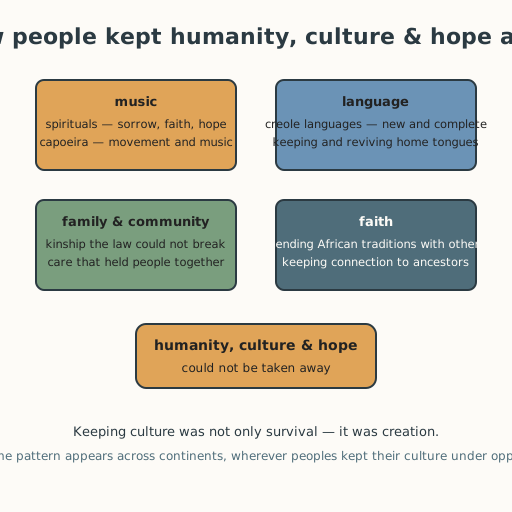
Learners explain how **enslaved and colonized peoples kept their humanity, culture, and hope alive** under oppression — through **music** (spirituals, capoeira), **language** (creoles), **family and community**, and **faith** — with specific examples. They learn that keeping culture was not only survival but creation.
Objectives
Objectives
- D08.S4.08.02 Explain how enslaved and colonized peoples kept their humanity, culture, and hope alive under oppression, with specific examples.
Essential question
How did enslaved and colonized peoples keep their humanity, culture, and hope alive under oppression?
Key vocabulary
Materials
Standard materials
- Kept-alive sheet · 1 per learner A sheet with four channels — music, language, family and community, faith — and a space to record a specific example under each
- Example cards · 1 set per group Cards carrying specific examples (spirituals, capoeira, creole languages, family and community, syncretic faith) to place under the channels
Low-tech / no-cost
- A shared board or large paper Draw the four channels together and fill them from discussion
- Voice and retelling Tell the examples aloud with respect and have learners retell them in their own words
Enriched / lab & device
- A short, age-appropriate recording of a spiritual or of capoeira music · 1 Listen respectfully to one example of culture kept alive, then discuss what it carries
- A reading on a colonized people's language revival · 1 An account of a people reviving their language or traditions under pressure, to read and discuss
Works in different contexts
- large-group Introduce the four channels once to the whole group, then small groups sort the example cards and fill the sheet
- multi-age Younger learners match each example to a channel; older learners explain what the example kept alive and why it mattered
- self-directed A learner reads the examples, fills the sheet, and writes a respectful paragraph on one example of hope kept alive
- level-grouped Learners ready to extend add a second example of their own (for example, a language revival or a tradition of storytelling) and explain it
- outdoor-only In a quiet outdoor space, reflect on what in your own life carries your culture and hope, and compare
Lesson 9 — Keeping Humanity, Culture & Hope Under Oppression
Summary
Learners explain how enslaved and colonized peoples kept their humanity, culture, and hope alive under oppression — through music (spirituals, capoeira), language (creoles), family and community, and faith — with specific examples. They learn that keeping culture was not only survival but creation.
Objectives
- Explain how enslaved and colonized peoples kept their humanity, culture, and hope alive under oppression, with specific examples. (D08.S4.08.02)
Connection
Think of a song your family sings, a word in your home language, a story told at a gathering. These small things carry who we are. When people were enslaved or colonized — when systems tried to strip away their names, languages, and families — they held onto these things, and made new ones. Culture was not just comfort; it was resistance, and it was hope. Today you see how people kept their humanity alive.
Materials
- Kept-alive sheet
- Example cards
Preparation
- Copy the kept-alive sheet and the example cards.
- Retrieval: from the previous lesson, recall the forms of resistance, including keeping culture (D08.S4.08.01); from Grade 7, recall that art and storytelling are forms of resistance (D08.S4.07.01).
Facilitator note
This lesson is written to the learner (“you”). It is the hopeful close to the unit’s hardest chapters. The idea to land: oppression tried to erase people’s culture, and people refused to let that happen — they kept and created culture, and that is how humanity and hope survived. The four channels with specific examples: (1) music — the spiritual, an African American religious song born of the enslaved experience, carrying sorrow, faith, hope, and sometimes hidden messages (S-385); and capoeira, an Afro-Brazilian art that joins movement, music, and play, created by enslaved Africans and kept alive by their descendants (S-325); (2) language — creole languages grew where African languages met European ones, becoming new, complete languages of their own (for example, Gullah and Kreyòl); (3) family and community — enslaved people built kinship, named “aunts” and “uncles” among those not of blood, and kept community when the law tried to break families apart; (4) faith — people blended African spiritual traditions with others to form new traditions (for example, Candomblé in Brazil and Vodou in Haiti), keeping connection to ancestors and the sacred. Colonized peoples did the same: preserving and later reviving their languages and traditions under pressure to abandon them. The ethics lens: we honor these traditions as peoples’ own living culture, never as specimens to study coldly. The egalitarian lens: the fact that these cultures survived — and in many cases thrive — is a victory of the people who kept them, not of the systems that tried to erase them. The global lens: the same pattern appears across continents — in the Americas, Africa, Asia, and the Pacific — wherever peoples kept their culture under colonial rule. The community lens: culture lives in people together — in song, in story, in shared food and work. Keep the door to hope wide open: this is a lesson about what could not be taken away (S-385, S-325).
Procedure
- Recall (5 min). From last lesson: what were the forms of resistance, and which one was “keeping culture”? Today we go deeper into how people kept culture — and hope — alive.
- Meet the four channels (10 min). People kept their humanity through music, language, family and community, and faith. Read the four channel names on the sheet.
- Meet the examples (15 min). Sort the example cards: music — the spiritual, born of the enslaved experience and carrying sorrow, faith, and hope (S-385), and capoeira, an Afro-Brazilian art of movement and music (S-325); language — creole languages, new and complete languages that grew where African and European languages met; family and community — kinship and care that the law could not break; faith — traditions that blended African spiritual ways with others, keeping connection to ancestors and the sacred.
- Fill the sheet (10 min). Under each channel, write the example in your own words and one sentence on what it kept alive.
- Reflect (7 min). In a group, name one thing in your own life — a song, a word, a story, a gathering — that carries your culture and hope. Notice the pattern: it is the same thing enslaved and colonized peoples did.
- Close (3 min). Oppression could not take their humanity, because they kept their culture — and their culture kept them. That is what hope looks like.
Differentiation
- Support: Match each example to its channel, then choose one to retell in one sentence.
- Extension: Add a second example of your own — a language revival, a tradition of storytelling, or a music — and explain what it kept alive.
Assessment
- Formative (observation): Can the learner name at least two channels with a specific example and explain what each kept alive — speaking of the peoples with respect?
- Portfolio artifact: The completed kept-alive sheet, kept in the portfolio.
Home connection
Share one thing in your family or community that carries its culture and hope, and ask a family member what it means to them.
Resources
- On the spiritual as music of the enslaved experience: Encyclopaedia Britannica, “Spiritual,” https://www.britannica.com/topic/spiritual (S-385).
- On capoeira as an Afro-Brazilian art created by enslaved Africans: Encyclopaedia Britannica, “Capoeira” (S-325).
- On the resistance and cultural survival of enslaved peoples: UNESCO, “Routes of Enslaved Peoples,” https://www.unesco.org/en/routes-enslaved-peoples (S-274).
- On explicit instruction and worked examples: Kirschner, Sweller & Clark (2006), https://doi.org/10.1207/s15326985ep4102_1 (S-011).