Lesson 01 — How Do We Know the Climate Is Changing?
Learners read two real data trends — global temperature and atmospheric CO₂ — and build an evidence-based explanation that links the data to a claim and states its limits. Then they practice evaluating sources: who made this, how do they know, and what do they stand to gain?
Objectives
Objectives
- D06.S1.09.01 Construct an evidence-based explanation that links data to a claim and states its limits and uncertainties.
- D06.S1.09.02 Critically evaluate a source of scientific information for reliability, bias, and conflicts of interest.
Essential question
How do we know the climate is changing, and how do we know who to trust about it?
Key vocabulary
Materials
Standard materials
- A printed graph of global average temperature over time · 1 per learner A simple line graph of global mean temperature anomaly, 1880 to present
- A printed graph of atmospheric CO₂ over time · 1 per learner From ice-core and direct measurements
- Two short articles about climate from different sources · 1 set per pair Chosen to differ in reliability or sponsorship
Low-tech / no-cost
- Hand-drawn or dictated graphs The facilitator sketches the two trends by hand; learners copy and annotate them
- Remembered examples of sources Learners name places they get information (TV, social media, elders, textbooks) and discuss
Enriched / lab & device
- Interactive climate data tools · 1 per pair A live temperature or CO₂ dataset learners can query directly
Works in different contexts
- large-group Work the two graphs together on a shared board; discuss the source-evaluation questions as a whole group
- self-directed A learner studies the graphs, writes their claim, then evaluates one source using the three questions
- outdoor-only Observe local weather or a long-lived plant/tree as a doorway to "how do we know what a normal year is?"
Lesson 1 — How Do We Know the Climate Is Changing?
Summary
Learners do what scientists actually do: look at data, build a claim that the data can support, and say honestly what the data cannot tell us. Then they turn the same critical eye on the sources of climate information, learning to separate evidence from assertion and reliability from bias.
Objectives
- Construct an evidence-based explanation that links data to a claim and states its limits and uncertainties. (D06.S1.09.01)
- Critically evaluate a source of scientific information for reliability, bias, and conflicts of interest. (D06.S1.09.02)
Connection
Every day you hear claims about the climate — from the news, from people you know, from social media. Some are careful and some are not, and it is not always obvious which is which. This lesson is not about telling you what to believe; it is about giving you the two skills that let you decide for yourself: reading evidence and judging sources. Those two skills transfer to every important question you will ever face.
Materials
- A graph of global average temperature over time (1880–present)
- A graph of atmospheric CO₂ over time (ice-core + direct measurement)
- Two short articles about climate from different sources
Preparation
- Print the two graphs (or draw them), large enough to read together.
- Choose two real articles that differ clearly in source reliability or sponsorship.
Facilitator note
This lesson is about method, not conclusion. Do not lead learners to a foregone
answer; let the data and the source questions do the work. The goal is that a learner
can state the claim the data supports and name the limits (“this shows a trend; it
does not, by itself, prove every cause”). When sources are discussed, stay neutral —
the point is to ask “how do you know?”, never to mock any source. Model saying “I
don’t know that” and “the evidence is uncertain there.” For learners distressed by
climate content, keep the focus on tools and agency; see docs/facilitation.md.
Procedure
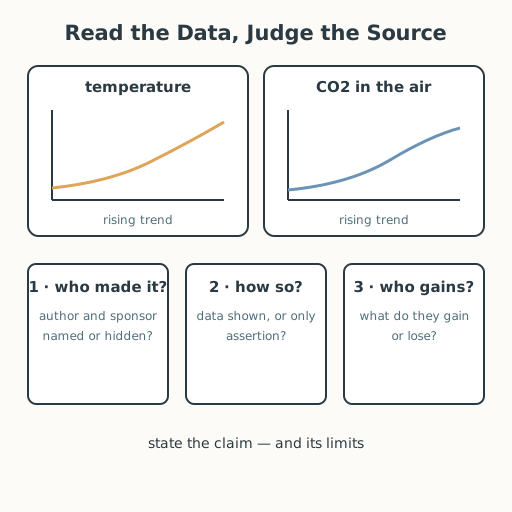
- Look at the data (10 min). Study the two graphs. Describe what you actually see: what is the overall direction of each line? (Not “why” — just “what.”)
- Build a claim (15 min). Write one sentence the data can support: “The data show that global average temperature has ___ since ___, and that atmospheric CO₂ has ___ over the same period.” Then write one thing the data does not show on its own.
- State the limits (10 min). What is uncertain here? Why does a graph of temperature not automatically tell you the cause? What else would you need to connect the two trends?
- Judge the sources (15 min). For each article, answer three questions: Who made it? How do they know? What do they stand to gain or lose? Which article would you trust more, and why?
- Close (5 min). Science earns trust by showing its evidence and its limits. A claim without evidence is an assertion; a claim without limits is a red flag. Bring these two habits to everything you read.
Differentiation
- Support: Provide sentence frames for the claim and the three source questions.
- Extension: Find the original dataset behind one article and check whether the article represents it faithfully.
Assessment
- Formative: Can the learner state a claim the data supports and name one limit?
- Summative/performance: The written claim–data–limits note, and a one-paragraph source evaluation naming reliability, bias, and any conflict of interest.
Resources
- IPCC — Climate Change 2023: Synthesis Report (authoritative summary): https://www.ipcc.ch/report/ar6/syr/
- NASA — Climate change evidence: https://science.nasa.gov/climate-change/evidence/
Home connection
Show someone at home one of the graphs and your claim. Ask where they get their information about the climate, and practice the three source questions together.