Lesson 10 — Capstone: Living Systems, Physical Systems & Our Origins — Putting It Together
Learners synthesize the unit's six ideas into one **evidence-based picture of the natural world**, linking living systems, physical systems, and Earth and origins. They assemble their portfolio and write a short synthesis that states its own limits — the unit's culminating artifact.
Objectives
Objectives
- D06.S2.09.01 Explain how matter cycles and energy flows through ecosystems, and how disruptions affect carrying capacity.
- D06.S2.09.02 Describe biodiversity and explain why it matters for resilient ecosystems and human well-being.
- D06.S3.09.01 Explain the law of conservation of energy and analyze energy transformations and efficiency in a real system.
- D06.S3.09.02 Use the structure of the atom to explain bonding and how chemical reactions absorb or release energy.
- D06.S4.09.01 Explain how greenhouse gases regulate climate and how human activity is changing the climate system.
- D06.S4.09.02 Explain the evidence for the age of the Earth and the universe and how scientists measure it.
Essential question
How do the six ideas of this unit fit into one evidence-based picture of the natural world?
Key vocabulary
Materials
Standard materials
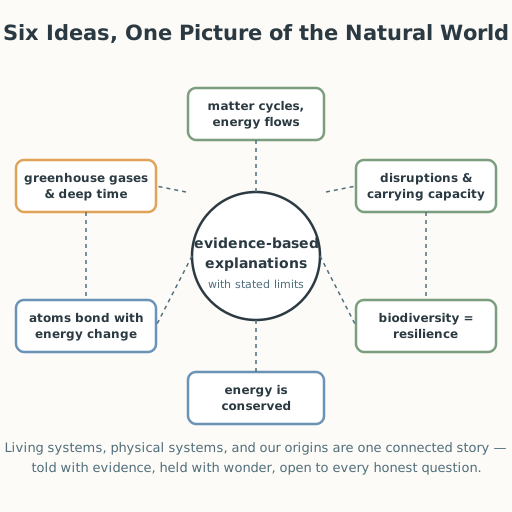
- Capstone synthesis map · 1 per learner A ring of the six ideas around a center labeled "evidence-based explanations," to connect with linking sentences
- Portfolio folder · 1 per learner The learner's own artifacts from Lessons 1–9, gathered for the final explanation
Low-tech / no-cost
- A shared board or large paper Draw the six-idea ring together and speak the links aloud before writing
- Voice and a partner Explain the whole picture to a partner in three minutes, then listen to theirs and ask one question
Enriched / lab & device
- A presentation tool or poster board · 1 per group Build a shared visual of the six ideas and how they connect
- A gallery-walk or mini-presentation format · 1 per class Each learner explains the connected picture to others, with questions and feedback
Works in different contexts
- large-group Model one link between two ideas to the whole group, then learners complete the map and share one link each
- multi-age Younger learners connect two ideas with one sentence; older learners write the full six-link synthesis with a stated limit
- self-directed A learner completes the map, writes the synthesis paragraph, and self-assesses against the unit objectives
- level-grouped Learners ready to extend identify one place where living, physical, and Earth systems meet (e.g., carbon moving through all three) and explain it
- outdoor-only Draw the six-idea ring in the ground and walk from idea to idea, saying aloud how each links to the next
Lesson 10 — Capstone: Living Systems, Physical Systems & Our Origins — Putting It Together
Summary
Learners synthesize the unit’s six ideas into one evidence-based picture of the natural world, linking living systems, physical systems, and Earth and origins. They assemble their portfolio and write a short synthesis that states its own limits — the unit’s culminating artifact.
Objectives
- Explain how matter cycles and energy flows through ecosystems, and how disruptions affect carrying capacity. (D06.S2.09.01)
- Describe biodiversity and explain why it matters for resilient ecosystems and human well-being. (D06.S2.09.02)
- Explain the law of conservation of energy and analyze energy transformations and efficiency in a real system. (D06.S3.09.01)
- Use the structure of the atom to explain bonding and how chemical reactions absorb or release energy. (D06.S3.09.02)
- Explain how greenhouse gases regulate climate and how human activity is changing the climate system. (D06.S4.09.01)
- Explain the evidence for the age of the Earth and the universe and how scientists measure it. (D06.S4.09.02)
Connection
You began this unit with a small, sturdy method: evidence, then claim, with limits stated. You used it on a forest, an atom, a power plant, a warming atmosphere, and a 13.8-billion-year sky. Today you turn around and see that they were never six separate topics. They are one story — matter and energy moving through living things, atoms bonding and releasing energy, gases holding heat, and deep time behind it all. The capstone is not learning something new; it is seeing the whole.
Materials
- Capstone synthesis map
- Portfolio folder
Preparation
- Copy the synthesis map.
- Gather each learner’s portfolio artifacts from Lessons 1–9.
- Retrieval: the six objectives, now stated in the learner’s own words.
Facilitator note
This lesson is written to the learner (“you”). Its job is synthesis and honest self-assessment, not new content. The idea to land: the six ideas connect — matter cycles and energy flows in living systems; disruptions move carrying capacity; biodiversity buffers those disruptions; energy is conserved as it transforms in physical systems; atoms bond with energy in and out; greenhouse gases and deep time frame the Earth and the cosmos — and every one is held as an evidence-based explanation with stated limits. Use a worked example first (S-011): link two ideas aloud (carbon atoms move through living systems by photosynthesis and respiration, into physical systems as fuel, and into the atmosphere as a greenhouse gas — one atom, three systems). The critical-thinking lens: a synthesis is only as honest as its limits, so the closing paragraph must state what the learner does not yet know or is uncertain about. The environment lens: the connected picture is also a stewardship picture — the carbon that flows through all three systems is the same carbon whose balance we have disturbed. The egalitarian and global lenses: the natural world’s rules are everyone’s inheritance and everyone’s responsibility — no one owns the carbon cycle or the conservation of energy, and the burdens of disrupting them fall unevenly, so caring for these systems is a shared, fair, worldwide task. The ethics lens: holding origins as models with evidence, never creed, and stating limits honestly, is the intellectual integrity the whole unit has practiced. This is a mastery moment, not a ranking: a learner who has not yet got it revisits and tries again (“not yet” is information, never a verdict).
Procedure
- Recall (5 min). From memory, write the six ideas in six words each. Then check against the unit map.
- Build the ring (15 min). On the synthesis map, write a linking sentence on each connector — how each idea hands off to the next (for example: “energy flowing one way leaves as heat, which is why efficiency matters…”).
- Model one link (8 min). Worked example: one carbon atom moves through living systems (photosynthesis, respiration), physical systems (fuel, combustion), and the atmosphere (a greenhouse gas). Trace it on the map.
- Write the synthesis (15 min). Write one paragraph: “The natural world is one connected system. In living things, ___. In matter and energy, ___. On the Earth and in the cosmos, ___. What I still don’t know or am unsure about is ___.”
- Peer-check (7 min). Read your paragraph to a partner. Ask: did I state a limit? Did I link at least two ideas? Give one specific suggestion.
- Close and gather (10 min). Assemble the portfolio: the artifacts from all ten lessons, in order, with the synthesis on top. This is your evidence-based picture of the natural world — your own.
Differentiation
- Support: Provide the synthesis paragraph as a fill-in frame with the six ideas listed; the learner completes the blanks and adds one stated limit.
- Extension: Identify one substance (carbon, water, energy) that moves through living, physical, and Earth systems and trace its full path in a short essay.
Assessment
- Summative (portfolio): The completed synthesis map and paragraph, with the gathered artifacts, show whether the learner can link the six ideas into one evidence-based account that states its limits.
- Peer and self: The partner check and a one-line self-assessment (“One idea I now see differently is ___.”).
Home connection
Explain the whole unit to someone at home in five minutes — the living systems, the physical systems, and the origins — and invite one question you don’t yet know the answer to.
Resources
- On explicit instruction and worked examples: Kirschner, Sweller & Clark (2006), https://doi.org/10.1207/s15326985ep4102_1 (S-011).
- On the six objectives and their sources: see Lessons 1–9 of this unit.