Lesson 10 — Freedom & Dignity: Ideas That Travel — and the Story Continues
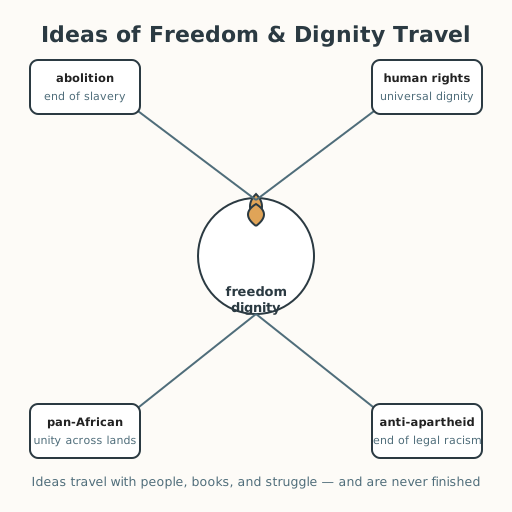
Learners explain how ideas of **freedom and dignity** spread and fueled struggles for liberation across continents — abolition, universal human rights, pan-African unity, and the end of apartheid — and place themselves in the long, unfinished story. This is the unit's capstone and synthesis.
Objectives
Objectives
- D08.S4.09.02 Explain how ideas of freedom and dignity spread and fueled struggles for liberation across different continents.
Essential question
How did ideas of freedom and dignity spread and fuel struggles for liberation across continents — and where does that leave you?
Key vocabulary
Materials
Standard materials
- Idea cards · 1 set per group Cards on the spread of four ideas — abolition, universal human rights, pan-African unity, and the end of apartheid
- Capstone web sheet · 1 per learner A sheet connecting the unit's seven goals into one synthesis and placing the learner in the story
Low-tech / no-cost
- A shared board or large paper Draw the spread of ideas as lines from a center, and add each idea
- Voice and memory Tell each idea's journey aloud and have learners retell it
Enriched / lab & device
- The Universal Declaration of Human Rights (plain-language version) · 1 To read a few articles and discuss how they travel and where they are contested
- A short clip or song of a liberation movement · 1 To hear how ideas of freedom travel through music
Works in different contexts
- large-group Present the four ideas to the whole group, then small groups build the capstone web and share one connection
- multi-age Younger learners match each idea to a place and a person; older learners trace the idea's spread and place themselves in the story
- self-directed A learner reads the idea cards, builds the web, and writes a short reflection on their own place in the unfinished story
- level-grouped Learners ready to extend evaluate how one idea was both spread and contested, using evidence
- outdoor-only Hold a closing circle outdoors; each learner names one idea worth carrying forward and why
Lesson 10 — Freedom & Dignity: Ideas That Travel — and the Story Continues
Summary
Learners explain how ideas of freedom and dignity spread and fueled struggles for liberation across continents — abolition, universal human rights, pan-African unity, and the end of apartheid — and place themselves in the long, unfinished story. This is the unit’s capstone and synthesis.
Objectives
- Explain how ideas of freedom and dignity spread and fueled struggles for liberation across different continents. (D08.S4.09.02)
Connection
An idea is not a thing you can hold, yet ideas move — across oceans, through books and songs and protest — and change what people believe is possible. The idea that every person has dignity, that no one should be owned, that a people can govern themselves: these ideas traveled the world and changed it. They are still traveling — and you are now part of their story.
Materials
- Idea cards
- Capstone web sheet
Preparation
- Copy the idea cards and the capstone web sheet.
- Retrieval: from the whole unit, recall the seven goals. Today we gather them into one synthesis and place the learner in the story.
Facilitator note
This lesson is written to the learner (“you”). It is the capstone and synthesis, so the goals are to (1) trace how ideas of freedom and dignity spread — not as inevitable progress but through people’s deliberate struggle; and (2) place the learner in the long, unfinished story. Four documented cases: (1) abolition — the movement to end slavery, for which the Haitian Revolution (1791–1804) was a world-changing turning point, followed by abolition across the 1800s (S-479, S-384); (2) universal human rights — the Universal Declaration of Human Rights (1948) declared dignity for all, though it has been criticized as reflecting some traditions more than others, and it remains contested and unfinished (S-149); (3) pan-African unity — the idea that peoples of African descent share a common struggle and future, carried by figures such as Kwame Nkrumah and the independence wave of the mid-1900s (S-276); (4) the end of apartheid — the long struggle, within South Africa and worldwide, that ended legal racial segregation in 1994 (S-480). The ethics lens: these ideas are moral claims about how people ought to be treated — distinguish them from factual claims (philosophy §5). The egalitarian lens: who has been included in “freedom for all,” and who has been left out? The global lens: these ideas did not come from one continent — they were forged by enslaved people, colonized peoples, and their allies everywhere. The critical-thinking lens: progress is real but never finished; ideas are both spread and contested. End on agency and hope, never nihilism (philosophy §12): the learner is a co-author of what happens next.
Procedure
- Recall (5 min). From the whole unit, list the seven goals — one per strand. Today we gather them into one story.
- Meet four traveling ideas (12 min). Read the idea cards. For each, note where it
came from, where it traveled, and what it fueled:
- Abolition: the end of slavery — the Haitian Revolution as a turning point, then abolition across the 1800s.
- Human rights: the 1948 Universal Declaration of Human Rights — dignity for all, still contested.
- Pan-African unity: a shared struggle and future for peoples of African descent.
- End of apartheid: the struggle, within South Africa and worldwide, that ended legal segregation in 1994.
- Build the capstone web (15 min). On the sheet, connect each idea to a movement from earlier in the unit. How did the idea fuel the movement — and how did the movement carry the idea?
- Hold the tension (10 min). These ideas are real, and they are unfinished: “freedom for all” has never fully included everyone. Write one sentence naming who has been left out, and one sentence on what including them would require.
- Place yourself (8 min). You are part of this story. Write two or three sentences: which idea from this unit do you most want to carry forward, and what is one small thing you could do with it?
- Close (5 min). The story of change, power, and liberation is not over — and you are in it. Gather your portfolio artifacts for the unit.
Differentiation
- Support: Provide the capstone web pre-drawn with the four ideas placed, and ask learners to connect each to one movement from the unit.
- Extension: Evaluate how one idea was both spread and contested, using evidence from two places and naming the values your judgment rests on.
Assessment
- Formative (observation): Can the learner connect each traveling idea to a movement and place themselves in the story?
- Summative/portfolio: The completed capstone web and the short reflection, gathered with the unit’s other artifacts into the portfolio.
- Self: The learner’s own two-to-three-sentence reflection on what they will carry forward.
Home connection
Ask an elder at home: what idea of fairness or freedom has shaped our family’s story? Where did it come from, and how did it travel to us?
Resources
- On the Haitian Revolution as a turning point: Encyclopaedia Britannica, https://www.britannica.com/biography/Toussaint-Louverture (S-384); on abolitionism: Encyclopaedia Britannica (S-479).
- On the Universal Declaration of Human Rights: United Nations (S-149).
- On pan-Africanism and independence: Encyclopaedia Britannica, https://www.britannica.com/biography/Kwame-Nkrumah (S-276).
- On apartheid and its end: Encyclopaedia Britannica (S-480).