Lesson 10 — Environmental Justice: Who Bears the Burden, Who Reaps the Benefit
Learners analyze environmental justice: the pattern by which the burdens of environmental change — pollution, extraction, floods, heat — fall disproportionately on low-income, Indigenous, and marginalized communities and on the Global South, while the benefits accrue elsewhere. They argue what fairness would require, and close the unit by gathering all eight goals.
Objectives
Objectives
- D10.S4.09.02 Analyze how the burdens and benefits of environmental change fall unevenly on different people (environmental justice).
Essential question
How do the burdens and benefits of environmental change fall unevenly on different people — and what would be fair?
Key vocabulary
Materials
Standard materials
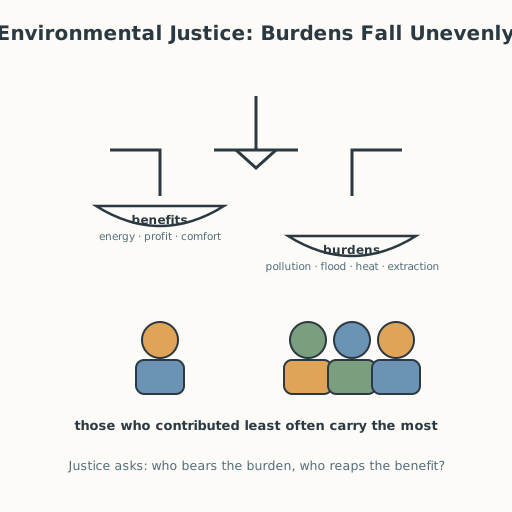
- Burden-benefit balance sheet · 1 per learner A two-pan balance sheet for listing who bears burdens and who reaps benefits in a case
- Case cards · 1 set per group Cards on documented cases — a waste or polluting site near a low-income community, sea-level rise on a small island state, a clean-energy project's local costs, and the Standing Rock Sioux Tribe's defense of the Missouri River against the Dakota Access Pipeline (Indigenous land and water stewardship) — with sources
Low-tech / no-cost
- A shared board or large paper Draw the balance and fill the two pans together
- Voice and memory Tell each case aloud and have learners retell who bears the burden and who gains
Enriched / lab & device
- A short documentary clip or news piece on one case · 1 Age-appropriate, to watch and then analyze who bears what
- A map of one case's location · 1 To see who lives nearest the burden and who does not
Works in different contexts
- large-group Analyze one case together on the board, then small groups work the other cases
- multi-age Younger learners match each case to who is burdened and who benefits; older learners explain the pattern and argue what fairness would require
- self-directed A learner fills the balance sheet for two cases and writes one paragraph on the pattern they see
- level-grouped Learners ready to extend compare a local and a global case and propose one fairer arrangement, naming its costs
- outdoor-only Look at the land around you — where does the waste go, who lives nearest the road or the smoke, and who does not
Lesson 10 — Environmental Justice: Who Bears the Burden, Who Reaps the Benefit
Summary
Learners analyze environmental justice: the pattern by which the burdens of environmental change — pollution, extraction, floods, heat — fall disproportionately on low-income, Indigenous, and marginalized communities and on the Global South, while the benefits accrue elsewhere. They argue what fairness would require, and close the unit by gathering all eight goals.
Objectives
- Analyze how the burdens and benefits of environmental change fall unevenly on different people (environmental justice). (D10.S4.09.02)
Connection
Where does the smoke from a factory drift, and who lives there? Who enjoys the electricity, and who breathes the ash? Who loses a home to rising water, and who sold the fuel that warmed it? The same change can give comfort to some and take safety from others. Seeing that unevenness clearly — and asking whether it is fair — is environmental justice.
Materials
- Burden–benefit balance sheet
- Case cards
Preparation
- Copy the burden–benefit balance sheet and the case cards.
- Retrieval: from Lesson 9, recall the trade-offs of each energy source. Today we ask who pays each source’s price, and who enjoys its gain — and we gather the whole unit.
Facilitator note
This lesson is written to the learner (“you”). The idea to land: environmental change is not felt evenly. Its burdens — pollution, resource extraction, floods, heat — fall disproportionately on low-income, Indigenous, and marginalized communities and on the Global South, while its benefits (energy, profit, comfort) often accrue to others. Environmental justice is the analysis of that unevenness and the demand that burdens and benefits be shared fairly. The term’s formal definition comes from the U.S. EPA (S-483); the field’s scholarship was founded in part by Robert Bullard’s documentation of hazardous-waste siting in Black communities (S-484); the global unevenness is documented by the IPCC (S-005). Use at least one non-U.S. / global case (e.g., a small island state facing sea-level rise it did little to cause; a community near extraction in the Global South) so the lens is planetary, not one nation’s story. The egalitarian lens is the heart here. The ethics lens: fairness is a values question — distinguish the documented facts of unevenness from the judgment that it is unjust (philosophy §5). The environment lens: the burdens are real, measurable harms. The global lens: the pattern repeats worldwide. End on agency, not despair — stewardship is something learners can practice (facilitation.md). Close with the unit’s retrieval pass: all eight goals recalled in one breath (S-039).
Indigenous peoples as stewards and defenders, not only victims. Always teach the Standing Rock case (S-485) alongside the burden cases: the Standing Rock Sioux Tribe — Lakota and Dakota people of what is now North and South Dakota — defended the Missouri River against the Dakota Access Pipeline, grounding the 2016–2017 “water protector” gatherings in Mní wičhóni (“water is life”). Frame it as a case of agency and stewardship: here Indigenous peoples are knowledge-holders (their relationship to the river, its water, and treaty lands), stewards (protecting water for future generations), and defenders (organizing and acting) — not passive victims. This corrects the flattening that would otherwise leave Indigenous peoples appearing only as burden-bearers, and it models stewardship as something learners can themselves practice.
Procedure
- Recall (5 min). From Lesson 9: name one trade-off of fossil fuels and one of renewables. Today: who pays each price, and who gains.
- Meet environmental justice (10 min). Read the definition: environmental justice is the fair treatment of all people in environmental decisions — and the honest study of how burdens and benefits actually fall. They do not fall evenly: those who contributed least to a problem often carry the most of it.
- Analyze cases (18 min). Use the case cards. Analyze at least the Indigenous stewardship case — the Standing Rock Sioux Tribe defending the Missouri River (Mní wičhóni, “water is life”) against the Dakota Access Pipeline — and one other (a polluting site near a low-income community, sea-level rise on a small island state, or a clean-energy project’s local costs). For each, fill the balance sheet: who bears the burden, who reaps the benefit, and who is acting to protect what — and how.
- Argue fairness (12 min). For one case, write one paragraph: what is unfair about the pattern, and what would a fairer arrangement require — and who would have to give something up for it?
- Gather the unit (8 min). In one breath, recall all eight goals: algorithms and feeds; who controls the platform; echo chambers and breaking out; tracing a viral claim; the greenhouse effect; the carbon cycle; feedback loops; energy and environmental justice. Which one will you carry with you?
- Close (5 min). The screen and the Earth are read with the same habit: critical judgment, neither worship nor fear — and a fairer sharing of burdens and benefits.
Differentiation
- Support: Provide the balance sheet pre-filled for one case and ask learners to fill the second.
- Extension: Compare a local and a global case, and propose one fairer arrangement, naming its real costs and who would bear them.
Assessment
- Formative (observation): Can the learner identify who bears the burden and who reaps the benefit in one case, and state what fairness would require?
- Portfolio artifact (summative for the unit): The completed balance sheet and fairness paragraph, added to the unit’s portfolio of eight artifacts.
Home connection
Ask at home: in our community, who lives nearest the road, the factory, the waste site, or the flood path — and who does not? Write down one thing your family might do, however small, to share a burden or a benefit more fairly.
Resources
- On the definition of environmental justice: U.S. Environmental Protection Agency, “Environmental Justice,” https://web.archive.org/web/2024/https://www.epa.gov/environmentaljustice (S-483).
- On the founding scholarship of environmental justice: Bullard (1990), Dumping in Dixie (S-484).
- On the global unevenness of climate burdens: IPCC, https://www.ipcc.ch/ (S-005).
- On Indigenous land and water stewardship and defense: Standing Rock Sioux Tribe, https://standingrock.org/ (S-485).
- On spaced retrieval of the unit’s ideas: Dunlosky et al. (2013), https://doi.org/10.1177/1529100612453266 (S-039).