Lesson 12 — My Sustainable Nutrition Plan
Learners close the unit by building a sustainable personal nutrition plan that honors their own needs, culture, budget, and values, and by retrieving the whole unit — mind-body practices, diverse bodies, movement traditions, and food systems — into one integrated understanding of the body as home.
Objectives
Objectives
- D03.S3.11.02 Build a sustainable personal nutrition plan that honors their own needs, culture, budget, and values.
Essential question
How do I build a sustainable way of eating that honors my own needs, culture, budget, and values — without shaming any body or any way of eating?
Key vocabulary
Materials
Standard materials
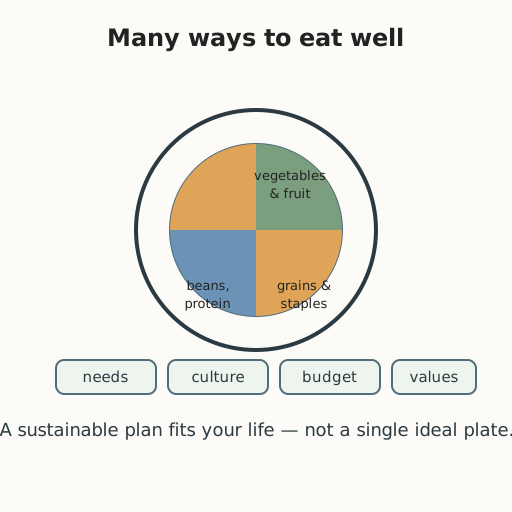
- Plate model chart (printed or drawn) · 1 for the group A plate with flexible sections and the four reminders — needs, culture, budget, values
- Practice log · 1 per learner
Low-tech / no-cost
- Voice and a drawn plate Draw the plate and the four reminders by hand
- Real local foods as examples Name familiar, affordable foods from the learners' own context
Enriched / lab & device
- Dietary-guidelines handouts (WHO, FAO food-based guidelines) · 1 per pair Reference guidance, treated as a starting point, not a rulebook
- Budget worksheet or spreadsheet · 1 per learner To price a week of eating within a real budget
Works in different contexts
- large-group Share anonymous example plans on a board; keep each learner's personal plan private unless they choose to share
- multi-age Younger learners build a one-day plan; older learners build the full week with needs, culture, budget, and values
- self-directed A learner builds and self-checks their own plan against the four criteria and writes a short rationale
- level-grouped Pair learners to peer-review plans for sustainability and cultural respect; a ready group writes a "how I'll adapt if my circumstances change" note
- outdoor-only Anchor the plan to what is actually available locally and seasonally in the learners' environment
Lesson 12 — My Sustainable Nutrition Plan
Summary
Learners build a sustainable personal nutrition plan — a flexible way of eating that fits their needs, culture, budget, and values — and then retrieve the whole unit into one integrated understanding: body as home, practices as tools, food as both personal and political. This is the unit’s final portfolio artifact.
Objectives
- Build a sustainable personal nutrition plan that honors your own needs, culture, budget, and values. (D03.S3.11.02)
Connection
There is no single “correct” plate on Earth. A rice-and-lentil meal, a maize-and-bean stew, a fish-and-greens dinner, a flatbread with vegetables — each can nourish a body, and each belongs to a people. A sustainable plan is not a diet to endure; it is a way of eating you can actually keep, made of foods you recognize, can afford, and believe in.
Materials
- Plate model chart
- Practice log
Preparation
- Prepare the plate model and the four reminders.
- Gather (if available) the dietary-guidelines handouts and a simple budget worksheet.
Facilitator note
This lesson is the unit’s capstone, and it must land two things at once: a concrete, personal nutrition plan, and a retrieval of the whole unit. No shaming, ever — about weight, about “unhealthy” foods, about any family’s or culture’s way of eating. The plan is about sustainability and fit, not moral purity.
A plan, not a diet. Guide learners to build a dietary pattern (what they usually eat over a week) rather than a list of allowed/forbidden foods. WHO’s healthy-diet guidance — diversity across food groups; moderate free sugars, salt, and saturated fat — is a population-level starting point, not a personal law (S-038). Energy needs differ by age, sex, body size, and activity (FAO/WHO/UNU; S-285). The plan must fit this learner: their needs, their culture’s foods, their real budget, and their values (religious, ethical, environmental). Food-based dietary guidelines exist in many countries and are themselves culturally adapted (FAO; S-118).
Retrieval at the close. The final step asks learners to recall the whole unit from memory — this spaced retrieval is the science-of-learning payoff (Dunlosky et al.; S-039). Do not let learners skip to their notes first; recall, then check.
Values vs. facts. “Everyone deserves enough to eat” is a value; the plan honors it personally, while the previous lesson’s proposal aimed at it collectively. Keep both visible.
The ethics lens: a plan built on self-respect, not shame, is a kind plan. The egalitarian lens: no way of eating is above another; access is the real divide. The global lens: every culture’s staple foods are legitimate foods. The technology lens: decide whether an app or tracker helps you or adds pressure — you choose. The environment lens: a sustainable plan can also be lighter on the Earth, but that is a value to weigh, not a duty to perform perfectly.
Procedure
- Retrieve the unit (10 min). From memory, write: (a) the three mind-body tools and one reason each works; (b) the social model of disability; (c) one movement tradition and what it offers; (d) one policy lever in the food system. Then open your log and correct or complete. This is how the unit becomes yours.
- Meet the plate model (5 min). Look at the chart: flexible sections, no single “right” food, and four reminders — needs, culture, budget, values. A sustainable plan fits all four.
- Build your pattern (15 min). Write a typical week of eating, using foods you actually eat and can afford. For each of the four reminders, add one line: what my body needs, what my culture’s foods are, what my budget allows, what my values ask of me. Adapt as needed — some days are lean, and that is reality, not failure.
- Check for fit (10 min). Ask yourself: Could I keep this for a year? Is it flexible when money or season changes? Does it shame me, or sustain me? Revise one part to make it more sustainable.
- Peer review (10 min). Share only what you choose. A partner checks: is this sustainable, culturally respectful, and free of shame? Suggest one small improvement, kindly.
- Close (5 min). One sentence to your future self: “I will feed my body with…” Remember the unit’s deepest idea: your body is your home, and you have learned to care for it with dignity and joy.
Differentiation
- Support: Provide a one-day plan template and a word bank of the four reminders; build a single day instead of a week.
- Extension: Ask learners to add an “if my circumstances change” note — a flexible fallback plan for lean or changed times.
Assessment
- Summative (portfolio): A sustainable personal nutrition plan addressing needs, culture, budget, and values, plus the unit-wide retrieval in the practice log.
- Peer: A partner’s check for sustainability, cultural respect, and absence of shame.
Home connection
Share one thing you learned this unit with someone you trust — a practice, an idea, a plan. Teaching it back is how you keep it. If you prefer, write it in your log for your future self.
Resources
- WHO — Healthy diet fact sheet: https://www.who.int/news-room/fact-sheets/detail/healthy-diet (S-038).
- FAO — Food-based dietary guidelines: https://www.fao.org/nutrition/education/food-dietary-guidelines/home/en/ (S-118).
- FAO/WHO/UNU — Human energy requirements (energy needs differ among bodies): https://www.fao.org/3/y5686e/y5686e00.htm (S-285).
- Dunlosky et al. (2013) — retrieval practice and spacing: https://doi.org/10.1177/1529100612453266 (S-039).