Lesson 01 — Asking Big Questions
Learners practice noticing the world and turning what they notice into "why" and "how" questions, then offer their own first ideas.
Objectives
Objectives
- D06.S1.K.01 Ask "why" and "how" questions about things in the world and offer their own ideas.
Essential question
What makes a question a "why" or "how" question, and what do I wonder about?
Key vocabulary
Materials
Standard materials
- Large paper "wondering wall" · 1 sheet A big paper where questions are drawn or written and posted
- Picture cards of everyday things · 1 set Sun, rain cloud, a seed, a bird, the moon, a baby
- Crayons and paper · per learner
Low-tech / no-cost
- Voice and body Wonder aloud together; no cards needed
- A found object from outdoors A leaf, stone, or stick to hold and wonder about
Enriched / lab & device
- Photo cards or a tablet slide show · 1 set Real photos of sky, plants, animals, and weather to spark questions
- Question-starter cube · 1 per small group A cube with "why," "how," "what if," and pictures to prompt wondering
Works in different contexts
- large-group Hold up each picture card large and slow; invite the whole group to whisper their question to a partner before a few share aloud, so many voices get a turn
- self-directed The learner holds each card, says a "why" or "how" question aloud, and draws one question on their paper
- outdoor-only Skip the cards and find real things outside — a cloud, an ant, a puddle — and wonder about each one
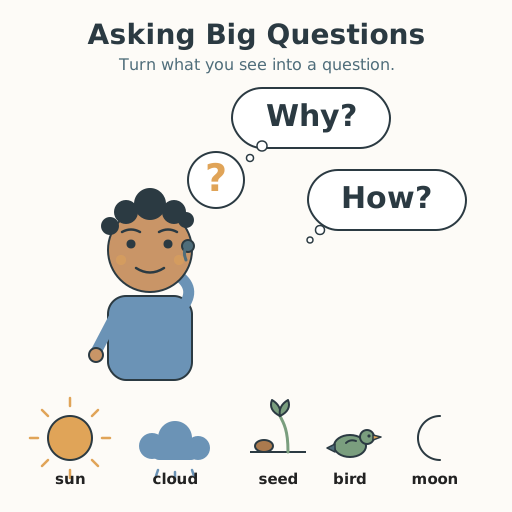
Lesson 1 — Asking Big Questions
Summary
Learners discover that a question is a way of looking closer at the world. They turn things they can see into “why” and “how” questions and offer their own first guesses. They close by drawing one question and posting it on the wondering wall.
Objectives
- Ask “why” and “how” questions about things in the world and offer their own ideas. (D06.S1.K.01)
Connection
Every day you see things that make you wonder — why the sky is blue, how a seed becomes a plant, where the rain goes after it falls. Wondering is a kind of looking, and a question is a way to look closer. When you ask “why” or “how,” you are doing what scientists and explorers and storytellers have always done: paying attention to the world.
Materials
- A large paper “wondering wall”
- Picture cards of everyday things (sun, rain cloud, a seed, a bird, the moon, a baby)
- Crayons and paper
Preparation
- Put up the wondering wall where everyone can reach it.
- Set out the picture cards where they can be picked up and passed around.
Facilitator note
This lesson is written to the learner (“you”) so it works in a classroom and for a self-directed learner. Your main job is to model wonder: wonder aloud yourself, and treat every learner’s question as a real question, never as a silly one. Do not judge answers as right or wrong. If a learner says “I don’t know,” say “I wonder too — what is your first idea?”
Procedure
- Gather (5 min). Sit comfortably. Look around the room or out a window. What is one thing you can see right now?
- Meet the question words (10 min). Some questions begin with “why” and some with “how.” Hold up a picture card — say, the rain cloud. Ask it a “why” question: “Why does it rain?” Now ask a “how” question: “How does rain get up into the cloud?” A question is a wondering said out loud.
- Wonder together (15 min). Pass the cards around. For each card, say one “why” or “how” question out loud. Then offer your own idea — any guess is welcome, even a wild one. There is no wrong question and no wrong first idea.
- Draw your question (10 min). Choose the thing you wonder about most. Draw it, and draw or tell your question. Post it on the wondering wall.
- Close (5 min). Remember: everyone wonders, and every question is a little light. Keep wondering.
Differentiation
- Support: Offer one card at a time and model the pattern — “I see a ____. I wonder why/how ____.” Accept a pointing or a word as a question.
- Extension: Invite learners to chain a question: “Why does it rain? …And how does the cloud get full?” and to offer two different ideas for the same question.
Assessment
- Formative (observation): Can the learner turn something they see into a “why” or “how” question and offer an idea of their own?
- Artifact (portfolio): The learner’s drawn question, kept for the unit’s closing wonder box.