Lesson 02 — A Story About the Beginning
Learners hear the Big Bang told gently as a story about stretching and growing, grounded in evidence, and held as one story among many — an invitation to wonder, not a rule to believe.
Objectives
Objectives
- D06.S4.K.01 Listen to an origin story about the universe and retell it in their own words, knowing it is one story among many.
Essential question
What is one story scientists tell about how everything began?
Key vocabulary
Materials
Standard materials
- A long stretchy cloth or scarf · 1 To act out the universe stretching
- A balloon (optional) · 1 To show how something small grows bigger
- Small stickers or beads · 1 sheet or handful To place on the balloon as "galaxies" that move apart
Low-tech / no-cost
- Hands and bodies Everyone crouches small, then stretches tall and wide to act out the stretch
- A found stretchy thing A piece of cloth, a rubber band, or dough that can be pulled bigger
Enriched / lab & device
- NASA Space Place "What Is the Big Bang?" page · 1 device A short, child-friendly illustrated explanation to share
- Dark cloth with dot stickers · 1 set A pretend "sky" where dots are galaxies; stretch the cloth to move them apart
Works in different contexts
- large-group Have the whole group crouch small together, then stretch tall and wide while you slowly tell the story, so everyone moves the story with their body
- self-directed The learner stretches the cloth or balloon alone while retelling the story aloud to a toy, a pet, or an older helper
- outdoor-only Lie on the ground and look at the wide sky; stretch your arms wide to feel how big "everything" is, and tell the story there
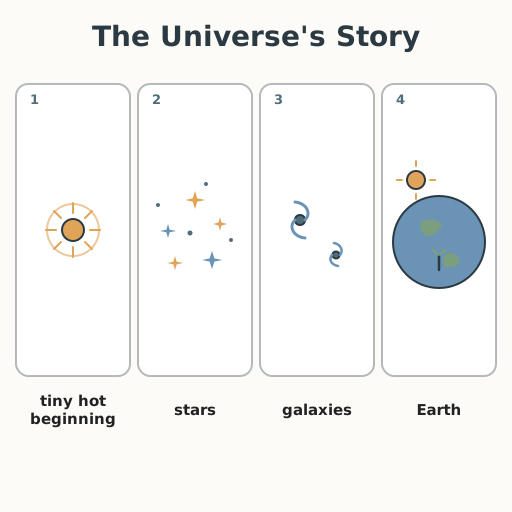
Lesson 2 — A Story About the Beginning
Summary
Learners hear the story of the beginning that scientists tell — the “Everywhere Stretch,” sometimes called the Big Bang — told gently as a story of growth. They learn that scientists tell it because of things they can see and measure, that nobody has to believe it, and that it is one story among many. They retell it with their bodies.
Objectives
- Listen to an origin story about the universe and retell it in their own words, knowing it is one story among many. (D06.S4.K.01)
Connection
Have you ever blown up a balloon and watched it grow bigger and bigger, or seen dough rise and stretch as it bakes? Those things grow from something small into something big, the way this story says everything once did. It is one way people have found to answer the biggest question there is: where did everything come from?
Materials
- A long stretchy cloth or scarf
- A balloon (optional)
- Small stickers or beads (optional)
Preparation
- Blow up a balloon a little (if using) and keep it ready to show stretching.
- Clear a wide space where everyone can crouch and stretch without bumping.
Facilitator note
This is the heart of the unit’s “inquiry over creed” voice. Tell the story with warmth and wonder, never as a fact a child must accept. Use the words “scientists tell this story because…” and “nobody has to believe it.” Do not say “this is how it really happened.” Keep it gentle: nothing explodes or breaks; everything stretches and grows. If a child offers their family’s own story of beginnings, receive it with respect and say “what a beautiful story — there are many.”
Procedure
- Gather (5 min). Sit together. Remember your questions from last time. Today we meet one story that tries to answer the very biggest question.
- Hear the story (10 min). Listen: a long, long time ago — longer than you can count — everything we can see was packed into one tiny point, smaller than a grain of sand. Then it began to stretch and grow, like a balloon filling with air, getting bigger and bigger. As it grew, it cooled, and tiny pieces came together to make stars, and later planets, and our Earth. And it is still stretching today. Some people call this the “Big Bang,” but “Everywhere Stretch” is a nicer name.
- Why scientists tell it (5 min). People who study the sky with big telescopes can see faraway groups of stars — galaxies — moving apart, like dots on a balloon being blown up. That is their clue that everything was once close together. That clue is called evidence: something you can see or measure.
- Act it out (15 min). Crouch into the smallest ball you can. Then stretch slowly — arms out, fingers wide, standing tall — while we say the story together: “It stretched… and stretched… and it is still stretching.” If you have a balloon and stickers, put stickers on it and blow it bigger to watch the “galaxies” move apart.
- Retell it your way (5 min). Tell the story in your own words to a partner, any way you like. Remember: this is one story among many, and nobody has to believe it. Everyone is invited to wonder.
Differentiation
- Support: Tell the story in very short beats and let the learner echo each beat with a movement (“small,” then “stretch,” then “stars,” then “still growing”).
- Extension: Invite learners to tell the story backward or to wonder what “before the beginning” might mean, and to name one question the story leaves open.
Assessment
- Formative (observation): Can the learner retell the beginning story in their own words and say it is one story among many?
- Performance: The body retelling (crouch-and-stretch) shows the idea of growth.
Resources
- NASA Space Place, “What Is the Big Bang?” — a child-friendly, evidence-based telling: https://spaceplace.nasa.gov/big-bang/