Lesson 04 — Retelling in My Own Words
Learners choose one beginning story they love, retell it in their own words to a partner, and make a picture of it, keeping the story as their own while knowing it is one story among many.
Objectives
Objectives
- D06.S4.K.01 Listen to an origin story about the universe and retell it in their own words, knowing it is one story among many.
Essential question
How do I retell a beginning story in my own words and pictures?
Key vocabulary
Materials
Standard materials
- Crayons and paper · per learner For drawing the retelling
- Story picture cards (from Lesson 3) · 1 set To help recall each story
- A "listening partner" card · 1 per pair A picture reminder: eyes look, ears listen, mouth quiet while a friend tells
Low-tech / no-cost
- Drawing in sand or dirt Retell with a finger-drawn picture on the ground where sand or dirt is available
- Telling aloud Retell with voice and hands only; no paper needed
- Acting it out Retell with the whole body — crouch small, then stretch tall and wide — like the Everywhere Stretch
Enriched / lab & device
- A class "book of beginnings" binder · 1 Collect each learner's picture into a shared book of retellings
- An audio recorder · 1 per small group To record each learner's spoken retelling to keep or share with family
Works in different contexts
- large-group Pair learners to tell in twos, then invite two or three volunteers to share with the whole circle, so everyone retells without a long wait
- self-directed The learner chooses a story, tells it to a toy, pet, or mirror, then draws the picture and tells it to an adult later
- outdoor-only Draw the retelling in sand or with sticks and leaves on the ground, and tell the story while pointing to the picture
Lesson 4 — Retelling in My Own Words
Summary
Learners choose one beginning story — the scientific “Everywhere Stretch” or one of the peoples’ stories they met — and retell it in their own words, then make a picture of it. The retelling and picture become a portfolio keepsake that shows they can hold a story as their own while knowing it is one among many.
Objectives
- Listen to an origin story about the universe and retell it in their own words, knowing it is one story among many. (D06.S4.K.01)
Connection
When you hear a story you love, you want to tell it again your own way — maybe to a grandparent, a friend, or a younger child. Retelling a story is how we share what moved us and make it our own. Today you will choose one beginning story and tell it with your own voice and your own picture.
Materials
- Crayons and paper
- Story picture cards (from Lesson 3)
- A “listening partner” card for each pair
Preparation
- Lay out the story picture cards where everyone can see and reach them.
- Pair learners (or set up a place for a self-directed learner to tell to a toy or mirror).
Facilitator note
This is the unit’s portfolio moment. Encourage learners to choose the story they love, not the one you love — the point is ownership, not correctness. When listening, model the listening partner card: eyes look, ears listen, mouth quiet. Do not correct a child’s retelling; a retelling is allowed to be their own. Praise the act of telling, and note on the picture which story it tells.
Procedure
- Gather (5 min). Look at all the story cards. Which beginning story do you love most? The “Everywhere Stretch”? The golden egg? The sky and the earth? Water and land? The Dreaming?
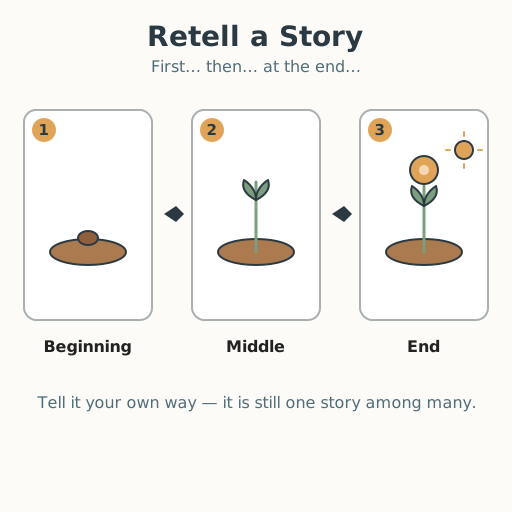
- Practice your retelling (10 min). Pick your story. Whisper it to yourself. Remember how it begins, what happens in the middle, and how it ends. It does not have to match the way I told it — it is your turn now.
- Tell it to a partner (10 min). Sit with your listening partner. Tell your story in your own words while your partner listens with eyes, ears, and a quiet mouth. Then swap. You may also tell it to a toy or a mirror.
- Draw it (15 min). Draw your story — the egg splitting, the sky lifting, water and land, the stretching universe, or the land waking up. Make it big and bright. You may also act it out with your whole body instead of, or along with, drawing.
- Close (5 min). Share your picture with the circle if you like. Remember: this story is yours to love, and it is still one story among many.
Differentiation
- Support: Offer a sentence starter — “First… then… at the end…” — and let the learner point to their picture as the “words.”
- Extension: Invite learners to combine two stories into one telling or to add what they wonder comes next in their story.
Assessment
- Formative (observation): Does the learner retell a beginning story in their own words, in order, and speak of it as one story among many?
- Artifact (portfolio): The drawn retelling, labeled with the story it tells, kept in the learner’s portfolio.