Lesson 01 — Big Movements
Learners practice big whole-body movements — running, hopping, jumping, and galloping — with growing control over speed, direction, and stopping, and notice how their bodies feel as they move.
Objectives
Objectives
- D03.S2.K.01 Demonstrate big movements (run, hop, balance) and small movements (draw, stack) with growing control.
Essential question
How can my whole body move big, strong, and in control?
Key vocabulary
Materials
Standard materials
- Open floor or outdoor space · 1 Enough room to run, hop, jump, and gallop safely
- Markers or cones · 1 set To mark a starting line and a turning line
- Music (optional) · 1 For starting, stopping, and changing speed
Low-tech / no-cost
- A drawn or imagined line A line in the dirt, a crack in the floor, or two stones mark the course
- Voice and body Clap or chant "go" and "stop"; no music or markers needed
Enriched / lab & device
- Soft cones or hoops · 1 set To build a safe running path with turns
- A drum or tambourine · 1 To signal fast, slow, go, and stop with a sound
Works in different contexts
- large-group Move in waves so everyone has room — half the group moves while the other half watches and cheers, then switch
- self-directed A learner works through the movement list at their own pace, checking off each big movement they try and how it felt
- outdoor-only Use a field, path, or shoreline as the course; a fallen branch or line in the sand marks the start and turn
- level-grouped Group by comfort, not age — some learners start with wide, steady steps while others try galloping; each group moves at its own challenge level
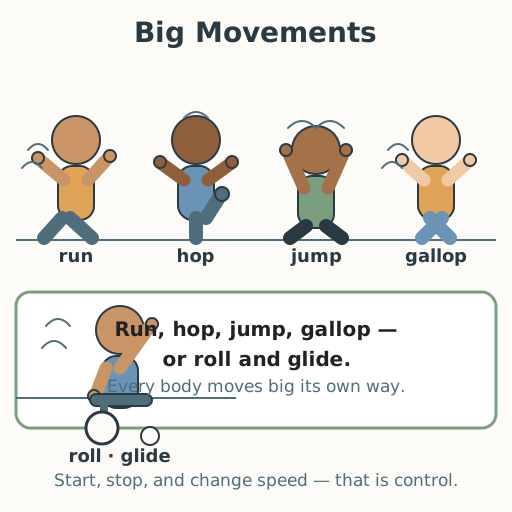
Lesson 1 — Big Movements
Summary
Learners return to the body in motion, practicing big movements — running, hopping, jumping, and galloping — and learning to control how fast, how far, and when to stop. They close by noticing how their bodies feel during and after moving.
Objectives
- Demonstrate big movements (run, hop, balance) with growing control. (D03.S2.K.01)
Connection
Your body is made to move big. You run to meet a friend, hop over a puddle, jump to reach a branch, and gallop like a horse in a game. Children everywhere move big in their own games, dances, and celebrations — running races on a beach, hopping in a playground, jumping at a festival — and every way of moving big is worth honoring. Moving big helps you feel strong, warm, and happy.
Materials
- Open floor or outdoor space
- Markers or cones for a start line and a turn line
- Music (optional)
Preparation
- Clear a safe space with a soft boundary and room to move without bumping.
- Mark a starting line and a turning line a short, safe distance apart.
- Remind learners to watch for others and to move at their own speed.
Facilitator note
This lesson is written to the learner (“you”). As facilitator, keep the space safe and the mood joyful. Honor every body: a learner who cannot run can pump their arms, roll, or glide in a wheelchair; a learner who cannot hop can step high or march; galloping can become a seated arm swing. Say this aloud so no one feels left out. Emphasize control — starting, stopping, and changing speed — over speed or height. Add a visual signal beside every sound cue — a raised hand for stop, a low hand for slow, a waving hand for fast — so learners who cannot hear the cue can join fully. This is a spiral step beyond “My Body Can Move” (U.00.002): now the focus is on controlling movement, not just trying it.
Procedure
- Gather (5 min). Stand or sit tall. Wriggle your fingers, your toes, and your whole body. Today you will move big and learn to control how you move.
- Warm up (5 min). March in place, stretch tall like a tree, then curl small like a seed. Breathe in and out slowly.
- Learn each big movement (20 min). Try each one your way, from the start line
to the turn line and back:
- Run: run gently to the turn line and back. If running is hard, roll, glide, or pump your arms fast.
- Hop: hop on one foot, then the other, then both together. If hopping is hard, step high or lift one knee with a big swing.
- Jump: jump forward and land softly like a frog, bending your knees.
- Gallop: step-hop like a horse — one foot leads, the other chases. If galloping is hard, swing your arms like a horse’s legs while you sit or stand.
- Control game (10 min). When the music or a clap says fast, move quickly; when it says slow, move in slow motion; when it says stop, freeze. Notice: can you stop your body all the way still? That is control.
- Close (5 min). Sit and rest. Put a hand on your chest and feel your heartbeat slow down. Which big movement made you feel strongest?
Differentiation
- Support: Offer one movement at a time and model it; allow seated or assisted versions of every movement and a shorter course.
- Extension: Invite learners to join two movements together (run then gallop) and to invent a new big movement to teach a friend.
Assessment
- Formative (observation): Can the learner attempt each big movement with growing control — starting, stopping, and changing speed — using an adapted version if needed?
- Self: The learner names the movement they felt most proud of.
Home connection
Show a grown-up your favorite big movement. Practice starting and stopping on a word: play “go and stop” in a safe open space at home.