Lesson 02 — Small Movements
Learners practice small hand and finger movements — stacking, drawing, pinching, and threading — with growing care and control, and notice how hands help us make and build.
Objectives
Objectives
- D03.S2.K.01 Demonstrate big movements (run, hop, balance) and small movements (draw, stack) with growing control.
Essential question
What careful things can my hands and fingers do?
Key vocabulary
Materials
Standard materials
- Blocks or small stacking objects · 1 set Blocks, cups, or smooth stones to stack
- Crayons and paper · per learner For drawing with control
- Beads or large buttons and a string · 1 set For threading with care
Low-tech / no-cost
- Found objects Stack stones, twigs, or leaves; pinch seeds or pebbles between finger and thumb
- Voice and hands Draw in the air with a finger; practice pinching and pretending to thread with no tools
Enriched / lab & device
- Tongs or tweezers · 1 per learner To pick up and move small objects, building pinch strength
- Lacing cards · 1 set Cards with holes and laces for threading practice
Works in different contexts
- large-group Set up small "hand stations" (stacking, drawing, threading) and rotate groups so every learner gets time at each
- self-directed A learner works through the hand tasks alone, trying each small movement and choosing the one they want to practice again
- outdoor-only Stack stones or twigs, draw in the dirt with a stick, and thread a blade of grass or a stem through a leaf
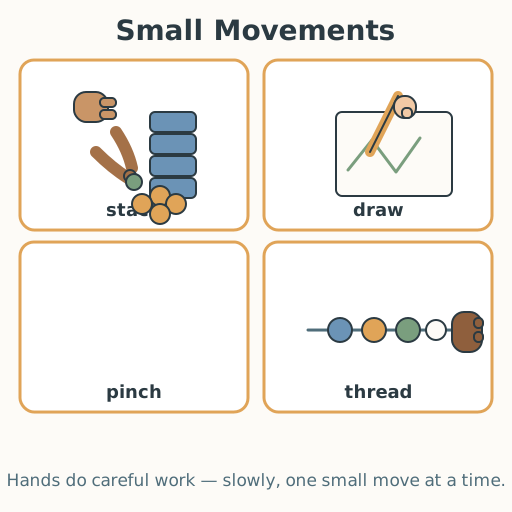
Lesson 2 — Small Movements
Summary
Learners practice small movements of the hands and fingers — stacking, drawing, pinching, and threading — with growing care and control. They close by choosing one small movement they are proud of and showing it.
Objectives
- Demonstrate small movements (draw, stack) with growing control. (D03.S2.K.01)
Connection
Your hands do careful work all day long. You stack blocks into a tower, draw a picture for someone you love, pinch a berry from a bush, and thread a button through its hole. People everywhere use their hands to make and build — stacking stones into a wall, threading beads onto a necklace, drawing patterns in the sand. Small movements are how your hands learn to be careful and strong.
Materials
- Blocks or small stacking objects (blocks, cups, or smooth stones)
- Crayons and paper
- Beads or large buttons and a string
Preparation
- Set up three simple hand stations: stacking, drawing, and threading.
- Make sure small objects are safe for little hands (nothing too tiny to manage).
- Remind learners to keep small objects away from mouths.
Facilitator note
This lesson is written to the learner (“you”). As facilitator, move among the stations encouraging patience and care, not speed or perfection. Honor every body: a learner with limited hand control can stack larger, lighter objects, draw with a chunky crayon or a whole-hand grip, and thread a wide shoelace through large holes. Celebrate effort — “look how carefully your fingers worked” — more than the finished product.
Procedure
- Gather (5 min). Look at your hands. Open and close them slowly, then wriggle each finger. Your hands are ready to do careful work.
- Warm up (5 min). Squeeze your hands into fists, then open them wide like a star. Pretend to play a tiny piano with your fingers in the air.
- Try each small movement (25 min). Move between the stations, trying each one
with care:
- Stack: build the tallest tower you can before it wobbles. Stack slowly — one block at a time.
- Draw: draw a picture of something you love. Hold your crayon however feels comfortable, and make slow, careful lines.
- Pinch: pick up a bead or button between your thumb and first finger. Move it from one pile to another.
- Thread: slide beads or buttons onto a string, one at a time.
- Show your best (5 min). Choose the one small movement you feel most proud of and show it to a partner. Tell them what your hands did carefully.
- Close (5 min). Shake your hands out and rest them. What is one thing your hands got better at today?
Differentiation
- Support: Offer larger, lighter objects to stack and thread; allow whole-hand or assisted drawing.
- Extension: Invite learners to combine two small movements (draw a shape, then stack blocks around it) and to thread a simple repeating pattern (red, blue, red).
Assessment
- Formative (observation): Can the learner attempt each small movement with growing care and control, using an adapted version if needed?
- Artifact (portfolio): The learner’s drawing, kept as a sample of growing hand control.
Home connection
Help with a careful hand job at home — stacking clean cups, threading a button, or sorting beans. Tell a grown-up which small movement your hands are best at.