Lesson 05 — My Senses Notice the World
Learners name the five senses, match each to the body part that does the sensing, and explore safe objects with their senses, noticing what each sense tells them about the world.
Objectives
Objectives
- D03.S1.K.01 Name the five senses and identify a body part used for each.
Essential question
How do my five senses tell me what is around me?
Key vocabulary
Materials
Standard materials
- Five-sense picture cards · 1 set Simple pictures of an eye, ear, nose, tongue, and hand
- A mystery bag · 1 A cloth bag holding safe objects to feel, smell, or hear
- Crayons and paper · per learner For drawing one sense at work
Low-tech / no-cost
- Voice and body Point to each sensing body part and name it aloud; no cards needed
- Found objects A leaf, stone, fruit peel, or bell to explore with the senses
Enriched / lab & device
- Sound and smell jars · 1 set Sealed jars holding things to shake and sniff (dried herbs, beans, cotton)
- A magnifying glass · 1 per pair To look closely with the sense of sight
Works in different contexts
- large-group Hold up each sense card large enough for all to see and invite the whole group to point to their own matching body part together
- self-directed A learner matches each sense card to its body part and explores safe objects alone, naming which sense each one uses
- outdoor-only Use the outdoors as the mystery bag — find one thing to see, hear, smell, and touch, and remember a taste from the day
Lesson 5 — My Senses Notice the World
Summary
Learners revisit the five senses, this time in motion and in connection with the world around them. They name each sense, match it to the body part that does the sensing, and explore safe objects to discover what each sense tells them.
Objectives
- Name the five senses and identify a body part used for each. (D03.S1.K.01)
Connection
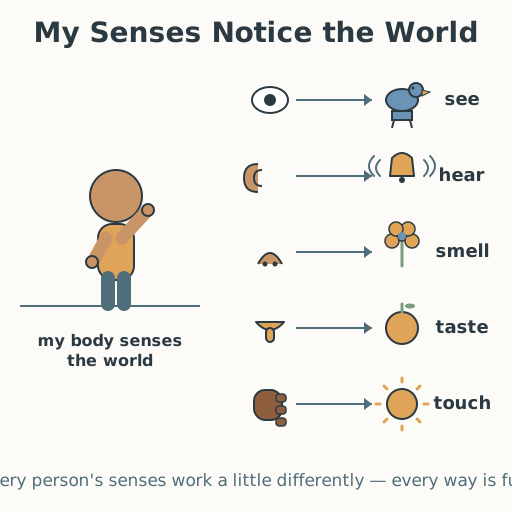
Your senses are always on, telling you about the world. Your eyes see a bird fly overhead, your ears hear a pot bubbling in the kitchen, your nose smells bread baking, your tongue tastes a sweet fruit, and your hands feel the warmth of the sun on your skin. Every person’s senses work a little differently — some people hear less and feel more, some see differently than you — and every way of sensing the world is a full way to know it.
Materials
- Five-sense picture cards (eye, ear, nose, tongue, hand)
- A mystery bag with safe objects to feel, smell, or hear
- Crayons and paper
Preparation
- Prepare or draw five-sense picture cards.
- Fill a mystery bag with safe objects (a smooth stone, a leaf, a bell, a lemon peel).
- Remind learners: nothing goes near the mouth or nose unless an adult says it is safe.
Facilitator note
This lesson is written to the learner (“you”). As facilitator, describe each sense aloud and name the body part so learners who cannot see the cards can still join. Honor every body: a learner with low vision or hearing is not “missing” a sense — they sense the world fully in their own way, often with stronger other senses. Frame all five senses as doors to the world, and celebrate the different ways people use them. Only taste should be limited for safety, and only with a safe, adult-approved food.
Procedure
- Gather (5 min). Sit comfortably. Look around, listen, and take a sniff. Your senses are already working!
- Meet the five senses (10 min). Point to each body part that senses the world: eyes (see), ears (hear), nose (smell), tongue (taste), and hands or skin (touch). Say each sense aloud and wiggle or point to the body part that does it.
- Mystery bag (15 min). Reach into the bag without looking. Feel the object with your hands — is it rough, smooth, soft, or hard? Guess what it is, then look. If an adult says it is safe, you may also smell or listen to it. Name which sense told you the most.
- Draw a sense at work (10 min). Choose one sense and draw a picture of you using it — your eyes seeing a rainbow, your nose smelling soup, your hands touching a kitten.
- Close (5 min). Which sense do you think you use the most? Which one would you like to notice more today?
Differentiation
- Support: Focus on two or three senses at a time; offer objects with one strong, clear quality (very smooth, very soft).
- Extension: Invite learners to describe an object using two senses at once and to name which sense gives the clearest clue.
Assessment
- Formative (observation): Can the learner name the senses and point to the body part used for each?
- Artifact (portfolio): The learner’s drawing of a sense at work.
Home connection
At home, play “what do I sense?” with a grown-up — close your eyes and guess a food by smell or a sound by ear. Tell them which sense gave you the best clue.