Lesson 04 — Moving Games
Learners play cooperative movement games — follow the leader, mirror, and freeze dance — moving their bodies together, taking turns to lead, and making sure every body can join in.
Objectives
Objectives
- D03.S2.K.01 Demonstrate big movements (run, hop, balance) and small movements (draw, stack) with growing control.
Essential question
How do I move my body when I play together with others?
Key vocabulary
Materials
Standard materials
- Open floor or outdoor space · 1 Enough room to move together safely
- Music (optional) · 1 For freeze dance and follow-the-leader
Low-tech / no-cost
- Voice and body Clapping, chanting, and call-and-response replace music; no tools needed
- A clear open space Any safe place to move — a room, a yard, or a path
Enriched / lab & device
- A drum or tambourine · 1 To set the beat for follow-the-leader and freeze games
- Scarves or ribbons · 1 per learner To wave and move while following the leader
Works in different contexts
- large-group Play cooperative games where everyone wins together — follow the leader, mirror, and freeze dance — so no one is "out"
- self-directed A learner invents a movement game and teaches it to a friend or a grown-up, or practices follow-and-freeze moves to a song
- outdoor-only Use a field or clearing; a tree line, path, or rope marks the boundaries of the game space
- multi-age Older learners lead rounds of follow-the-leader so younger learners can copy; leaders are encouraged to include movements every body can do
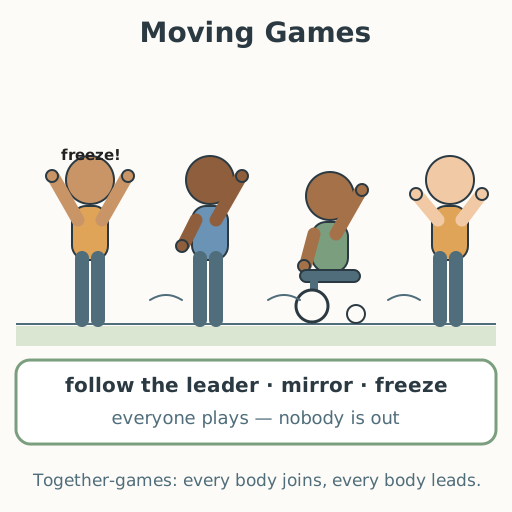
Lesson 4 — Moving Games
Summary
Learners bring their growing movement skills into play, joining cooperative games — follow the leader, mirror, and freeze dance — where everyone belongs and no one is “out.” They practice moving together, taking turns to lead, and inviting every body to join.
Objectives
- Demonstrate big movements (run, hop, balance) with growing control while playing together. (D03.S2.K.01)
Connection
Games are how children everywhere move and play together. You might chase and tag on a beach, play hopscotch on a sidewalk, follow a leader through a field, or clap and dance in a circle at a celebration. Some games are the same in many places, and some belong to just one family or one people. Moving games help you have fun, make friends, and practice moving your body with control.
Materials
- Open floor or outdoor space
- Music (optional)
Preparation
- Clear a safe space with enough room to move without bumping.
- Remind learners that these are together-games: everyone plays, nobody is “out.”
- Plan simple, large, safe movements for the follow-the-leader rounds.
Facilitator note
This lesson is written to the learner (“you”). As facilitator, keep every game cooperative — cooperation over competition is a core commitment. No elimination, no winners and losers. Honor every body: choose and model leader movements that can be done big or small, standing or seated, so a learner who uses a wheelchair or has limited mobility can lead as easily as anyone. Add a visual “freeze” cue — a raised hand, a flag, or the leader lifting both arms — alongside the clap or music so learners who cannot hear can play fully. Rotate who leads fairly so everyone who wants a turn gets one.
Procedure
- Gather (5 min). Stand in a loose circle. Wave to the friends around you. Today you will move and play together, and everyone is welcome.
- Warm up (5 min). March in place together, then freeze on a clap. Shake your hands and feet.
- Follow the leader (10 min). One person is the leader and makes a big movement — hop, gallop, stretch, or roll — and everyone follows. The leader chooses movements every body can do. Change leaders often so many people get a turn.
- Mirror (10 min). Face a partner. One person moves slowly — raise an arm, wiggle a finger, bend a knee — and the other copies like a mirror. Then switch.
- Freeze dance (10 min). When the music or a clap plays, dance or move your way. When it stops, freeze like a statue. Everyone plays; no one is out.
- Close (5 min). Sit together and rest. What did it feel like to move with your friends? What movement did you learn from someone else today?
Differentiation
- Support: Offer seated or small versions of every movement; pair a learner who wants support with a calm partner.
- Extension: Invite learners to invent a new moving game and to lead a round using a movement they created themselves.
Assessment
- Formative (observation): Can the learner join cooperative movement games, following and taking a turn to lead, with growing control?
- Peer: Partners tell each other one movement they enjoyed doing together.
Home connection
Teach a grown-up or a friend a moving game you played today. Play follow the leader or freeze dance together, and let them lead a round too.