Lesson 09 — Sorting Everyday and Sometimes Foods
Learners sort common foods into "everyday" and "sometimes" groups with guidance, discovering that the same food can be everyday for one family and a treat for another — and that both kinds have a place.
Objectives
Objectives
- D03.S3.K.01 Sort common foods into "everyday" and "sometimes" groups with guidance.
Essential question
Which foods do I eat every day, and which are for sometimes?
Key vocabulary
Materials
Standard materials
- Food picture cards · 1 set A mix of everyday foods and special-occasion foods from many places
- Two sorting baskets or mats · 2 One labeled "everyday" and one labeled "sometimes"
- Crayons and paper · per learner For drawing one everyday and one sometimes food
Low-tech / no-cost
- Two drawn circles Draw two circles on the ground or floor and label them "everyday" and "sometimes"
- Named or remembered foods Sort foods by saying their names and pointing to a circle; no cards needed
Enriched / lab & device
- Laminated sorting cards · 1 set per pair Durable food cards for repeated sorting games
- A class food chart · 1 A large chart to record each learner's everyday and sometimes foods
Works in different contexts
- large-group Sort as a whole group, holding up each card and letting learners call out or point to which basket it goes in, then talk about why
- self-directed A learner sorts a small set of food cards alone, then checks by saying why each food went where
- outdoor-only Draw two big circles in the dirt with a stick and "sort" foods by naming them aloud and standing in the matching circle
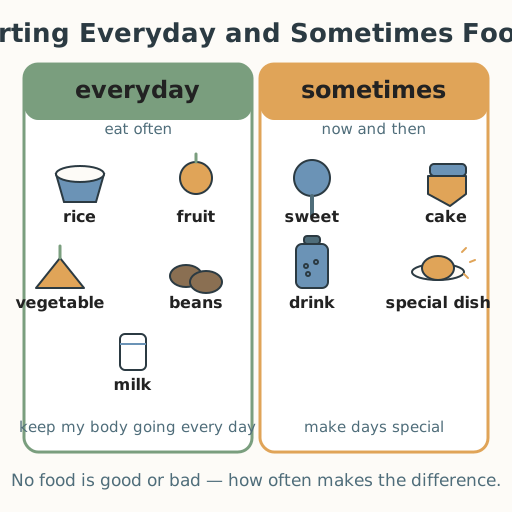
Lesson 9 — Sorting Everyday and Sometimes Foods
Summary
Learners sort common foods into “everyday” and “sometimes” groups with gentle guidance. They discover that foods are not “good” or “bad” — some we eat often to keep our bodies going, some we enjoy on special days — and that every family’s “everyday” is different.
Objectives
- Sort common foods into “everyday” and “sometimes” groups with guidance. (D03.S3.K.01)
Connection
Think about the foods in your home. Some you eat often — they keep your body going every day, like rice, bread, fruit, vegetables, or beans. Some are special treats you enjoy once in a while — a sweet at a festival, a special dish at a holiday, a cool drink on a hot day. Every family is different: what is “everyday” in one home may be a treat in another, and both ways of eating are okay. There is no shame in food, and no food is “bad” — we just enjoy different foods in different amounts.
Materials
- Food picture cards (a mix of everyday and special-occasion foods from many places)
- Two sorting baskets or mats labeled “everyday” and “sometimes”
- Crayons and paper
Preparation
- Prepare food cards showing a variety of everyday and special foods from different cultures.
- Set out two sorting baskets or mats labeled “everyday” and “sometimes.”
- Remind learners that this sorting is about how often, not about good or bad.
Facilitator note
This lesson is written to the learner (“you”). As facilitator, hold the line on no food shaming — the categories are about how often a food is eaten, never about whether a food (or a body) is “good” or “bad.” Frame “sometimes” as special and enjoyable, not forbidden. Honor every family: a food you might call “sometimes” could be a daily staple for a learner’s family, and vice versa — let learners place cards by their own family’s real life, and celebrate the differences. This extends U.00.002’s “Everyday Foods and Sometimes Foods” by centering the sorting as a shared, discussion-rich activity.
Procedure
- Gather (5 min). What is a food you eat almost every day? What is a food you only have on special days? Both are part of eating well.
- Meet the two groups (10 min). Look at the two baskets. “Everyday” foods are the ones that keep your body going day after day — like grains, fruits, vegetables, beans, or milk. “Sometimes” foods are the ones you enjoy once in a while — a sweet at a celebration, a special holiday dish, a fizzy drink on a hot day.
- Sort together (15 min). Pick up a food card. Think: do I eat this often, or only sometimes? Place it in a basket and say why. Remember: there is no wrong answer, because every family is different. A food can be “everyday” for one friend and “sometimes” for another.
- Draw one of each (10 min). Draw one everyday food and one sometimes food you enjoy. Notice: do you like them both? Of course — and that is fine.
- Close (5 min). Everyday foods keep us going; sometimes foods make days special. Both have a place in a happy, healthy life.
Differentiation
- Support: Offer a small set of very familiar foods and sort together one card at a time; let learners point, gesture, or name foods aloud instead of picking up cards, so the sort does not require fine hand control.
- Extension: Invite learners to sort by their own family’s real routine and to explain why a food goes where it does.
Assessment
- Formative (observation): Can the learner place a common food in an “everyday” or “sometimes” group and give a simple reason?
- Self: The learner names one everyday food and one sometimes food they enjoy.
Home connection
With a grown-up, look at the foods in your home and sort a few into “everyday” and “sometimes.” Talk about which treats your family saves for special days.