Lesson 10 — Moving & Growing
Learners celebrate how movement, senses, and food all work together to help a body grow, revisiting each idea at a celebration circuit and creating a "things that help me grow" drawing.
Objectives
Objectives
- D03.S1.K.01 Name the five senses and identify a body part used for each.
- D03.S2.K.01 Demonstrate big movements (run, hop, balance) and small movements (draw, stack) with growing control.
- D03.S3.K.01 Sort common foods into "everyday" and "sometimes" groups with guidance.
Essential question
How do movement, senses, and food all work together to help me grow?
Key vocabulary
Materials
Standard materials
- Crayons and paper · per learner For a "things that help me grow" drawing
- Open space · 1 Enough room to move through the celebration circuit
- Food picture cards and sense cards (from earlier lessons) · 1 set each To revisit the senses and food-sorting at stations
Low-tech / no-cost
- Voice and body The celebration circuit needs only space and imagination; no cards required
- A drawing surface Paper, dirt, or a shared board to draw on
Enriched / lab & device
- A celebration ribbon or scarf · 1 per learner To wave and move with joy during the closing celebration
- A class "growing" display board · 1 To hang all the "things that help me grow" drawings together
Works in different contexts
- large-group Run the celebration circuit in rotating stations — movement, senses, food — then gather to hang everyone's drawings as one big class picture
- self-directed A learner revisits each idea alone — a movement, a sense, a food — and makes one drawing of the things that help them grow
- outdoor-only Hold the celebration outside — move in the open air, notice with the senses, and name growing foods found or remembered from the garden or market
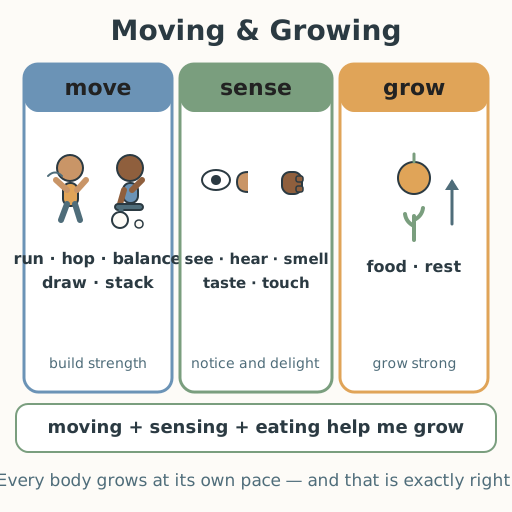
Lesson 10 — Moving & Growing
Summary
This capstone lesson gathers everything from the unit. Learners celebrate that movement, senses, and food all work together to help a body grow strong and happy, revisit each idea at a celebration circuit, and create a “things that help me grow” drawing to keep.
Objectives
- Name the five senses and identify a body part used for each. (D03.S1.K.01)
- Demonstrate big movements (run, hop, balance) and small movements (draw, stack) with growing control. (D03.S2.K.01)
- Sort common foods into “everyday” and “sometimes” groups with guidance. (D03.S3.K.01)
Connection
You are growing every single day — taller, stronger, and more able. Three things help you grow together: moving your body, using your senses to enjoy the world, and eating food that fuels you. You move to build strength, your senses help you notice and delight in life, and food gives you the energy to do both. All of these are your body’s way of growing — and every body grows at its own pace, which is exactly right.
Materials
- Crayons and paper
- Open space for a celebration circuit
- Food picture cards and sense cards (from earlier lessons)
Preparation
- Set up three simple celebration stations: a movement spot, a senses spot, and a food spot.
- Gather food cards and sense cards from earlier lessons.
- Prepare space to hang the finished drawings together.
Facilitator note
This lesson is written to the learner (“you”). As facilitator, make this a joyful, low-pressure celebration — the unit’s summative moment should feel like a party, not a test. Honor every body and every pace of growth: remind learners that bodies grow at different speeds and in different ways, and that every pace is worthy. Observe each learner across the three stations to gather evidence of the unit’s three objectives. Keep the message gentle: no comparisons, no “best,” just celebration of each learner’s own growing.
Procedure
- Gather (5 min). Stand or sit tall. Think about all you have done in this unit: moving big and small, sensing the world, and learning about food. Today we celebrate how they all help you grow.
- Celebration circuit (25 min). Visit each station:
- Movement: do one big movement (run, hop, or balance) and one small movement (draw a shape or stack a few things). Feel your body working.
- Senses: point to each sensing body part and name the five senses. Share one thing your senses love.
- Food: sort a few food cards into “everyday” and “sometimes,” and name one food that helps you grow.
- Make your drawing (10 min). Draw a picture of the things that help you grow: you moving, something your senses love, and a food that fuels you. Write or draw your name on it.
- Share and celebrate (5 min). Hang the drawings together as one big class picture. Look at how many ways there are to move, sense, and grow.
- Close (5 min). Put a hand on your heart and feel it beat — proof that your body is alive, working, and growing. What is one thing you are proud your body can do now?
Differentiation
- Support: Visit one station at a time and allow adapted versions of every movement; let a learner dictate or describe their drawing while an adult or peer scribes.
- Extension: Invite learners to add a fourth “growth helper” of their own (rest, water, love) to their drawing and explain it.
Assessment
- Summative (portfolio): The “things that help me grow” drawing, kept as a unit artifact showing movement, senses, and food.
- Observation: Across the three stations, can the learner demonstrate a movement, name the senses, and sort a food — the unit’s three objectives?
Home connection
Show your “things that help me grow” drawing to a grown-up and tell them the three ways you grow: moving, sensing, and eating. Pick one to enjoy together today.