Lesson 01 — Day and Night
Learners observe the change between day and night, notice that the sun gives us light, and show the change through sorting, movement, and drawing.
Objectives
Objectives
- D06.S4.K.02 Observe and describe changes in the natural world (day and night, seasons, growth).
Essential question
What changes when day turns into night?
Key vocabulary
Materials
Standard materials
- Paper and crayons · per learner
- A sun/moon picture set (drawn or printed) · 1 set A bright sun card and a dark night card to sort and act around
- A flashlight or lamp (optional) · 1
Low-tech / no-cost
- Body and voice Act out "light" (arms wide, bright face) and "dark" (arms in, still) — no cards or lamp needed
- Skin and ears Feel the sun's warmth on your face for day; notice cooler air and softer sounds for night — a way to tell light from dark without sight
- Stick and ground Draw the day sky and night sky in the dirt or sand with a stick
Enriched / lab & device
- A globe or ball and a flashlight · 1 set Shine the light on one side to show how one half of the Earth is in light and the other in dark
- A picture book about day and night · 1
Works in different contexts
- large-group Hold up the sun and night cards big enough for all to see; invite the whole group to call out "light!" or "dark!" and act it out together
- self-directed A learner sorts or acts out things they do in the light and things they do in the dark, then draws both skies
- outdoor-only Go outside and find where the light comes from; use your own shadow to show the sun is out, then imagine the same spot at night
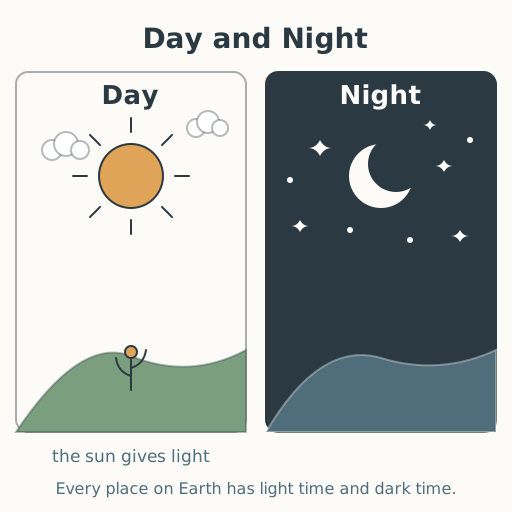
Lesson 1 — Day and Night
Summary
Learners notice the change between day and night — the light comes and goes — and show what they know by sorting, moving, and drawing the two skies. Science here is watching and wondering, not facts to memorize.
Objectives
- Observe and describe the change from day to night. (D06.S4.K.02)
Connection
Look out your window in the morning, and look again at night — the sky changes from light to dark. Every place on Earth has light time and dark time, every single day. Day and night are the biggest change you can watch, and you can watch them again and again.
Materials
- Paper and crayons
- A sun/moon picture set (drawn or printed)
- A flashlight or lamp (optional)
Preparation
- Draw or print a simple bright sun card and a dark night card.
- Clear a space for acting things out.
Facilitator note
This lesson is written to the learner (“you”) so it works in a classroom and for a self-directed learner. As facilitator, hold the core idea lightly: day and night are a repeating change of light and dark. If learners ask, you may add that near the equator day and night are about equal all year, while near the poles some seasons have very long days or very long nights — but only if the question comes up; the goal is wonder, not a diagram.
Procedure
- Gather (5 min). Look around (or out the window). Is it light or dark right now? What will it be later?
- Light and dark (10 min). Look at the sun card and the night card. The sun gives us light. Act it out: bright (arms wide, smile) and dark (arms in, still). Point to the card that matches now. If you cannot see the cards, notice day and night with your skin and ears: the sun’s warmth on your face means day; cooler air and quieter sounds mean night.
- What do you do when? (15 min). Sort or act out these moments: you wake up, you see the moon, you eat breakfast, you see stars, you sleep, you see your shadow. Is each one day or night?
- Draw both skies (10 min). On one side of the paper, draw your sky in the day. On the other, draw your sky at night.
- Close (5 min). Day and night follow each other, over and over, all around the world. Tomorrow you can watch it happen again.
Differentiation
- Support: Use only two cards and two moments (“I sleep” = night, “I play” = day); act together with a partner. For learners who cannot see the cards, tell light from dark with skin (sun warmth) and sound (birdsong vs quiet).
- Extension: Invite learners to draw three moments in a day and put them in order: morning, afternoon, night.
Assessment
- Formative (observation): Can the learner point to or act out which moments are day and which are night?
- Artifact (portfolio): The “two skies” drawing.
Home connection
At home, look out the same window in the morning and again at night. Tell a grown-up one thing that is the same and one thing that changed.