Lesson 02 — Look Closely and Describe
Learners sharpen their observing by looking closely at objects, plants, animals, and weather, and putting what they notice into describing words.
Objectives
Objectives
- D06.S1.01.01 Use the five senses to observe and describe objects, plants, animals, and weather.
Essential question
What can I notice when I look closely and describe what I find?
Key vocabulary
Materials
Standard materials
- A set of things to observe closely · 1 set A leaf, a flower, a stone, a picture of an animal, and a look at the sky/weather
- Paper and crayons · per learner
Low-tech / no-cost
- Body and voice Describe aloud with a partner — color, shape, feel, sound; no objects needed
- The sky outside a window or door Observe and describe the weather with senses, no materials required
Enriched / lab & device
- A magnifying lens · a few to share To look even closer at the leaf, flower, or stone
- Picture cards of plants and animals · 1 set Photos or drawings of living things from different places to describe
Works in different contexts
- large-group Observe one shared object together first, gathering describing words on a chart before learners choose their own to describe
- self-directed A learner picks one thing, lists three describing words (or draws them), then shares the description with someone
- outdoor-only Choose a plant, an animal (watched gently from a distance), and the sky; describe each with two details
- level-grouped Learners new to describing use a picture card and one detail; learners who can describe compare two things and say how they differ
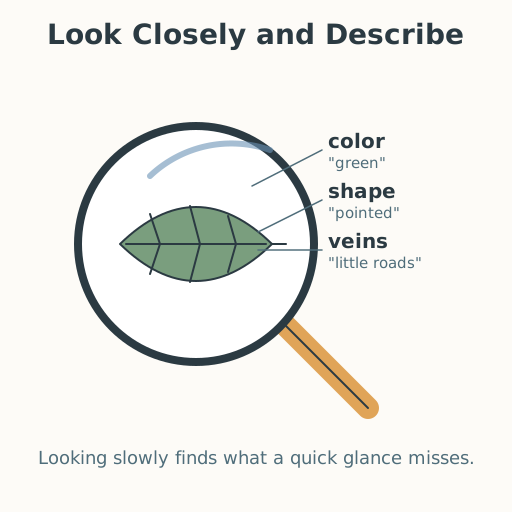
Lesson 2 — Look Closely and Describe
Summary
Learners practice the scientist’s habit of looking closely — at objects, plants, animals, and the weather — and naming what they notice with describing words. They discover that careful observation finds details a quick glance misses.
Objectives
- Use the senses to observe and describe objects, plants, animals, and weather. (D06.S1.01.01)
Connection
A leaf is not just “a leaf.” Look closely: it has veins like little roads, a smooth top and a rough bottom, a color that changes with the light. The sky is not just “the sky” — it might be blue, gray, or gold. When you look closely and say what you see, hear, and feel, you are doing what a scientist does: observing and describing.
Materials
- A set of things to observe closely (a leaf, a flower, a stone, a picture of an animal, and a look at the sky or weather)
- Paper and crayons
Preparation
- Gather a leaf, a flower, and a stone (or local equivalents), a picture of an animal, and a place to look at the weather.
- Prepare a simple chart or space to collect describing words.
Facilitator note
This lesson is written to the learner (“you”). The heart is slow looking — noticing details, not naming things correctly. There is no “right answer” for what a child notices; praise noticing itself. If an animal is observed live (a bird, an insect), model gentle watching: stay still, stay back, and never touch or chase — observe without harming, and return any found creature gently where it came from. Honor every body: a learner who cannot see describes by feel, sound, and smell; a learner who does not speak points, gestures, or draws; a learner who moves differently may need the object brought to them or a partner to describe with. Describing words differ across languages and places — welcome words in the learners’ home languages.
Procedure
- Gather (5 min). Yesterday you met your five senses. Today you will use them to look even closer. What is one thing you noticed on the way here today?
- Look closely together (10 min). Look at the leaf (or flower or stone) as a group. Slow down. What color is it? What shape? Run a finger over it — is it smooth or bumpy? What does it smell like? Collect all the describing words.
- Describe on your own (20 min). Choose one thing — an object, a plant, a picture of an animal, or the weather outside. Look closely and find three details. Say them or show them: “It is green and small.” “It feels soft.” “The sky is gray and the air feels cool.”
- Draw one detail (7 min). Draw your thing and its best detail — the veins in the leaf, the stripes on the animal.
- Close (3 min). Looking closely finds what a quick glance misses. A scientist looks slowly, and then says what they see.
Differentiation
- Support: Give a describing-word frame: “It is ___ (color), it is ___ (shape), it feels ___.”
- Support (blind/low-vision): Describe by touch, sound, and smell; a partner reads the sky aloud (“the sun feels warm, the wind is moving”).
- Support (non-speaking): Point to the details and draw them; a partner says your describing words aloud.
- Extension: Compare two things and name one way they are alike and one way they are different.
Assessment
- Formative (observation): Can the learner give at least two describing words for a chosen thing, using a sense?
- Artifact (portfolio): The “close-looking” drawing with its details.
Home connection
At home, choose one thing — a spoon, a leaf, a pet — and look at it very slowly for one minute. Tell a grown-up three details you had never noticed before.