Lesson 03 — Ask a Question and Make a Guess
Learners turn a notice into a question, offer their own guess, and name one simple way they could check it — the seed of a scientific idea.
Objectives
Objectives
- D06.S1.01.02 Ask a question about something they notice and offer a guess they can check.
Essential question
How do I turn what I notice into a question and a guess I can check?
Key vocabulary
Materials
Standard materials
- One interesting thing to wonder about · 1 A seed, a shell, a floating leaf, a toy car, or a shadow
- A "wonder board" or large paper · 1 To collect questions and guesses
- Paper and crayons · per learner
Low-tech / no-cost
- Voice and a partner Take turns asking "I wonder…" and answering "I think maybe…" — no board needed
Enriched / lab & device
- A "wonder wall" in the room · 1 A permanent place to post questions and guesses and revisit them later
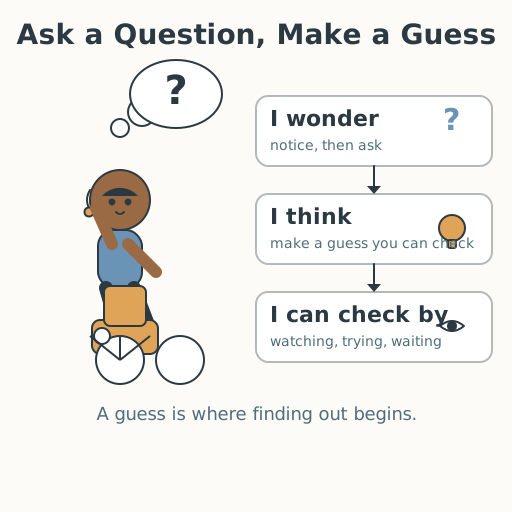
- A simple prediction card · per learner A card with "I wonder ___" and "I think ___" and "I can check by ___"
Works in different contexts
- large-group Use a spoken or drawn "wonder box" so learners who prefer not to speak can still ask; read questions aloud without naming who asked
- self-directed A learner writes or draws a question, adds their own guess, and plans one way to check it
- outdoor-only Find something outside to wonder about, ask a question aloud, and offer a guess you could check by watching
- multi-age Older learners model the "I wonder… I think… I can check by…" chain, then coach younger ones through their own
Lesson 3 — Ask a Question and Make a Guess
Summary
Learners practice the next step of science after noticing: asking a question and offering a guess they could check. They learn that a guess is not something to be scared of — it is the very beginning of finding out, and being wrong is part of learning.
Objectives
- Ask a question about something they notice and offer a guess they can check. (D06.S1.01.02)
Connection
You notice a seed on the ground and you wonder: Will it grow? You notice a shadow and you wonder: Why does it move? A scientist does not stop at wondering — she asks the question out loud and makes a guess: “I think maybe it needs water.” A guess is not about being right or wrong. It is where finding out begins.
Materials
- One interesting thing to wonder about (a seed, a shell, a floating leaf, a toy car, or a shadow)
- A “wonder board” or large paper
- Paper and crayons
Preparation
- Choose one thing everyone can look at and wonder about together.
- Prepare the wonder board (or plan to draw one) with two columns: “I wonder…” and “I think…”.
Facilitator note
This lesson is written to the learner (“you”). Make guessing safe and joyful: say
clearly that a guess does not have to be right — “a wrong guess is still a great
guess, because now we can check it.” Never let a guess be mocked or ranked. In
settings where questioning adults is not safe or usual, frame this as wondering
together, not challenging anyone, and offer the wonder box so learners can ask
without speaking up (see docs/contexts.md). The goal is the habit: notice →
question → guess → a way to check. The check can be as simple as “watch tomorrow and
see.” Some questions we cannot answer yet — and that is wonderful, not a failure.
Procedure
- Gather (5 min). You have been noticing and describing. Now a scientist asks: “I wonder…?” What have you been wondering about?
- Notice and question (10 min). Look at the thing together. Turn what you notice into a question: “I wonder why it floats.” “I wonder if it will grow.” “I wonder where it came from.” There are no silly questions.
- Make a guess (15 min). For one question, offer your own guess: “I think maybe it floats because it is light.” Say it, sign it, point to a picture, or have it written for you. Then ask: how could we check? “We could drop it in water and watch.” “We could plant it and wait.” A guess you can check is called a prediction.
- Draw your wonder (10 min). On your paper, draw your question and your guess — what you noticed, and what you think.
- Close (5 min). Notice, ask, guess, check — that is the rhythm of science. Some questions we cannot answer yet, and wondering about them is wonderful too.
Differentiation
- Support: Offer the frame “I wonder ___” and “I think ___” and fill it in together.
- Support (non-speaking): Point to a picture of the question and the guess, or act the guess out.
- Support (blind/low-vision): Wonder about a thing you can touch or hear (a shell, a seed, a bell) instead of a shadow; a partner names it aloud as you explore it.
- Extension: Add the third step on paper — “I can check by ___” — and plan when you would do it.
Assessment
- Formative (observation): Can the learner ask a question about something noticed and offer a guess (prediction) they could check?
- Artifact (portfolio): The drawn or scribed “I wonder… I think…” page.
Home connection
At home, wonder about one thing out loud — “I wonder why the moon changes shape?” — then tell a grown-up your guess. You can even plan how to check it together.