Lesson 10 — The Wonder Fair
A capstone celebration in which learners gather everything they observed, asked, guessed, and found across the unit, share it with one another, and name the wonders they will carry forward — celebrating mastery without ranking.
Objectives
Objectives
- D06.S1.01.01 Use the five senses to observe and describe objects, plants, animals, and weather.
- D06.S1.01.02 Ask a question about something they notice and offer a guess they can check.
- D06.S2.01.01 Observe and describe what living things need to stay alive (food, water, air, and shelter).
- D06.S2.01.02 Sort things into living and nonliving, and tell what living things do (grow, move, and reproduce).
- D06.S3.01.01 Observe and describe the properties of materials (such as hard, soft, shiny, heavy, and light).
- D06.S3.01.02 Describe how objects move (push, pull, roll, and slide) and what makes them start or stop.
- D06.S4.01.01 Observe and describe patterns of the Sun, Moon, and stars, and how day turns into night.
- D06.S4.01.02 Observe and describe weather and seasons where they live and in other places.
Essential question
What have I learned about the living world, and what do I still wonder?
Key vocabulary
Materials
Standard materials
- Learners' own work from the unit · per learner Sense drawings, wonder pages, needs drawings, sorts, property and movement drawings, day/night and weather pages
- A display space (table, mat, or wall) · 1 For the "wonder fair" where learners show and tell
- Paper and crayons · per learner
Low-tech / no-cost
- Voice and body Share by speaking, pointing, or acting — no display needed
- Found things from the unit A leaf, a stone, a seed, a ball — to show and tell
Enriched / lab & device
- A class "wonder wall" or "wonder book" · 1 To gather the unit's questions and keep them for the year
- A simple share table with labels · 1 set Learners label their own work — "I observed…", "I wondered…", "I found out…"
Works in different contexts
- large-group Run the fair as a gallery walk — half the group shows while the other half visits, then they switch; keep visits short and kind
- self-directed A learner gathers their own work, chooses what to share, and writes or draws one "I wonder" question to carry forward
- outdoor-only Hold the fair outside as a "wonder walk" — each learner stops at a place and shares one thing they observed or wondered there
- multi-age Older learners act as fair hosts, helping younger ones hang work and read labels aloud
Lesson 10 — The Wonder Fair
Summary
A capstone celebration: learners gather everything they observed, asked, guessed, and found across the unit, share it with one another, and name the wonders they will carry forward. This is a chance to remember, to teach each other, and to celebrate how much they have grown as scientists — together, with no ranking.
Objectives
- Review and show learning across all four strands of the unit. (D06.S1.01.01, D06.S1.01.02, D06.S2.01.01, D06.S2.01.02, D06.S3.01.01, D06.S3.01.02, D06.S4.01.01, D06.S4.01.02)
Connection
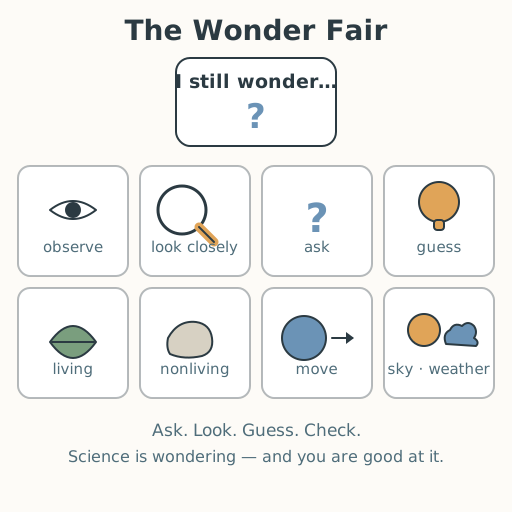
Think back over these weeks: you met your five senses, looked closely, asked questions and made guesses, found out what living things need, sorted living from nonliving, felt the properties of materials, pushed and pulled things, watched the sky, and noticed the weather. You have become a scientist — someone who wonders, observes, and finds out. Today you celebrate that, together.
Materials
- Learners’ own work from the unit (sense drawings, wonder pages, needs drawings, sorts, property and movement drawings, day/night and weather pages)
- A display space (table, mat, or wall)
- Paper and crayons
Preparation
- Help learners gather their work from the unit.
- Set up a display space and decide how sharing will flow (gallery walk, circle share, or wonder walk).
Facilitator note
This lesson is written to the learner (“you”). This is a celebration of mastery, not a competition — there are no winners, no rankings, no “best” work. Every learner shares; every share is welcomed exactly as it is. Keep praise about effort and wonder, not comparison (“you looked so closely,” not “yours is the best”). If a learner has gaps or “not yet” moments, this is not the time to surface them — the fair is about what they did learn and what they still wonder. Retrieval is built in: recalling and explaining to a peer is the deepest kind of remembering (spaced, interleaved across the whole unit). Honor every body: sharing may be by speaking, pointing, signing, acting, or simply displaying work; a learner who prefers not to speak can point to their work while a peer or adult reads a label. End by gathering the unit’s questions — “what do you still wonder?” — and honor that some questions we cannot answer yet, and that is wonderful.
Procedure
- Gather (5 min). You are a scientist now. What is one thing you remember from this unit — something you saw, asked, or found out?
- Set up your share (10 min). Gather your work from the unit and choose the piece you are most proud of, or the one that holds your favorite wonder. Put it in the display space.
- The Wonder Fair (20 min). Visit each other’s work. When it is your turn to share, tell (or point to or show) two things: one thing you observed or found out, and one thing you still wonder about. Listen to your friends with kind ears. Ask each other questions.
- One more wonder (7 min). On fresh paper, draw or write your biggest question to carry into the rest of the year: “I still wonder…” Add it to the wonder wall or wonder book if you have one.
- Close (3 min). Look at all we did together. You asked, you looked, you guessed, you checked. Science is wondering — and you are good at it. Keep wondering.
Differentiation
- Support: Choose one piece and share one sentence (“I saw…” or “I wonder…”) with a partner first.
- Support (non-speaking): Display work and point to it; a peer or adult reads the label aloud.
- Support (blind/low-vision): Share by telling and listening; a peer or adult describes each displayed piece aloud as you visit the fair.
- Extension: Write or draw three “I wonder” questions and star the one you most want to explore next.
Assessment
- Formative (observation): Can the learner name one thing they learned and one thing they still wonder, across the unit?
- Self / peer: Learners tell one another one thing they liked about each other’s sharing.
- Portfolio: The gathered unit work plus the final “I still wonder…” page, as a record of growth.
Home connection
Bring your “I still wonder…” question home and ask a grown-up what they wonder about. Wonder together — and keep watching the world.