Lesson 09 — Weather and Seasons
Learners observe and describe the weather where they live, discover that seasons differ from place to place — some places are wet and dry, some warm all year, some cold — and learn there is no "correct" season, only the one that is home.
Objectives
Objectives
- D06.S4.01.02 Observe and describe weather and seasons where they live and in other places.
Essential question
What is the weather like here, and how is it different in other places?
Key vocabulary
Materials
Standard materials
- Weather picture cards · 1 set Sun, rain, wind, snow, storm clouds, dry ground, green leaves, fallen leaves
- A weather chart · 1 A simple chart to record today's weather and tomorrow's
- Paper and crayons · per learner
Low-tech / no-cost
- The sky outside Look, feel, and listen to describe today's weather with your senses
- Voice and body Act out rain (fingers tapping), wind (swaying), sun (arms wide) — no cards needed
Enriched / lab & device
- Pictures or videos of weather in other places · a few A snowy place, a desert, a rainforest, a coast — to see how weather differs elsewhere
- A simple classroom weather station · 1 A cup for rain, a ribbon to watch the wind — to observe weather over days
Works in different contexts
- large-group Record the weather together on a big chart, then act out weather from three very different places as a group
- self-directed A learner describes today's weather with their senses, records it, and draws one other place's weather
- outdoor-only Stand outside and describe today's weather with all your senses; then wonder what it is like somewhere else right now
- multi-age Older learners read or tell about weather in another region while younger ones act out what it would feel like
Lesson 9 — Weather and Seasons
Summary
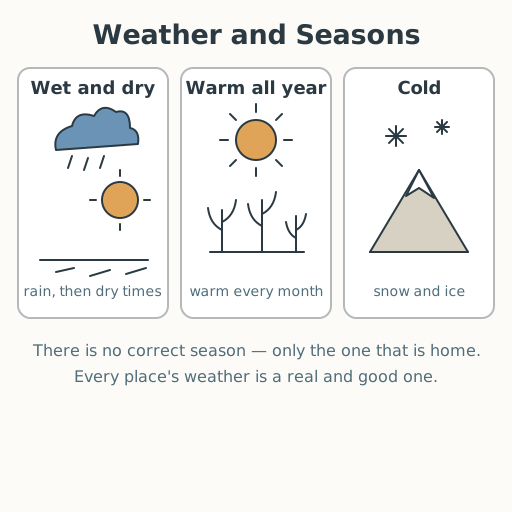
Learners observe and describe the weather where they live and discover that the world has many kinds of weather and many kinds of seasons. Some places have wet and dry times, some are warm all year, some are cold — and there is no “correct” season, only the one that is home.
Objectives
- Observe and describe weather and seasons where they live and in other places. (D06.S4.01.02)
Connection
Step outside and the world tells you its weather: sun on your face, rain on your skin, wind in your hair. The weather where you live is your weather — and it is not the same everywhere. While it rains here, the sun may blaze in a faraway desert, or snow may fall on a distant mountain. Weather and seasons are different in every place, and every place’s weather is a real and good one.
Materials
- Weather picture cards (sun, rain, wind, snow, storm clouds, dry ground, green leaves, fallen leaves)
- A weather chart
- Paper and crayons
Preparation
- Prepare weather picture cards and a simple weather chart (today / tomorrow).
- Gather one or two images or stories of weather in very different places (a snowy place, a desert, a rainforest, a coast).
Facilitator note
This lesson is written to the learner (“you”). No four-season default: do not assume spring–summer–autumn–winter. Many places have two seasons (wet and dry), some are warm all year near the equator, some are cold most of the year near the poles, and the monsoon shapes life across South and Southeast Asia. Say plainly: there is no correct season, only the one that is home — and all of them are real. Name seasons in the learners’ local language and calendar. This is a good place to be global: a child who has never seen snow can still wonder at it, and a child who has never seen a dry season can wonder at that. Honor every body: describe weather with skin and ears (warmth, wind sound) for a learner who cannot see; act it out for a learner who does not speak. Avoid frightening content: name storms matter-of-factly and keep the tone of wonder, never fear.
Procedure
- Gather (5 min). What is the weather like right now? Go to the window or door, or remember. Use your senses: what do you see, feel, and hear?
- Describe today (10 min). Use the weather cards to name what you observed — sun, rain, wind, heat, cold, clouds. Record today’s weather on the chart. Then predict: what might tomorrow be like? (A guess you can check by watching.)
- Seasons here and elsewhere (15 min). What is your weather like at this time of year? Some places have wet times and dry times; some are warm all year; some are cold for much of the year. Look at pictures of two very different places and wonder: what would the air feel like there? What would you wear, what would grow there? There is no correct season — only the one that is home.
- Act out the weather (10 min). Be the weather: rain (fingers tapping), wind (swaying side to side), sun (arms wide and warm), snow (soft and still). Move from one kind of weather to another.
- Close (5 min). Weather changes day to day, and seasons change through the year — here and everywhere. All of them are the world’s weather, and all are worth noticing.
Differentiation
- Support: Describe just today’s weather with two words (hot/cold, wet/dry) and act it out.
- Support (blind/low-vision): Describe weather by feel and sound — warmth, cool air, wind, rain tapping.
- Support (Deaf/HH): Name the weather by what you see and feel — sun, clouds, wind on the skin — and act it out with your body.
- Extension: Draw two places with very different weather and label one difference, or keep a weather chart for a full week.
Assessment
- Formative (observation): Can the learner describe today’s weather with a sense word and name one way weather or seasons differ in another place?
- Artifact (portfolio): The weather chart entry or a “two places’ weather” drawing.
Home connection
At home, watch the weather tomorrow morning and record it — sunny, rainy, windy, hot, cold. Ask a grown-up what the weather is like right now in another place your family knows.
Resources
- NASA Space Place, “What Causes the Seasons?” — Earth’s tilted axis causes the seasons, so different parts of Earth get the Sun’s most direct rays at different times of year (summer in one hemisphere while it is winter in the other). https://spaceplace.nasa.gov/seasons/en/
- BBC Bitesize (KS1 Science), “What is day and night?” — covers the seasons and how daylight and weather differ across the year and between places (for example, north of the Arctic Circle the Sun does not set in summer). https://www.bbc.co.uk/bitesize/topics/zkvv4wx/articles/zyfhxbk