Lesson 05 — Offering Help, Without Being Asked
Learners practice noticing a classmate who is struggling and offering help without being asked, holding that help is mutual — not pity — and that "no thank you" is always an okay answer.
Objectives
Objectives
- D02.S4.01.01 Offer help to a classmate who is struggling, without being asked.
Essential question
How can I offer help to a classmate who is struggling, without being asked?
Key vocabulary
Materials
Standard materials
- Picture cards of helping moments · 1 set A stuck zipper, a hard word, a spill, a dropped stack of pencils
- A soft ball or beanbag (optional) · 1 For passing during the practice offers
Low-tech / no-cost
- Real classroom moments Use live moments — a real struggle in the room — instead of picture cards
- Voice and body Act out offering help and hearing "no thank you" with no cards needed
Enriched / lab & device
- A class "help chain" poster A paper chain where each link names one way someone gave or got help
- Recording device (optional) · 1 per group Record practice offers to replay and reflect on tone and words
Works in different contexts
- large-group Model an offer for the whole group, then let learners practice in pairs around the circle
- self-directed A learner thinks of one person they could help today and practices the offer aloud or in writing
- outdoor-only Notice real struggles outdoors (a heavy load, a stuck gate) and practice offering help there
- multi-age Older learners model noticing a struggle and offering help; younger learners practice with them
- level-grouped Learners ready to extend notice a help need for the whole group and offer to help everyone
Lesson 5 — Offering Help, Without Being Asked
Summary
Learners practice noticing when a classmate is struggling — with a zipper, a hard word, a spill — and offering help without being asked. They learn that help is mutual aid, not pity: everyone needs help sometimes and everyone can give it, and “no thank you” is always an okay answer.
Objectives
- Offer help to a classmate who is struggling, without being asked. (D02.S4.01.01)
Connection
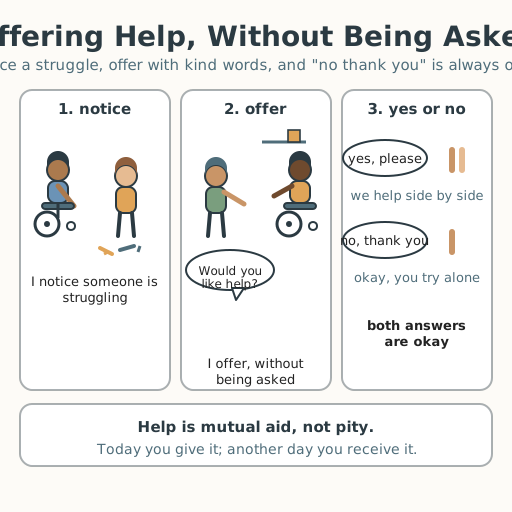
Everyone needs help sometimes, and everyone can give help. When you see a classmate struggling — a stuck zipper, a hard word, a dropped stack of pencils — you can notice and offer to help, even before they ask. Help is something people give to each other, back and forth: today you give it, another day you receive it. It is not something one “better” person gives to a “lesser” one. And a person can always say “no thank you,” and that is completely okay — it just means they want to try alone.
Materials
- Picture cards of helping moments
- A soft ball or beanbag (optional)
Preparation
- Prepare or gather picture cards of simple struggles (a stuck zipper, a hard word, a spill, dropped pencils).
- Arrange pairs for practice.
- Plan a live example from the room to use as the first “notice.”
Facilitator note
This lesson is written to the learner (“you”). Its commitments: help is mutual aid, not pity — no one is only a helper or only the helped — and consent matters: “no thank you” is always okay and must be honored calmly. Model the offer with warm, plain words (“Would you like help?” or “Can I help you with that?”) and the calm reply when the answer is no. For a learner who does not use a speaking voice, an offer can be a point, a sign, a gesture, or a gentle touch to get attention — practice these as real offers, not lesser ones. Keep this about noticing and caring, never about being the “best” helper.
Procedure
- Gather (5 min). Think of a time you struggled with something. Did anyone help you? How did it feel? Now think of a time you helped someone. How did that feel?
- Notice a struggle (10 min). Look at the picture cards (or around the room). What clues tell you someone is struggling? A frown at a page, a stuck zipper, a spill, dropped pencils. Practice noticing without being told.
- Offer help (10 min). Offer with kind words: “Would you like help?” or “Can I help you with that?” Then wait for their answer. Practice the offer with a partner.
- “No thank you” is okay (10 min). Sometimes a person wants to try alone. If they say “no thank you,” say “okay” and let them be — that is respect. If they say “yes please,” then help, side by side, not taking over.
- We all help and are helped (10 min). Help is mutual. Today you give it; another day you receive it. No one is only ever the helper or only ever the helped. Name one way you gave help this year and one way you received it.
Differentiation
- Support: Practice one scripted offer with a partner; use pictures of helping moments to choose from.
- Support (non-speaking): Offer help by pointing, signing, or a gentle gesture; practice the calm “no thank you” pause.
- Support (blind/low-vision): Describe the struggle aloud and practice the spoken offer; use a partner to role-play.
- Extension: Notice a help need for the whole class (a mess, a broken thing, a shared chore) and offer to help the group.
Assessment
- Formative (observation): Can the learner notice a classmate struggling and offer help without being asked, and accept “no thank you” calmly?
- Performance: The learner practices a real offer during the lesson.
Home connection
At home, watch for one time someone needs help and offer it without being asked — and notice how it feels.
Resources
- CASEL SEL Framework (relationship skills): https://casel.org/fundamentals-of-sel/