Lesson 04 — My Communities
Learners name several communities they belong to — family, class, neighborhood, and others such as a faith community, team, market, or language group — and see that no community is "correct" or better than another, only different.
Objectives
Objectives
- D02.S3.01.01 Name several communities they belong to, such as family, class, and neighborhood.
Essential question
What circles do I belong to, and what do we do together in them?
Key vocabulary
Materials
Standard materials
- Drawing paper and crayons · per learner For drawing a "community web" — yourself in the middle and a circle for each community
- Chart paper and markers · 1 set To list the communities the class can name
Low-tech / no-cost
- Stones, sticks, or drawn circles Place one object for each community in a web on the ground; no paper needed
- Voice and body Name each community aloud and move to a different spot for each one
Enriched / lab & device
- Photographs of local communities · 1 set Pictures of a market, a team, a place of worship, a neighborhood to spark naming
- A tablet or map · 1 Optional, to look at a neighborhood map or images of communities around the world
Works in different contexts
- large-group Name communities together as a group, then each learner draws their own web in small groups
- self-directed A learner draws their own community web and names each circle to a trusted person
- outdoor-only Build the web outdoors with stones or sticks — one object per community, yourself in the middle
- multi-age Older learners share the communities they belong to as examples, then help younger ones name theirs
- level-grouped Learners ready to extend name one thing each community does together and one way they help out
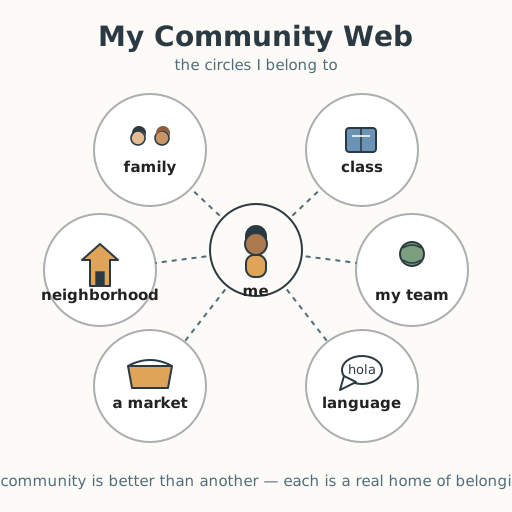
Lesson 4 — My Communities
Summary
Learners name the circles they belong to — family, class, and neighborhood, plus others such as a faith community, a sports team, a market, or a language group. They build a “community web” with themselves at the center and celebrate that communities exist everywhere on Earth, each with its own way, and none is “correct” or better than another.
Objectives
- Name several communities they belong to, such as family, class, and neighborhood. (D02.S3.01.01)
Connection
You do not live alone — you belong to circles of people. Your family is one community. Your class is another. Your neighborhood is another. So are a faith community, a sports team, a market you visit, or a group of people who speak your language. A community is a group of people who share something and do things together. Communities look different all over the world — some gather around a well, a market, a festival, or a game — and no community is better than another. They are just different ways people belong.
Materials
- Drawing paper and crayons
- Chart paper and markers
Preparation
- Set out drawing supplies.
- Prepare chart paper for listing communities.
- Plan a simple example of a community web to model.
Facilitator note
This lesson is written to the learner (“you”). Its commitment is that no community is “correct” and none is better — the goal is belonging, not ranking. Honor every community a learner names, including ones outside the usual list (a language group, a market, a place of worship, a team, a care circle). Keep the global view visible: communities vary worldwide, and each has its own way. For a learner who is blind or has low vision, build the web tactually — place an object for each community around a center object that stands for the learner, and name each one aloud. A learner who does not use a speaking voice names communities by pointing to pictures or objects.
Procedure
- Gather (5 min). Think of all the circles you belong to. How many can you name? Start with three everyone shares in some form: your family, your class, and your neighborhood.
- Name my communities (15 min). Name several — family, class, neighborhood, and any others: a faith community, a team, a market you visit, a language group. Draw yourself in the middle of your page, then draw a circle for each community and a line from you to it. This is your community web.
- What we do together (10 min). Pick one community and name one thing people do together there. (In my family we eat together; in my class we read together; in my neighborhood we greet each other.)
- Communities everywhere (10 min). Communities look different all over the world — some gather around a well, a market, a festival, or a game. Notice: every community has its own way, and none is “correct” and none is better. They are all real homes of belonging.
- Close (5 min). You belong to many circles, and every circle is a place where you are known. All of them together are part of who you are.
Differentiation
- Support: Name just two communities (family and class) and draw them.
- Support (non-speaking): Point to pictures of communities and circle the ones you belong to.
- Support (blind/low-vision): Build a tactile web with objects; name each community as it is placed.
- Extension: Name one thing each community does together, or add a community you would like to belong to someday and say one thing you would do there.
Assessment
- Formative (observation): Can the learner name several communities they belong to (family, class, neighborhood, plus at least one more)?
Home connection
Ask someone at home what communities they belong to, and add one new circle to your web.