Lesson 01 — Feelings That Look Alike
Learners meet two pairs of feelings that look and feel almost the same — mad and frustrated, sad and disappointed — and learn a clue question to tell each pair apart, growing a more exact feeling vocabulary.
Objectives
Objectives
- D01.S1.02.01 Use feeling words to tell the difference between similar emotions, such as mad and frustrated or sad and disappointed.
Essential question
How do I tell two feelings apart when they look and feel almost the same?
Key vocabulary
Materials
Standard materials
- Look-alike feelings chart (two pairs) · 1 Mad vs. frustrated and sad vs. disappointed, each with a face and a one-line clue
- Feeling scenario cards · 1 set Short everyday moments the learner can sort into mad, frustrated, sad, or disappointed
- Chart paper and markers · 1 set To write the two clue questions large enough to read
Low-tech / no-cost
- Voice and body Act out each feeling and say the clue aloud; no chart or cards needed
- Hand-drawn faces Draw the four faces together on any paper or in the sand
Enriched / lab & device
- Laminated look-alike card deck · 1 set per pair Durable cards for repeated sorting and matching games all year
- Camera or tablet · 1 per group Photograph learners' own "look-alike" faces to build a class feelings wall
Works in different contexts
- large-group Hold the chart high and say each clue aloud; invite the whole group to make the two faces and say how they differ
- self-directed A learner reads each pair, makes each face in a mirror, and names the clue that tells them apart
- outdoor-only Use the chart as a reference; invite learners to find a spot or object that matches each feeling (a stuck stone for frustrated, a drooping leaf for disappointed)
- multi-age Older learners act out a pair while younger learners guess which one it is, using the clue question
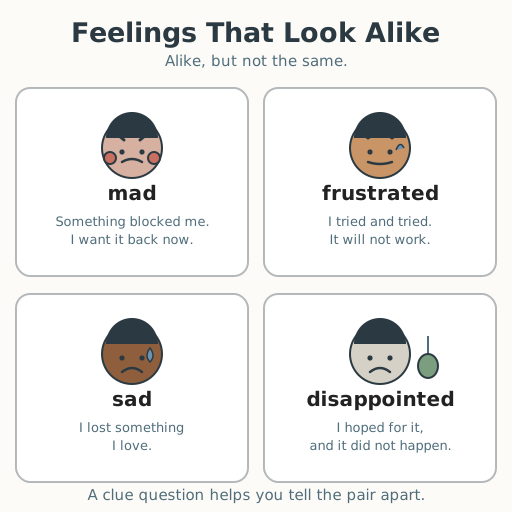
Lesson 1 — Feelings That Look Alike
Summary
Learners meet two pairs of feelings that look and feel almost the same: mad and frustrated, and sad and disappointed. They learn a simple clue question to tell each pair apart and practice sorting small everyday moments. This is the first step toward naming feelings exactly, not just roughly.
Objectives
- Use feeling words to tell the difference between similar emotions, such as mad and frustrated or sad and disappointed. (D01.S1.02.01)
Connection
Imagine your little sibling knocked over the tower you just built. Your face gets hot, your hands curl into fists — that is mad. Now imagine you tried and tried to tie your own shoes and the knot keeps slipping loose. Your face is scrunched and your chest is tight — that is frustrated. Both feel hot and tight, but they are not the same. Two more: you lose a favorite toy — sad. You hoped for rain so you could splash in puddles, and it stayed dry — disappointed. Learning to tell feelings that look alike apart helps you say exactly what is happening inside you.
Materials
- Look-alike feelings chart (mad/frustrated, sad/disappointed)
- Feeling scenario cards
- Chart paper and markers
Preparation
- Print or draw the look-alike chart and the scenario cards.
- Write the two clue questions on chart paper: “Did something block me, or did my trying not work?” and “Did I lose something, or did something I hoped for not happen?”
- Arrange a circle for gathering and a space for the sorting game.
Facilitator note
This lesson is written to the learner (“you”). Prepare the chart, cards, and clue questions, then guide the sorting game and closing reflection. Feelings are personal — no answer is “wrong.” If a learner names a different feeling, honor it and wonder together about why. The goal is noticing the difference, not memorizing a chart. Keep the clue questions simple and concrete; read them aloud for learners who are still growing as readers.
Procedure
- Gather (5 min). Think back: last year you learned feeling names like proud, lonely, and excited, and long ago you learned happy, sad, angry, and scared. Today you meet feelings that look alike — almost the same, but not quite.
- Meet the first look-alike pair (10 min). Look at the two faces side by side. Mad is when something blocks you — someone grabs your toy, and you want it back now. Frustrated is when you try and try and it will not work — the button slips, the page rips, the ball will not balance. Both feel hot and tight. The clue question is: did something block me, or did my trying not work?
- Meet the second look-alike pair (10 min). Now look at the other two faces. Sad is when you lose something you love — a pet, a friend moving away, a broken treasure. Disappointed is when you hoped for something and it did not happen — the rain did not come, the game was canceled. Both feel heavy and slow. The clue question is: did I lose something, or did something I hoped for not happen?
- Sort game (10 min). Hear a moment, then point or say which feeling it is: “You build a sandcastle and a wave washes it flat.” (mad — something blocked you, or frustrated — your trying was washed away? Talk about why you chose.) “The market ran out of the fruit you saved your coins for.” (disappointed.) “Your dog ran away.” (sad.) No answer is silly — the clue question is your tool.
- Close (5 min). Look-alike feelings are like cousins — they resemble each other, but they are not the same person. The clue question helps you tell them apart. More exact words mean people can understand you better.
Differentiation
- Support: Work with one pair at a time (mad/frustrated first); use only the faces and clues, no written words.
- Extension: Add a third look-alike pair of your own (for example, excited and nervous) and write a clue question for it.
Assessment
- Formative (observation): Can the learner name a clue that tells mad from frustrated, or sad from disappointed, when shown a moment?
Home connection
Teach one look-alike pair — mad and frustrated, or sad and disappointed — to someone at home, and share a time you felt each one.
Resources
- CASEL SEL Framework (self-awareness competency): https://casel.org/fundamentals-of-sel/