Lesson 09 — Throw, Catch, and Kick Together
Learners put throwing, catching, and kicking together in simple partner games, passing a soft ball back and forth and into a goal, learning to share the ball and take turns with a friend.
Objectives
Objectives
- D03.S2.02.02 Throw, catch, and kick a ball with developing control using both hands and both feet.
Essential question
How do I share a ball with a friend using throw, catch, and kick?
Key vocabulary
Materials
Standard materials
- Soft balls or beanbags · 1 per pair Light and easy to throw, catch, and kick
- Floor markers (cones, chalk, or rope) · 1 set To mark where partners stand and the goal to kick into
Low-tech / no-cost
- A rolled-up pair of socks or crumpled paper ball A safe, no-cost ball to pass with a partner
- Two stones or shoes as a goal A simple goal made from what is around
Enriched / lab & device
- A variety of soft balls and beanbags · 1 set So each pair can choose the ball that works for both partners
- A simple game layout with two goals and a passing zone · 1 set To practice passing and kicking in a small cooperative game
Works in different contexts
- large-group Pairs stand in two lines facing each other across a safe gap, all throwing and kicking the same direction, then switch partners
- self-directed A learner practices all three skills with a wall or a target, tossing to themselves, kicking into a goal, and checking their own control
- outdoor-only Pairs pass a soft ball back and forth across a clear space, then kick it into a goal marked by stones or chalk
- multi-age Older learners pair with younger ones, tossing gently and letting the younger learner choose the distance and the goal
Lesson 9 — Throw, Catch, and Kick Together
Summary
Learners bring their three ball skills together and share them. In pairs and small games they throw, catch, and kick a soft ball to a friend and into a goal, learning that a ball is more fun — and a friend more trusted — when you pass and take turns.
Objectives
- Throw, catch, and kick a ball with developing control using both hands and both feet. (D03.S2.02.02)
Connection
A ball by yourself is a ball; a ball with a friend is a game. In every place people live, passing a ball back and forth is how friends play together. Passing takes two skills at once: your hands or feet do the work, and your kindness waits for the other person’s turn.
Materials
- Soft balls or beanbags
- Floor markers to mark where partners stand and the goal
- A goal (cones, a box, or chalk lines)
Preparation
- Mark partner spots facing each other across a safe gap, and a goal at one end.
- Set out soft balls and beanbags.
- Clear the space so passes and kicks travel safely.
Facilitator note
This lesson is written to the learner (“you”) so it works in a classroom and for a self-directed learner. Prepare the partner spots and goal, then model a gentle pass and a kick before pairs try. The heart of this lesson is cooperation: celebrate passing, waiting, and encouraging, not winning or scoring the most. Honor every body: pairs can pass seated, with wheels, or with a scoop or larger ball, and every version counts fully. Rotate partners so learners play with different friends. Watch for a learner who always gives the ball away and never gets it back — gently model taking turns so everyone both gives and receives.
Procedure
- Gather (5 min). You can throw, catch, and kick. Today you will share all three with a friend. A ball is more fun when you pass it.
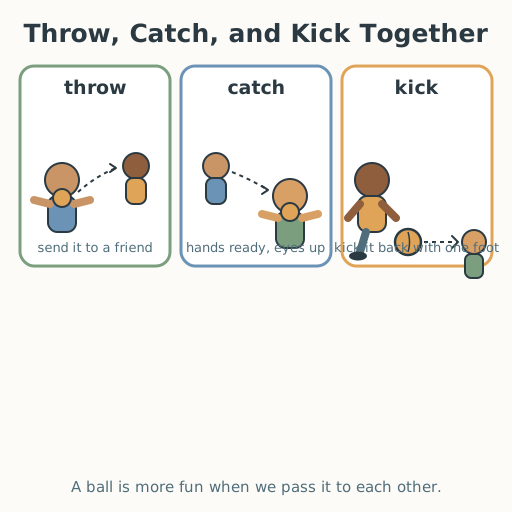
- Pass back and forth (15 min). Stand or sit facing your partner. Take turns: throw the ball with both hands, your partner catches with both hands, then they throw it back. Try a few gentle passes. If the ball drops, no problem — pick it up and try again.
- Kick to a goal (10 min). Now take turns kicking. One of you kicks the ball gently toward the goal, the other stops it and kicks it back. Try with your left foot, then your right.
- Play a small passing game (10 min). Put it together: throw, catch, kick — pass to your partner, they catch, they kick toward the goal, you bring it back. Say kind words as you play: “Nice pass!” “Your turn!”
- Close (5 min). How did it feel to share the ball? A game with a friend is built on turns and kind words, just as much as on hands and feet.
Differentiation
- Support: Keep the gap small, use a large soft ball, and let a learner choose to roll instead of throw or kick if that is more comfortable.
- Extension: Ask pairs to pass with a “one bounce” catch or to kick through a narrower goal, still taking turns.
Assessment
- Formative (observation/peer): Can the learner throw, catch, and kick a soft ball to a partner with growing control, and take turns with kind words?
Home connection
Play a passing game at home with a soft ball or rolled-up socks — throw, catch, and kick it back and forth, taking turns.