Lesson 08 — Kicking with Both Feet
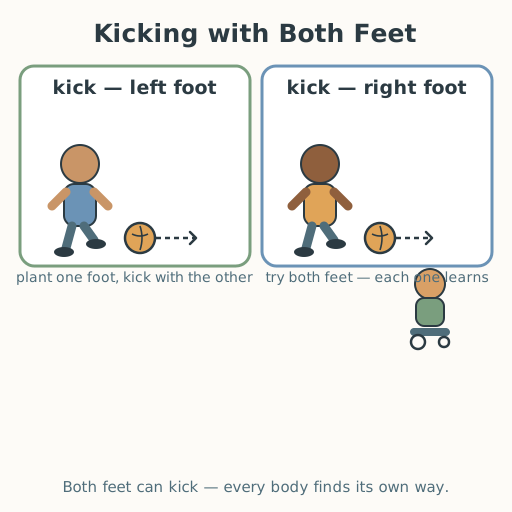
Learners practice kicking a soft ball toward a goal, learning to plant one foot and kick with the other, and try both feet so each one learns control.
Objectives
Objectives
- D03.S2.02.02 Throw, catch, and kick a ball with developing control using both hands and both feet.
Essential question
How do I kick a ball with both feet and growing control?
Key vocabulary
Materials
Standard materials
- Soft balls (a little larger than a hand, but light) · 1 per learner or pair Easy to kick without hurting a foot
- A goal (two cones, a box on its side, or chalk lines) · 1 set A clear target to kick toward
- Floor markers (cones, chalk, or rope) · 1 set To mark a kicking line
Low-tech / no-cost
- A rolled-up bundle of cloth or a light plastic bottle A safe, no-cost object to kick that will not hurt a foot
- Two stones or sticks as a goal A simple goal made from what is around
Enriched / lab & device
- Soft balls of several sizes · 1 set So each learner can choose the size that fits their feet and control
- A set of small goals or targets · 1 set For aiming practice from different distances
Works in different contexts
- large-group Kick in one direction toward a row of goals so balls travel the same way, and take turns in small groups
- self-directed A learner sets up a goal, kicks with one foot then the other, and checks their own control from different spots
- outdoor-only Kick a soft ball toward a goal marked by stones, a wall, or chalk lines, trying both feet on the grass or dirt
- level-grouped Learners who kick with control aim at a farther or narrower goal, while others use a closer, wider goal and a lighter ball
Lesson 8 — Kicking with Both Feet
Summary
Learners build ball control with their feet. They learn to plant one foot and kick with the other toward a goal, then practice with both feet so each foot grows its own control, in every body’s way.
Objectives
- Kick a ball with developing control using both feet. (D03.S2.02.02)
Connection
People kick balls in games on every continent — a football in a field, a ball in a courtyard, a rolled-up bundle on a dirt road. Kicking takes balance: one foot plants to hold you steady while the other foot does the kicking. Both feet can learn, and practice is how they do.
Materials
- Soft balls
- A goal (two cones, a box, or chalk lines)
- Floor markers to mark a kicking line
Preparation
- Set up a kicking line and a goal at a reachable distance.
- Set out soft, light balls.
- Clear the kicking lane so no one is in the path of a kick.
Facilitator note
This lesson is written to the learner (“you”) so it works in a classroom and for a self-directed learner. Prepare the goal and line, then model a kick slowly — plant one foot, swing the other — before learners try. This is skill-building, not competition: celebrate control and growing accuracy, never power or distance. Use soft, light balls so no foot gets hurt. Honor every body: a learner who uses a wheelchair can push the ball with a wheel or a foot, and that counts fully; a learner who needs support can kick from a seated position or with a partner steadying them. Offer adapted versions as real choices. Supervise kicks so everyone faces the same direction.
Procedure
- Warm up (5 min). Stand tall and practice standing on one foot, then the other. Balance is what a good kick stands on.
- Learn to kick (10 min). Stand beside the ball. Plant one foot next to it, look at the goal, and gently swing the other foot to push the ball toward the goal. Keep your eyes on the ball. Try it slowly first.
- Try both feet (15 min). Kick once with your left foot, then once with your right. Which foot feels more sure? Practice the other one a little more — that is how it learns. Aim for the goal each time.
- Step back (10 min). Move back a step or two and kick again. Control is more important than distance. If you use wheels or are seated, push the ball with a wheel or your foot toward the goal.
- Close (5 min). Shake out your legs. You kicked with both feet, and both of them learned something today.
Differentiation
- Support: Use a light, larger ball and a close, wide goal; kick from a seated position if that is more stable.
- Extension: Ask learners to kick through a narrower goal or to stop the ball with one foot before kicking with the other.
Assessment
- Formative (observation): Can the learner kick a soft ball toward a goal with both feet, with growing control, in their own body’s way?
Home connection
At home, kick a soft ball or a rolled-up cloth toward a goal made of two stones or shoes, and try both feet.