Lesson 03 — Two Feelings, Same Moment
Learners discover that two people can feel differently about the same moment, that neither feeling is wrong, and that noticing this helps us care for each other.
Objectives
Objectives
- D02.S2.02.01 Describe how two people in the same situation might feel differently.
Essential question
How can two people feel differently about the same thing?
Key vocabulary
Materials
Standard materials
- Situation picture cards · 1 set Cards showing one shared moment — rain at playtime, a dog visiting, a new baby, moving house, a birthday cake
- Feeling tokens · per learner Small counters or paper circles learners place to show how they would feel
Low-tech / no-cost
- Voices and bodies Act out the same situation and each person shows their different feeling with face and body
- A real shared moment Use something happening right now (the weather, a shared snack) and ask how each feels
Enriched / lab & device
- A picture book about two viewpoints · 1 A story where two characters feel differently about the same event, to read and discuss
- Two-sided feeling cards · 1 set Cards where the same scene is drawn with two different children and feelings
Works in different contexts
- large-group Hold up each situation card and have the whole group place feeling tokens on a big class chart to see the mix
- self-directed A learner looks at each situation, writes or draws two different feelings two people might have, and explains why both are true
- outdoor-only Use the real weather or a found object as the shared situation and ask how each person feels about it
- multi-age Younger learners name a feeling; older learners explain why the same moment can make two people feel differently
- level-grouped Group learners who can already name many feelings with those still learning, and have them pair up to share
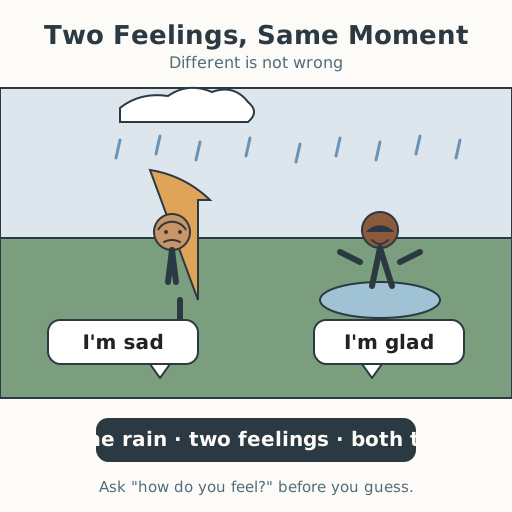
Lesson 3 — Two Feelings, Same Moment
Summary
Learners explore a surprising idea: two people can be in the very same moment and feel different things — and both feelings are real and true. They practice describing two different feelings about one shared situation.
Objectives
- Describe how two people in the same situation might feel differently. (D02.S2.02.01)
Connection
It starts to rain during playtime. One child frowns — they wanted to run outside. Another child smiles — they love the smell of rain and know the garden needed it. Same rain, two feelings. A dog visits the class: one child is thrilled, another is afraid. Both feelings are true. The same moment can feel very different to different people, and noticing that helps us be kind — because we stop thinking “you should feel what I feel” and start wondering “how do you feel?”
Materials
- Situation picture cards (rain at playtime, a dog visiting, a new baby, moving house, a birthday cake)
- Feeling tokens (counters or paper circles)
Preparation
- Arrange a circle for gathering.
- Set out the situation cards and feeling tokens where all can reach them.
Facilitator note
Perspective-taking is a cornerstone of empathy and of social awareness (CASEL). The point to protect: different is not wrong. A child who feels afraid of the dog is not “overreacting”; a child who feels glad about rain is not “silly.” Name both as true, and never rank feelings as better or worse. This is also where the global lens lives: people in different places may feel differently about the same thing — rain is welcome where fields are dry, unwelcome where it floods — and each feeling makes sense in its own life. Keep examples light; avoid a situation that a learner is living through painfully. Every learner can take part: a non-speaking learner places a token or points to a feeling face; a learner with low vision describes the feeling in words while you describe the card aloud. Read the procedure aloud and model the first example.
Procedure
- Gather (5 min). Sit in a circle. Think: have you ever felt one way about something while a friend felt the opposite? What was it?
- Meet the big idea (10 min). Look at the rain card. One person says “I’m sad,” another says “I’m glad.” Wonder together: can both be true? Yes — the same moment can hold two feelings, and neither is wrong. Say it together: “Same moment, two feelings, both true.”
- Feelings detective (15 min). For each situation card — the dog, the new baby, moving house, the birthday cake — place a feeling token to show how you would feel. Notice how the tokens land in different places. Take turns describing two different feelings and why each one makes sense.
- Pair share (10 min). With a partner, pick one card and tell two feelings two different people might have. Listen to your partner’s two — did they match yours or differ?
- Close (5 min). Remember: when someone feels differently, they are not wrong. Ask “how do you feel?” before you guess. That is how caring begins.
Differentiation
- Support: Limit to two feeling faces (sad/glad); model each card’s two feelings aloud. A non-speaking learner points to a feeling face and places a token.
- Extension: Invite learners to think of a third feeling the same moment could hold, or a moment from their own life when two people felt differently.
Assessment
- Formative (observation): Can the learner describe two different feelings for the same situation and say why each makes sense?
- Peer (pair share): Did the learner listen to their partner’s two feelings and treat them as true?
Resources
- CASEL SEL Framework (social awareness): https://casel.org/fundamentals-of-sel/
Home connection
At home, ask two family members how they feel about the same thing — the weather, a food, a song — and notice how the same moment can hold two feelings.