Lesson 04 — Caring When Someone Hurts
Learners learn four ways to care when a classmate is sad, left out, or hurt — notice, ask, stay, include — and practice them in gentle role-plays.
Objectives
Objectives
- D02.S2.02.02 Show caring when a classmate is sad, left out, or hurt.
Essential question
What can I do when a classmate is sad, left out, or hurt?
Key vocabulary
Materials
Standard materials
- Caring-steps chart · 1 A four-step chart — notice, ask, stay, include
- Scene cards · 1 set A classmate is sad, a classmate is left out of a game, a classmate is hurt
Low-tech / no-cost
- Voices and bodies Act out the three scenes and the four caring steps with words and gestures
- A soft cloth or found object Stand in for a comfort object or bandage in the role-play
Enriched / lab & device
- A picture book about comforting a friend · 1 A story of a child caring for someone who is sad, left out, or hurt, to read and discuss
- Puppets or small figures · 1 set To act out caring scenes for the whole group
Works in different contexts
- large-group Act out each scene with volunteers up front while the whole group says the four steps together
- self-directed A learner matches each scene card to a caring action, then draws themselves caring for a friend
- outdoor-only Role-play caring outside — helping someone who falls on the grass, inviting someone into a game
- multi-age Older learners model the four steps; younger learners practice the "ask" question
- level-grouped Pair learners so one models the caring sentence and the other repeats it back
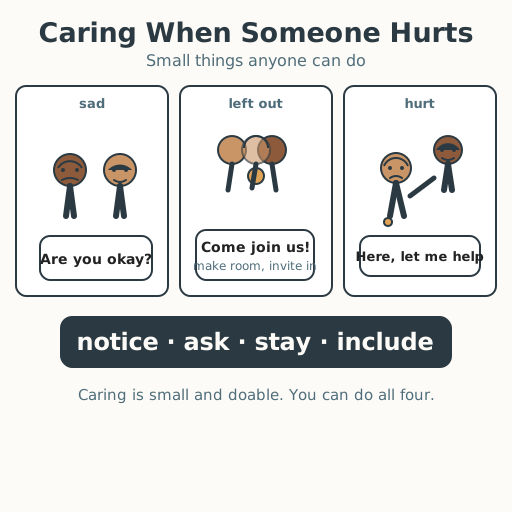
Lesson 4 — Caring When Someone Hurts
Summary
Learners learn four caring steps — notice, ask, stay, include — and practice them in three scenes: when a classmate is sad, left out, or hurt. Caring is taught as something everyone can offer, not as a special talent for a few.
Objectives
- Show caring when a classmate is sad, left out, or hurt. (D02.S2.02.02)
Connection
Think of a time you felt sad, or a time you were left out of a game, or a time you fell and hurt yourself. What made it better? Usually it was someone noticing, asking if you were okay, staying with you, or pulling you into the circle. Caring is not magic — it is a set of small things anyone can do. In every part of the world, when someone is hurting, people come close, ask, and help. Today you will learn the steps and practice them.
Materials
- A caring-steps chart (notice, ask, stay, include)
- Scene cards (a classmate is sad; a classmate is left out of a game; a classmate is hurt)
Preparation
- Arrange a circle for gathering.
- Post the four caring steps where all can see them.
Facilitator note
Empathy becomes care through action — and action is a skill to teach, model, and practice (CASEL’s relationship-skills competency). Teach the four steps as explicit instruction with a worked example first, then guided practice (Kirschner, Sweller & Clark, 2006). Keep scenes fictional and gentle; do not ask a learner to act out a real hurt they are living. Protect two commitments: care is for everyone (no “most caring” prize — care is not a competition), and caring does not mean fixing (a child does not need to solve a big problem; sitting nearby and asking is already caring). A non-speaking learner shows care by staying close, holding out a hand, or signing “are you okay?”; a learner with a motor difference cares in their own way — by speaking, by staying, or by directing a partner — and their care counts fully. Read the procedure aloud and model each step.
Procedure
- Gather (5 min). Sit in a circle. Think: when you were sad, left out, or hurt, what did someone do that helped?
- Meet the four steps (10 min). Learn the caring steps and act each one out: notice (look around — who needs a friend?); ask (“Are you okay?” in a soft voice); stay (sit or stand close, wait); include (invite them in). Say them together until you know them.
- Watch a worked example (10 min). Two volunteers show the scene “a classmate is sad.” Watch them use all four steps: notice, ask, stay, and then — when the friend is ready — include.
- Practice in threes (15 min). In a group of three, act out each scene — sad, left out, hurt. One person feels, one person cares, one person watches and names the steps they saw. Swap so everyone tries each part.
- Close (5 min). Remember: caring is small and doable. Notice. Ask. Stay. Include. You can do all four.
Differentiation
- Support: Model one step at a time; offer the exact question “Are you okay?” to copy. A non-speaking learner signs or holds out a hand for “stay.”
- Extension: Invite learners to add a fifth step of their own (offer a comfort object, get help from an adult) and explain when they would use it.
Assessment
- Formative (observation): Does the learner use at least two caring steps in a role-play scene?
- Performance: The learner shows care — by word, sign, or action — for a classmate in the scene.
Home connection
At home, notice someone who is sad, left out, or hurt, and try the four steps — notice, ask, stay, include — then tell a grown-up what you did.