Lesson 09 — Teamwork Rehearsal
A rehearsal lesson: learners bring two earlier skills — giving encouragement and doing a part — together in one team challenge, retrieving what they learned and using both at once.
Objectives
Objectives
- D02.S1.02.01 Give a sincere compliment or word of encouragement to a classmate during an activity.
- D02.S4.02.01 Cooperate with others to finish a task that no one could do alone.
Essential question
How do encouraging words and doing my part help a team finish together?
Key vocabulary
Materials
Standard materials
- Blocks, cups, or a relay ball · 1 set per team For a small team challenge where each person contributes a part
- A soft turn marker · 1 For the closing reflection circle
Low-tech / no-cost
- Bodies and voices Do a team task with bodies only — pass a clap, row together, carry together — cheering each other on
- Found objects Stones, sticks, or leaves can be the pieces each person adds in turn
Enriched / lab & device
- A timer or chime · 1 To mark turns gently without rushing or ranking
- Camera or tablet · 1 per team Record the team task to reflect on the parts and the cheers
Works in different contexts
- large-group Run several small teams side by side, then gather to share one cheer and one part each team is proud of
- self-directed A learner reviews the two skills from earlier lessons — encouraging and doing a part — then does a task with a helper and names both
- outdoor-only Do the team task outside — pass a found object down a line, or carry something together — cheering each other on
- multi-age Mixed-age teams do the task together; older learners model a cheer, younger learners do a part
- level-grouped Form teams so each has a mix of confident and quiet voices, and every part is needed
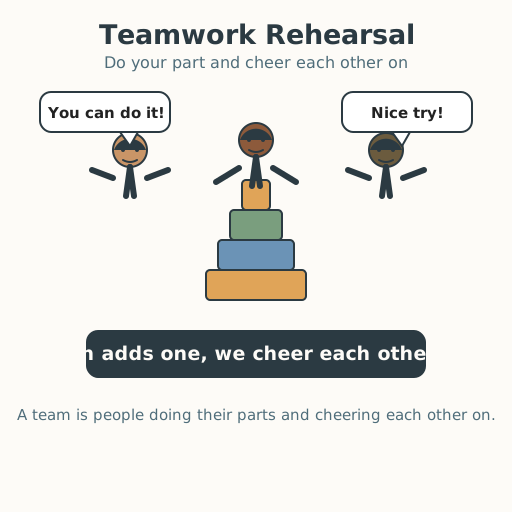
Lesson 9 — Teamwork Rehearsal
Summary
This rehearsal lesson brings two skills from earlier in the unit back together: giving sincere encouragement (Lesson 1) and doing a part in a shared task (Lesson 7). Learners use both at once in a small team challenge — finishing together, not competing against other teams.
Objectives
- Give a sincere compliment or word of encouragement to a classmate during an activity. (D02.S1.02.01)
- Cooperate with others to finish a task that no one could do alone. (D02.S4.02.01)
Connection
Remember the cheers from our first lesson — “You can do it!”, “Nice try!” — and the feeling of lifting something together that no one could lift alone? Teams everywhere put these two together: a boat crew rows in time and cheers the stroke; a harvest is gathered by many hands and by voices calling each other on. Today you will be a team: each person does a part, and everyone cheers everyone on.
Materials
- Blocks, cups, or a relay ball
- A soft turn marker
Preparation
- Set up one small challenge per team (build a tower where each adds one block; pass a ball down a line without dropping it; carry a shared item a short way together).
- Arrange a circle for the closing reflection.
Facilitator note
This is deliberate retrieval and spacing: learners are asked to recall and use skills from Lessons 1 and 7, not re-read them (the science-of-learning retrieval and spacing commitments). Keep the challenge cooperative, not competitive: teams are not ranked against each other, and there is no “winning team.” Celebrate that every team finished together and every voice cheered. Name the two skills explicitly as they appear (“I heard a real cheer,” “I saw you steady the tower”). Watch that quiet learners get a turn to speak and to act; a learner who does not speak with their mouth cheers with a sign, a clap, or a gesture. Read the procedure aloud; model one cheer and one part before teams begin.
Procedure
- Gather (5 min). Sit in a circle. Think: what two skills did we learn earlier — in the first lesson and in the “Together We Can” lesson?
- Recall the two skills (10 min). Say them together. Cheering: name something true and specific (“I like how you…”, “You can do it!”). Doing a part: each person takes one part, no one takes over, and the team finishes together.
- Team challenge (20 min). In your team, do the challenge — the tower, the passing game, or the carrying. As you work, do your part and cheer your teammates on with real, specific words.
- Reflect in a circle (10 min). Pass the turn marker. Tell one cheer you gave and one part you did. Listen to the others.
- Close (5 min). Remember: a team is people doing their parts and cheering each other on. You did both today.
Differentiation
- Support: Offer a one-part challenge and a cheer sentence starter; a non-speaking learner does their part and cheers with a clap or sign.
- Extension: Invite teams to try a harder challenge and name the new parts it needs before they begin.
Assessment
- Formative (observation): Does the learner give a sincere cheer and do their part during the challenge?
- Peer (check): Did every team member get a turn to act and to be cheered?
Home connection
At home, be a teammate: do your part in one family job and cheer on a family member who is trying something hard — then tell how it felt.