Lesson 06 — Who and What
Learners read a short text and answer two questions — who it is about and what happened — the first two of the five questions that unlock a text.
Objectives
Objectives
- D04.S2.02.02 Answer who, what, where, when, and why questions about a text read independently or with support.
Essential question
How do I find who and what a text is about?
Key vocabulary
Materials
Standard materials
- A short text with clear people and happenings · 1 A simple story or notice in the home writing system
- Question cards for who and what · 1 set Two cards, each with a question word and a small picture
Low-tech / no-cost
- A story told aloud from memory Listen for who the story is about and what happened
- Who/what written in the air Trace the two question words with a finger while saying them
Enriched / lab & device
- A recorded text to re-listen · 1 Learners pause the recording to answer who and what
- Who/what answer frames · 1 set Sentence starters such as "The story is about…" and "What happened is…"
Works in different contexts
- large-group Read the text together, then have the whole group hold up a "who" or "what" card to match each question asked
- self-directed A learner reads or hears a text, then writes or draws two answers — who it is about and what happened — and checks them against the text
- multi-age Older learners ask the who/what questions; younger learners find the answers in pictures or point to them in the text
- level-grouped Each group reads a text at its own level and answers who and what, then shares one answer with the class
- outdoor-only Observe something happening outdoors — a bird, a game, a market stall — and answer who it is about and what happened
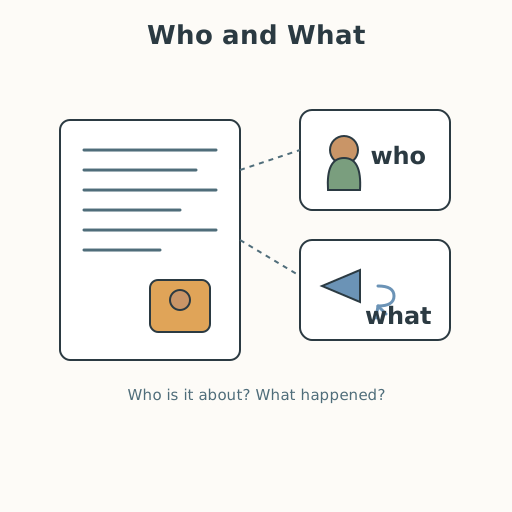
Lesson 6 — Who and What
Summary
Learners read a short text and answer the first two of the five great reading questions: who the text is about and what happened. These two questions are the doorway into every story and every notice.
Objectives
- Answer who and what questions about a text. (D04.S2.02.02)
Connection
When a friend comes home bursting with news, you ask two things right away: “Who was there?” and “What happened?” Those two questions work on everything you read — a story, a market sign, a message from a neighbor. They tell you the people and the happening, and everything else in a text hangs on those two hooks.
Materials
- A short text with clear people and happenings (in the home writing system)
- Question cards for “who” and “what”
Preparation
- Choose a short text with one clear “who” and one clear “what.”
- Prepare the two question cards.
Facilitator note
This lesson is written to the learner (“you”) so it works in a classroom and for a self-directed learner. The five questions (who, what, where, when, why) are taught two at a time so each gets real practice; today is who and what. Model answering once with evidence from the text, then guide, then release. “Who” may be a person, an animal, or a character in the learner’s culture of stories; “what” is the main happening, not every small detail. A learner answers who/what by speaking, signing, pointing to a picture, or writing — the answer is what matters. Work in the learner’s home language; every language asks these same questions, with its own words for them.
Procedure
- Gather (5 min). When someone tells you news, what do you want to know first? Usually who was there and what happened.
- Meet the two questions (5 min). Meet the first two reading questions: Who? — who is the text about? What? — what happened?
- Read the text (10 min). Read the short text once, all the way through.
- Find who and what (15 min). Read it again, hunting for the answers. Who is the text about? What happened? Point to, say, or write each answer — and find the place in the text that shows you.
- Ask each other (5 min). Trade who/what questions with a partner about the same text, and answer with evidence from the page.
- Close (5 min). Who and what are the first two keys. Two more questions — where and when — are coming next.
Differentiation
- Support: Answer just “who” first, with a picture; then add “what.”
- Support (non-speaking): Point to the person and the happening in the text or in pictures — pointing with evidence is answering.
- Extension: Find a second, smaller “what” detail and tell which one is the main happening and why.
Assessment
- Formative (observation): Can the learner name who a text is about and what happened, with evidence from the text?
Home connection
After hearing or reading a short story today, tell someone at home who it was about and what happened.
Resources
- National Reading Panel (2000), reading comprehension — question answering is a core comprehension strategy. (Cited as a widely used evidence base.)