Lesson 01 — Tens and Ones
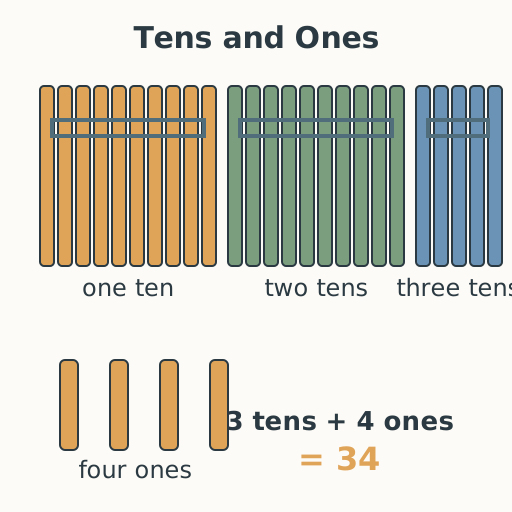
Learners build groups of ten from a collection and discover that every two-digit number is made of tens and ones — three tens and four ones is thirty-four. Place value begins as a thing you can hold, not a symbol.
Objectives
Objectives
- D05.S1.02.01 Use place value of tens and ones to read, write, compare, and order two-digit numbers.
Essential question
How do tens and ones help me understand a number like 34?
Key vocabulary
Materials
Standard materials
- Small objects · about 100 per learner or pair Pebbles, seeds, beans, buttons, or counters
- Ten small cups, bags, or squares of cloth · 10 per learner or pair One holder for each group of ten
- Paper or slate and a drawing tool · per learner To record tens and ones
Low-tech / no-cost
- Found objects and the ground Bundle sticks or stalks into groups of ten with string or grass, and lay ones in the dirt
- Fingers and body Ten fingers make a group of ten; hold up tens as fists and ones as single fingers
Enriched / lab & device
- Ten-frames and place-value cards · 1 set per pair A ten-frame per group of ten, and tens/ones cards to match to a number
- Base-ten blocks (rods and units) · 1 set per pair Rods of ten and single unit cubes to build and read two-digit numbers
Works in different contexts
- large-group Build tens together as a whole group, counting by tens in one voice, then hold up tens and ones while the class reads the number aloud
- self-directed A learner makes groups of ten from their collection, counts the tens and the leftover ones, and writes or says the number
- outdoor-only Gather sticks and bundle tens on the ground, then lay out ones beside them to read the number
- multi-age Older learners coach younger ones in bundling tens and reading tens-and-ones aloud; younger learners echo each number
- level-grouped Learners who already read tens and ones can read three-digit numbers or trade ten ones for a ten; others build and count tens with support
Lesson 1 — Tens and Ones
Summary
Learners bundle objects into groups of ten and discover that a two-digit number is tens and ones — for example, three tens and four ones is thirty-four. They read and record numbers as tens and ones, treating place value as something you can hold and count, not just a symbol.
Objectives
- Use place value of tens and ones to read, write, compare, and order two-digit numbers. (D05.S1.02.01)
Connection
A farmer counts eggs into trays of ten, a fisher ties fish into bundles of ten to sell at market, a shopkeeper stacks coins in piles of ten to count money fast. Most peoples around the world group by ten because ten fingers and ten toes make ten easy to see and count. Some peoples have kept count other ways — by fives, by twenties, with tally marks, or with knots on a cord — and every counting way is a real way to keep track. Here we practice the ten-way: when you bundle ten and count the bundles, a big pile becomes a small, easy number: three tens and four ones.
Materials
- About 100 small objects (pebbles, seeds, beans, buttons)
- Ten small cups, bags, or cloth squares for groups of ten
- Paper or slate and a drawing tool
Preparation
- Give each learner or pair about 100 objects and ten holders.
- Clear space to move, bundle, and count aloud.
- Prepare (or plan to draw) a quick example of “three tens and four ones.”
Facilitator note
This lesson is written to the learner (“you”). It builds directly on Grade 1, where learners bundled tens to count to 120; today the bundles become the key idea of place value — tens and ones. Teach the one new skill as a worked example (philosophy §13): bundle ten, then ten more, then read the tens and ones aloud before learners try it themselves. The central move is unitizing — seeing ten ones as one ten (Clements & Sarama, 2014). Keep it concrete: objects first, symbols last. No one’s speed at bundling measures their smartness, and “more” is a fact about a collection, never a worth about a person. Count in the home language; number words differ across languages and all are correct. For learners who are Deaf or hard of hearing, count in sign or by tapping each bundle; for learners who are blind or low-vision, move objects into cups so the number grows by feel and sound. Learners with limited hand or body movement direct a partner to move each object. Mastery arrives at its own pace for each child.
Procedure
- Gather — remember the ten (5 min). Last year you bundled objects into groups of ten to count all the way to one hundred twenty. Make one group of ten right now. Hold up your ten fingers — that is one ten.
- Worked example — three tens and four ones (8 min). Watch and help: take ten objects, bundle them (or fill one cup), and say “one ten.” Do it again — “two tens.” Again — “three tens.” Now add four loose ones. Count: ten, twenty, thirty, then thirty-one, thirty-two, thirty-three, thirty-four. Three tens and four ones is thirty-four. Say it together.
- Guided practice — build and read (15 min). From your own collection, make as many groups of ten as you can, and keep the leftovers loose. Count your tens by tens, then count on the ones. Say your number. Now write it: how many tens? How many ones?
- Trade and check (10 min). Trade bundles with a friend. Read their tens and ones, and let them read yours. Do you both agree on the number? If not, count again together, kindly. A second count that matches is a sign you read it well.
- Record it (5 min). Draw your tens and ones on paper — three lines for three tens and four dots for four ones — and write the number beside your drawing.
- Close (2 min). Remember: every two-digit number is tens and ones. Ten, twenty, thirty — the tens — then the little ones on top. You can now hold a number in your hands.
Differentiation
- Support: Build only up to two tens today; add more tens another day, echoing each decade number.
- Support (motor): Bundle larger, easy-to-grip objects, or have a partner move objects while the learner counts and directs.
- Extension: Build a number, then build the number that is ten more (or ten less) and say how you know.
Assessment
- Formative (observation): Does the learner group into tens, count the tens by tens, and count on the leftover ones to say and write the number?
- Formative (oral): Can the learner tell how many tens and how many ones are in a number they built?
Home connection
At home, gather a pile of beans, stones, or buttons, make groups of ten, and tell a grown-up how many tens and how many ones there are — and what number that makes.
Resources
- Clements, D. H., & Sarama, J. (2014). Learning and Teaching Early Math: The Learning Trajectories Approach (2nd ed.). Routledge. (Unitizing — seeing ten ones as one ten — as the foundation of place value.)