Lesson 01 — Wonder Becomes a Prediction
Learners take the first step of science: turning a "wonder" into a question, then into a prediction — a guess they can test. They learn a prediction is not about being right or wrong; it is where finding out begins.
Objectives
Objectives
- D06.S1.02.01 Make a prediction, test it by doing, and tell whether the result matched the prediction.
Essential question
How do I turn my wonder into a prediction I can test?
Key vocabulary
Materials
Standard materials
- One thing everyone can wonder about · 1 A seed, a floating leaf, a toy car, a shadow, or a cup of water
- A class "wonder board" or large paper · 1 Two columns — "I wonder…" and "I predict…"
- Paper and crayons · per learner
Low-tech / no-cost
- Voice and a partner Take turns saying "I wonder…" and "I predict…" — no board needed
- A found object from outside One leaf, stone, or seed to wonder about and predict over
Enriched / lab & device
- A "prediction card" per learner · per learner A card with "I wonder ___", "I predict ___", and "I can test by ___"
- A wonder wall to keep all year · 1 A permanent place to post questions and predictions and revisit them
Works in different contexts
- large-group Collect predictions on the shared board; invite learners who prefer not to speak to add a drawn prediction or whisper it to a partner who shares it
- self-directed A learner writes or draws one "I wonder" question and one "I predict" guess, then plans how they would test it
- outdoor-only Find something outside to wonder about, say the question aloud, and offer a prediction you could check by watching tomorrow
- multi-age Older learners model the "I wonder… I predict… I can test by…" chain, then coach younger ones through their own
- level-grouped Learners still forming predictions use the spoken frame with a partner; learners who can write their own prediction and a test plan work independently
Lesson 1 — Wonder Becomes a Prediction
Summary
Last year learners noticed things and asked “why?” and “how?” and made a guess they could check. This year, wonder grows a step further: into a prediction — a guess you say clearly and plan to test. Learners turn a shared wonder into a question, offer their own prediction, and name how they will test it. Being wrong is welcomed, because a wrong guess is the start of finding out.
Objectives
- Make a prediction, test it by doing, and tell whether the result matched the prediction. (D06.S1.02.01)
Connection
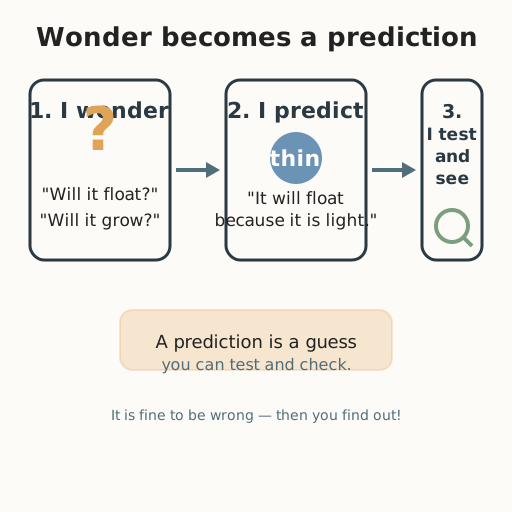
You drop a seed in a cup of soil and you wonder: Will it grow? You drop a leaf in a puddle and you wonder: Will it float? A scientist does not stop at wondering — she says her guess out loud: “I predict it will float because it is light.” A prediction is a guess you can test. It is not about being right; it is about finding out, and being wrong is how we learn.
Materials
- One thing everyone can wonder about (a seed, a floating leaf, a toy car, a shadow, or a cup of water)
- A class “wonder board” or large paper
- Paper and crayons
Preparation
- Choose one thing everyone can look at and wonder about together — something safe and close at hand, indoors or out.
- Prepare the wonder board with two columns: “I wonder…” and “I predict…”.
Facilitator note
This lesson is written to the learner (“you”), so it works in a classroom and for a
self-directed learner. Make predicting safe and joyful: say plainly that a prediction
does not have to be right — “a wrong prediction is still a great prediction, because
now we can test it.” Never let a guess be mocked or ranked. Where questioning adults is
not safe or usual, frame this as wondering together, not challenging anyone, and offer
a written or drawn “wonder box” so learners can share without speaking up (see
docs/contexts.md). The goal is the habit: wonder → question → prediction → a way to
test. Some questions we cannot test yet — and that is wonderful, not a failure. This
lesson introduces the skill with a worked example and guided practice: you model the
chain once, then learners try it with a partner before working alone (Kirschner,
Sweller & Clark, 2006).
Procedure
- Gather and remember (5 min). Last year you noticed things and asked “why?” and “how?” What is one thing you noticed and wondered about? Today your wonder grows into a prediction.
- Wonder together (10 min). Look at the thing together. Turn what you notice into a question: “I wonder if it will float.” “I wonder if it will grow.” “I wonder how far it will roll.” There are no silly questions — write or draw them on the wonder board.
- Predict (15 min). For one question, say your own guess out loud: “I predict it will float because it is light.” A prediction is a guess you can test. Say it, sign it, point to a picture, or have it written for you. Then ask: how could we test it? “We could drop it in water and watch.” “We could plant it and wait.”
- Draw your prediction (15 min). On your paper, draw three little boxes: I wonder, I predict, and I can test by. Fill them in with words or pictures.
- Close (5 min). Notice, ask, predict, test — that is the rhythm of science. Keep your prediction card; tomorrow we will test it and see.
Differentiation
- Support: Offer the spoken frame “I wonder ___” and “I predict ___” and fill it in together with a partner.
- Support (non-speaking): Point to a picture of the question and the prediction, or act the prediction out.
- Support (blind/low-vision): Wonder about a thing you can touch or hear (a seed, a shell, a bell) instead of a shadow; a partner names it aloud as you explore it.
- Extension: Write a second prediction for the same object and predict which test would be the better check and why.
Assessment
- Formative (observation): Can the learner turn a shared wonder into a question and offer a prediction they could test?
- Artifact (portfolio): The drawn “I wonder… I predict… I can test by…” page.
Home connection
At home, wonder about one thing out loud — “I wonder if this seed will grow in a cup on the window?” — then tell a grown-up your prediction. You can even plan how to test it together.
Resources
- BBC Bitesize (KS1 Science), “Working scientifically” — how scientists ask questions, test ideas, and predict outcomes, and how they record what they found. https://www.bbc.co.uk/bitesize/topics/z8q9pbk