Lesson 10 — Making, Music & Movement
Learners bring the whole unit together in a gallery and celebration. They share a mixed color, a rhythm or melody pattern, a movement sequence, a partner scene, or a planned build, and see that all of it is one thing: making — and that every piece has a story worth hearing.
Objectives
Objectives
- D07.S1.02.01 Mix two colors to make a new one and use it in a picture.
- D07.S1.02.02 Compare two artworks and tell one way they are alike and one way they are different.
- D07.S2.02.01 Play or sing a short rhythm or melody pattern and repeat it accurately.
- D07.S2.02.02 Identify one instrument by its sound and say whether the music feels happy, sad, or another way.
- D07.S3.02.01 Create and repeat a short movement sequence with a clear beginning and end.
- D07.S3.02.02 Act out a scene with a partner, taking turns leading and following.
- D07.S4.02.01 Plan a making task by choosing materials and saying the steps before starting.
- D07.S4.02.02 Compare two ways to solve a making problem and choose one, explaining why.
Essential question
How do my colors, rhythm, movement, scene, and plans all come together as making?
Key vocabulary
Materials
Standard materials
- Each learner's favorite piece from the unit · 1 per learner A mixed-color picture, a rhythm or melody pattern, a movement sequence, a scene, or a planned build to share
- A simple display space · 1 A table, wall, or cloth to lay work out like a gallery
Low-tech / no-cost
- The work itself and a circle to share in No special supplies; gather and share what was already made
- Voices, hands, and bodies Celebrate with a song, a beat, and a movement made by the body alone
Enriched / lab & device
- A camera or tablet · 1 per group Photograph the gallery and the sharing to revisit later
- A simple celebration snack · per learner A shared treat to close the unit together
Works in different contexts
- large-group Set up a whole-class gallery and take turns sharing one piece each, then close with a shared song, beat, and movement
- multi-age Older learners act as the audience and ask one question about each piece; younger learners share and point
- self-directed A learner gathers their favorite pieces, lays them out like a gallery, and tells a grown-up or recording the story of each one
- level-grouped Mix groups across levels so every learner both shares and asks a question; celebrate all four kinds of making equally
- outdoor-only Lay the unit's work — pictures, patterns, movements, and builds — out on the ground and walk the gallery under the open sky
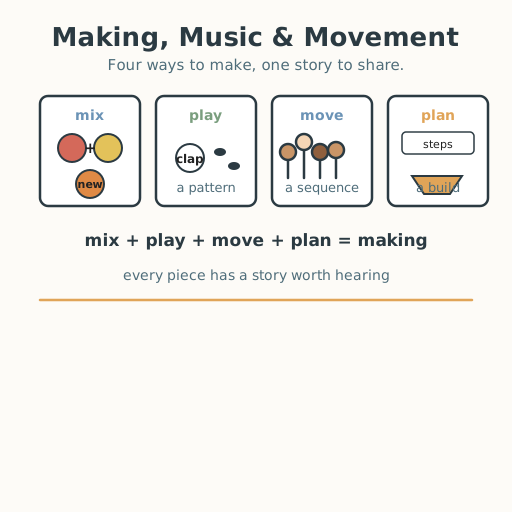
Lesson 10 — Making, Music & Movement
Summary
This capstone gathers everything the unit explored. Learners lay out their work like a gallery and share one thing they made — a mixed color, a rhythm or melody pattern, a movement sequence, a partner scene, or a planned build. They see, all at once, that colors, music, movement, and making are all making — and that every piece has value and a story.
Objectives
- Mix two colors to make a new one and use it in a picture. (D07.S1.02.01)
- Compare two artworks and tell one way they are alike and one way they are different. (D07.S1.02.02)
- Play or sing a short rhythm or melody pattern and repeat it accurately. (D07.S2.02.01)
- Identify one instrument by its sound and say whether the music feels happy, sad, or another way. (D07.S2.02.02)
- Create and repeat a short movement sequence with a clear beginning and end. (D07.S3.02.01)
- Act out a scene with a partner, taking turns leading and following. (D07.S3.02.02)
- Plan a making task by choosing materials and saying the steps before starting. (D07.S4.02.01)
- Compare two ways to solve a making problem and choose one, explaining why. (D07.S4.02.02)
Connection
All through this unit, you have made things with your hands, your voice, your body, and your ideas — a color you mixed, a pattern you played, a sequence you moved, a scene you led, a build you planned. Today you get to look at it all together, the way a family or a village shows its work at a fair or a festival. Making is how you share who you are with the world — and every piece you made has a story worth hearing.
Materials
- Each learner’s favorite piece from the unit
- A simple display space (table, wall, or cloth)
Preparation
- Help learners choose one favorite piece (a mixed-color picture, a rhythm or melody pattern, a movement sequence, a scene, or a planned build).
- Arrange a display space and a circle for sharing.
Facilitator note
This lesson is written to the learner (“you”) so it works in a classroom and for a self-directed learner. Make this a true celebration, not a contest. There are no “best” pieces — the point is that every learner shares and every learner is heard. Let learners share in whatever form suits them: talk, point, sing, move, or show. Sharing is a choice, never a duty — a learner may pass, and watching and clapping for others is full participation. Never single out a shy learner to share alone. Honor every culture’s arts as living heritage, and every learner’s work as belonging. Close by naming the unit’s big idea together: making is a voice, and every voice matters.
Procedure
- Gather (5 min). Bring your favorite thing from this unit. Look around at what everyone brought. It is a gallery of making.
- Set up the gallery (10 min). Lay out the pictures and builds. Remember the patterns, movements, and scenes are part of the gallery too — they live in your voice and body.
- Walk the gallery (10 min). Move quietly around and look. Find one thing that makes you curious. Ask its maker, “Tell me about this” — or point to it and smile.
- Share and celebrate (15 min). One at a time, share your piece if you want to — show your mixed color, play your pattern, move your sequence, act your scene, or explain your planned build and the way you chose. You may also pass, or let a friend help you share. Everyone claps for everyone, because every piece has a story.
- Close (5 min). Remember: your hands, your voice, your body, and your ideas can all make something new. That is making, music, and movement — and it is yours forever.
Differentiation
- Support: Offer a gentle prompt to share (“show us the color you mixed,” or “play your pattern for us”) and let the learner point or gesture rather than speak.
- Support (seated/adapted, non-speaking): Share from where the learner is — point, show, sign, move a hand, or have a friend help present the piece; that is full participation.
- Extension: Invite learners to name one thing they want to make next, and how they would make it better.
Assessment
- Summative (portfolio): The learner’s favorite piece, kept in the portfolio with a note of its story.
- Performance (observation): The learner shares one piece from the unit, in any form.
Home connection
Make a tiny gallery at home: lay out a few things you made this unit and give a grown-up a “tour,” telling the story of each one.