Lesson 01 — Many Ways to Eat Well
Learners recall the food groups from Grade 1 and discover that families around the world build meals from several groups in many different ways — the first step toward building a balanced meal. Every way of eating is honored; no food or meal is ranked.
Objectives
Objectives
- D03.S3.02.01 Build a simple balanced meal by choosing foods from several different groups.
Essential question
How many different ways are there to eat well, and what do they have in common?
Key vocabulary
Materials
Standard materials
- Food group reminder cards · 1 set Fruits, vegetables, grains, and proteins from many places — rice, flatbread, maize, beans, lentils, greens, mango, fish, eggs, root vegetables
- Four sorting mats · 4 Labeled "fruits," "vegetables," "grains," and "proteins"
Low-tech / no-cost
- Four drawn circles Draw four circles on the ground or floor and sort foods by naming them and standing in the circle
- Voice and remembered foods Recall and sort foods from home and the market by saying their names; no cards needed
Enriched / lab & device
- Real foods to touch and smell · a few Safe whole foods — rice, a mango, a root, a handful of beans — to sort by feel and scent
- A "many ways to eat well" picture book · 1 A book showing varied meals families eat around the world
Works in different contexts
- large-group Sort cards together at the front, then send pairs to re-sort a small set and explain one food each
- self-directed A learner sorts a small set of cards alone, checks by naming why each food went where, then draws one meal from home
- outdoor-only Draw four circles in the dirt and sort foods by naming them and standing in the matching circle
- multi-age Older learners act as recorders, writing each food name under its group while younger learners sort
- level-grouped Learners who remember the groups sort on their own; others re-match foods to groups with a reminder card
Lesson 1 — Many Ways to Eat Well
Summary
Learners recall the four food groups they met in Grade 1 and discover that families around the world build their meals from several groups in many different ways. This retrieval opens the unit’s path toward building a balanced meal, and it holds the line that every family’s way of eating is honored, never ranked.
Objectives
- Build a simple balanced meal by choosing foods from several different groups. (D03.S3.02.01)
Connection
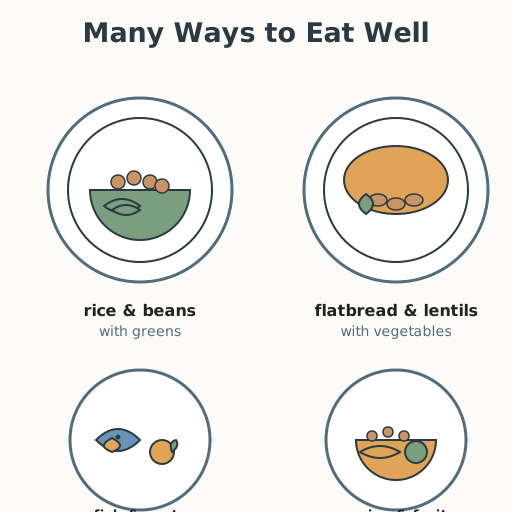
Last year you learned to sort foods into groups: fruits, vegetables, grains, and proteins. A rice-and-beans meal, a flatbread-and-lentils meal, a fish-and-root-vegetables meal — they look different, but each one pulls foods from several groups. Before we build our own balanced meals, we will remember the groups and notice the many wonderful ways families eat well.
Materials
- Food group reminder cards (fruits, vegetables, grains, and proteins from many places)
- Four sorting mats labeled “fruits,” “vegetables,” “grains,” and “proteins”
Preparation
- Prepare four labeled sorting mats or drawn circles.
- Gather food picture cards covering all four groups, from many cultures.
- Set a warm tone: every family’s food is welcome here, and no food or meal is “better” than another.
Facilitator note
This lesson is written to the learner (“you”). Hold the line on no food shaming. The goal is to recall the groups and notice variety, never to rank a food, a meal, or a family. A meal that is everyday for one family may be rare for another, and neither is wrong — the four groups are one way to sort, not the only right one. Do not comment on what or how much a learner eats, and never tie food to body size, weight, or appetite. A learner who is blind or has low vision sorts real foods by touch and scent; a learner who does not use a speaking voice sorts by pointing or signing. A learner who is deaf or hard of hearing sorts by pointing to the labeled mats and watching the demonstration from the front, since every step is shown, not only told. This lesson retrieves Grade 1’s food groups (U.01.008) and opens the spiral toward this unit’s balanced-meal work.
Procedure
- Gather (5 min). Think of a meal your family eats. Tell a partner what foods are in it. No two families eat exactly the same way, and every family’s food matters.
- Remember the four groups (10 min). Look at the sorting mats. Fruits grow from a plant’s flower and often hold seeds. Vegetables are plant parts we eat — leaves, roots, stems. Grains are seeds like rice, maize, wheat, and millet. Proteins help your body grow, build, and mend — beans, lentils, eggs, fish, and meat. Point to the mat that matches each food card.
- Sort together (15 min). Take a card. Which group does it go in? Place it and say why: “A mango is a fruit because it holds a seed.” If you are not sure, wonder together — sorting is for noticing, not for being right. Some foods, like beans, can fit more than one group, and that is fine.
- Many ways to eat well (10 min). Look at the four plates in the picture. A rice-and-beans meal, a flatbread-and-lentils meal, a fish-and-roots meal, a maize-and-fruit meal. Each one reaches into several groups. There is no single “right” meal — there are many ways to eat well.
- Close (5 min). Say one food from each group that your family enjoys. Eating well can look a hundred different ways, and each one is a gift.
Differentiation
- Support: Sort just four familiar foods first; use real foods from the learner’s own kitchen. Learners may point, sign, or gesture instead of speaking.
- Support (blind/low-vision): Use real or textured foods and sort by touch, naming each food as it is felt.
- Extension: Name one food from each of the four groups that their family eats, and draw a meal that uses foods from at least three groups.
Assessment
- Formative (observation): Can the learner place a food into one of the four groups and, in their own way, show that different families build meals from several groups?
- Self: The learner names one food they already knew and one new way they saw a meal built.
Home connection
At your next meal, point to one food from each group on the table — a fruit, a vegetable, a grain, and a protein. Tell a grown-up which group each food belongs to.
Resources
- World Health Organization, “Healthy diet” (what a balanced way of eating includes): https://www.who.int/news-room/fact-sheets/detail/healthy-diet