Lesson 01 — A Timeline of Our Community
Learners order three or four events from their family's or community's recent past on a simple timeline and explain the order using before and after — the first real historian's skill at this grade.
Objectives
Objectives
- D08.S1.02.01 Order a few events from their family's or community's recent past on a simple timeline and explain the order.
Essential question
How do I put a few events from my family's or community's recent past in order on a timeline and explain the order?
Key vocabulary
Materials
Standard materials
- A long strip of paper or a drawn line · 1 per learner A left-to-right line with a "long ago" end and a "now" end, marked with spaces for events
- A set of "community events" cards for the worked example · 1 set Simple drawn cards for recent community events, such as a new building opening, a festival, a baby being born, a storm
Low-tech / no-cost
- Found objects in a line A stone, a leaf, a seed, a shell — one object stands for each event, laid in a line on the ground to show the order
- Body and voice Walk the timeline outside, stopping at each "event" spot in order; no printed cards needed
Enriched / lab & device
- A cloth or rope timeline with clothespins · 1 per group A reusable timeline where learners clip event cards in order again and again
- Photos from the community's recent past · 1 set Optional — real photographs (a new road, a school event) to place on the timeline
Works in different contexts
- large-group Build one big floor timeline together; the whole group calls out "before!" or "after!" while one learner places each event card
- self-directed The learner draws or lays out three or four recent family events in order alone, then explains the order to a grown-up or peer
- outdoor-only Lay the timeline on the ground with found objects and walk it from "long ago" to "now," naming each event as you step
- multi-age Older learners read the event labels aloud and scribe, while younger learners place the cards and act each event
- level-grouped Learners who grasp ordering quickly coach others by asking "what came before this? what came after?" rather than telling
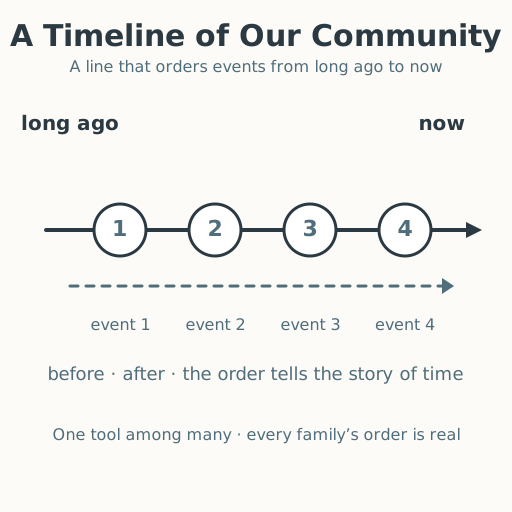
Lesson 1 — A Timeline of Our Community
Summary
Learners build a simple timeline — a line that orders events from the past toward today — and place three or four events from their family’s or community’s recent past in order. They explain the order using before and after. This is the first real historian’s skill at this grade: telling what came first and what came next.
Objectives
- Order a few events from their family’s or community’s recent past on a simple timeline and explain the order. (D08.S1.02.01)
Connection
You already know that a day has an order: you wake, you eat, you play, you rest. A timeline does the same thing for bigger stretches of time — it lines up events that happened before today, one after another, so we can see which came first. Your family and your community have their own order of recent events: a baby was born, then a new building opened, then a festival happened. Putting them in order is how people begin to tell the story of time.
Materials
- A long strip of paper or a drawn line (one per learner)
- A set of “community events” cards for the worked example
Preparation
- Draw or gather simple cards for recent community events (a new building, a festival, a baby being born, a storm, a harvest).
- Give each learner a timeline strip with a “long ago” end and a “now” end.
- Decide whether the line reads left-to-right or top-to-bottom, and keep it the same for everyone.
Facilitator note
This lesson is written to the learner (“you”) so it works in a classroom and for a self-directed learner. Ordering is a foundational skill, so teach it with a worked example first (Kirschner, Sweller & Clark, 2006): model placing three community events on the line, saying “this came first… then… then…,” before learners do their own. Keep events recent, local, and gentle — a baby being born, a festival, a new road or school — never frightening or private material. Honor every body and every family shape: a learner who is blind or has low vision sequences real objects by touch and says or signs the order; a learner who does not use a speaking voice points or acts the order. Some families have moved, or have members far away — every family’s order of recent events is real and worthy, and none is “correct.” Remember that different peoples mark time in different ways (many calendars, many ways of naming years) — a timeline is one tool among many, not the only truth about time.
Procedure
- Gather and remember (5 min). Think back: what is one thing that happened in your family or your town not long ago — a celebration, a new baby, a change? Did it happen before or after something else you remember?
- Meet the timeline (10 min). Look at the worked example. A line with a “long ago” end and a “now” end. Three cards: a new building opening, a festival, a baby being born. Place them in order, saying the words aloud together: “The baby was born before the festival. The new building opened after the baby was born.”
- Guided practice (10 min). Mix the cards. Together, put them back in order on the line. For each card, say “this came before…” or “this came after…” so the order has a reason.
- Build your own timeline (15 min). Choose three or four real events from your family’s or community’s recent past. Draw or show each one on its spot along your line, from “long ago” (the furthest back) to “now” (the most recent).
- Explain your order (5 min). Point to each event and tell why it is there: “This came first because… this came after that because…” You may point, act, draw, or sign.
- Close (5 min). You just did what historians do: you ordered events and explained the order. A timeline is a story of time told in order.
Differentiation
- Support: Use only three events, and place them together with clear gestures toward “before” and “after.”
- Support (blind/low-vision): Sequence real objects (a shell, a stone, a leaf) by touch and say or sign the order aloud; a partner reads the labels.
- Support (non-speaking): Order picture cards or objects, and point to “before” and “after” spots instead of speaking.
- Support (Deaf/HH): The cards are already pictures — read the order with your eyes and hands, and sign “before” and “after” as you place each card.
- Support (motor-difference): Use a large, stable line and bigger cards; point or eye-gaze to each spot while a partner moves the card, or name the order while someone else places it.
- Extension: Add a fifth event, and tell two “before/after” pairs (“the storm came before the harvest; the festival came after”).
Assessment
- Formative (observation): Can the learner place three or four recent events on the timeline in a sensible order, from furthest back to most recent?
- Formative (oral/performance): Does the learner explain the order using at least one “before” and one “after” — by speaking, signing, pointing, or acting?
Home connection
At home, ask someone to tell you two or three things that happened in your family recently, and put them in order together. Then tell them the order using “before” and “after.”