Lesson 01 — Tools Are Made to Solve Problems
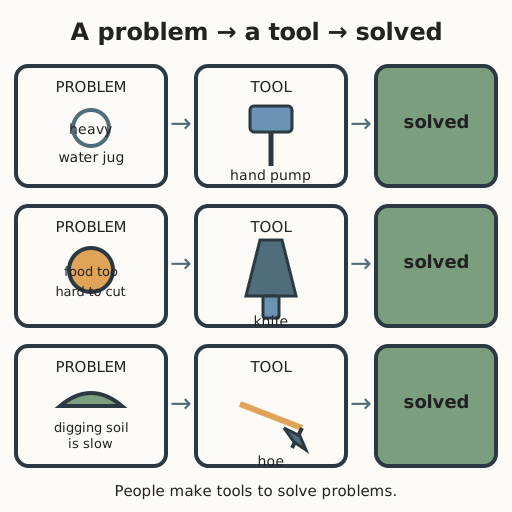
Learners discover that tools and machines are things people make to solve a problem, and match a problem to the tool that solves it — a heavy water jug to a pump, food to cut to a knife, soil to dig to a hoe. They learn that a machine is a tool with moving parts, that people everywhere make tools, and that a tool is not magic — it is a problem made easier.
Objectives
Objectives
- D10.S1.02.01 Explain that tools and machines are made by people to solve a problem, and give an example.
Essential question
Why do people make tools and machines, and what problem does one tool solve?
Key vocabulary
Materials
Standard materials
- Problem-and-tool picture cards · 1 set Pairs showing a problem and the tool that solves it (a heavy water jug and a pump; food to cut and a knife; soil to dig and a hoe; cloth to join and a needle)
- Paper and crayons · per learner For drawing a problem and a tool that solves it
Low-tech / no-cost
- Real objects and a spoken problem Hold a real tool (a spoon, a cup, a digging stick) and say the problem it solves; no printed cards needed
- Voice and body Act out a problem (carrying, cutting, digging) and the tool that solves it, and let a partner guess the tool
Enriched / lab & device
- A simple machine to see or touch (a hand pump, a whisk, a toy pulley) · 1 per group A machine with moving parts, handled safely with help, to see that machines are tools with moving parts
- A photo set of tools and machines used around the world · 1 set A mortar and pestle, a water pump, a sewing needle, a bicycle — one problem each solves
Works in different contexts
- large-group Hold each problem card up big; the whole group names the problem and then calls out a tool that solves it before a few learners match the pairs
- self-directed A learner matches problem cards to tool cards alone, then draws one problem and the tool that solves it with a sentence
- outdoor-only Find a real problem outside (carrying water, digging soil, cutting a stalk) and name or make the tool that solves it
- multi-age Older learners read the problem cards aloud and coach younger ones in naming a tool that solves each problem
- level-grouped Learners who finish early tell how a machine's moving parts help solve the problem; others match one problem to one tool
Lesson 1 — Tools Are Made to Solve Problems
Summary
Learners discover that a tool is a thing people make to solve a problem, and that a machine is a tool with moving parts. They match a problem to the tool that solves it — a heavy water jug to a pump, food to cut to a knife, soil to dig to a hoe — and draw one problem and the tool that solves it. Along the way they learn that people everywhere make tools, that no people’s tools matter more than another’s, and that a tool is not magic: it is a problem made easier.
Objectives
- Explain that tools and machines are made by people to solve a problem, and give an example. (D10.S1.02.01)
Connection
Think of a problem you met today. A jar lid was too tight to open. A bag was too heavy to carry. A piece of food was too hard to cut with your fingers. People made tools to solve problems exactly like these: a gripper to open the jar, a basket or a cart to carry the bag, a knife to cut the food. Every tool you see was made by a person who wanted to make a problem easier.
Materials
- Problem-and-tool picture cards (a problem and the tool that solves it, in pairs)
- Paper and crayons
Preparation
- Prepare or draw problem-and-tool pairs: a heavy water jug → a pump; food to cut → a knife; soil to dig → a hoe; cloth to join → a needle.
- Set out one real, safe tool to hold and name (a spoon, a cup, a digging stick).
- Clear space to act out a problem and its tool.
Facilitator note
This lesson is written to the learner (“you”). Keep the message gentle and true: tools are wonderful, but they are not magic and they are not better just because they are new. The heart of the idea is made by people, to solve a problem — a rock is not a tool until a person picks it up to grind or dig; a spoon is a tool because a person made it. Honor every tool equally: a mortar and pestle solves the same kind of problem as a blender, and a water jug is just as real a tool as a pump. Never rank one people’s tools above another’s, and never present any one tool as “the real modern one.” A machine is simply a tool with moving parts (a whisk, a pump, a bicycle); introduce it only as an extension of the same idea. Honor every body: naming and matching can be done by voice, sign, touch, gesture, or a partner’s hands, and each way counts equally. Supervise any handling of tools. For a learner who is blind or has low vision, let them hold and feel each tool and name the problem it solves by its shape and weight; a learner who does not use a speaking voice can point, gesture, or place the card to show the answer.
Procedure
- Gather (5 min). Look around you. A tool is a thing people make to help them solve a problem. Name one tool you can see right now and the problem it helps with.
- Meet problems and tools (10 min). Look at the problem cards one by one. For each, name the problem: “This person has a heavy water jug to carry.” Then find the tool that solves it: “A pump helps lift the water so it is easier to carry.”
- Meet a machine (5 min). Some tools have moving parts — they are called machines. A whisk, a pump, and a bicycle are machines. They still solve a problem; they just move while they do it.
- Match problem to tool (10 min). With the cards, match each problem to the tool that solves it. Say it in a full sentence: “The knife solves the problem of food that is hard to cut.”
- Draw a problem and its tool (10 min). Draw one problem and the tool a person made to solve it. Write or say one sentence: “People made the ___ to solve ___.”
- Close (5 min). People everywhere make tools to solve problems. A tool is not magic and not better just because it is new — it is a problem made easier by a person’s hands.
Differentiation
- Support: Name one problem and one tool together aloud, using the frame “People made the ___ to solve ___,” while holding the real tool.
- Blind/low vision: Hold and feel each tool, naming the problem it solves by shape, weight, and texture, with a partner describing each card.
- Deaf/hard of hearing: Share each problem and tool with sign, pictures, and acting; the learner signs or points to the tool and to the problem it solves.
- Non-speaking: Point to or gesture toward the tool and the problem it solves, while a partner says the full sentence aloud.
- Motor differences: Choose the tool and direct a partner’s hands to match and draw while the learner says or points to the problem; use big, light cards placed within reach.
- Extension: Name a machine with moving parts (a pump, a whisk, a bicycle) and tell the problem it solves.
Assessment
- Formative (observation): Can the learner explain that a tool is made by people to solve a problem, and give one example of a problem and its tool?
- Artifact (portfolio): The “problem and its tool” drawing with a sentence.
Home connection
At home, find one problem in a room — a lid to open, a floor to sweep, water to carry — and name the tool your family uses to solve it. Ask a grown-up which tool they are most glad someone invented, and why.
Resources
- Britannica Kids, “Tool” — a tool is anything used to make a change to something else or to help do a job, supporting the lesson’s core idea that people make tools to solve a problem. https://kids.britannica.com/kids/article/tool/400194