Lesson 05 — A Habitat Is a Home for Living Things
Learners describe a habitat — a living thing's home — and name one plant and one animal that live there and why each suits it: a reed and a frog in a pond, a cactus and a lizard in a desert, a tree and a squirrel in a forest. They learn that homes differ all over the world, and each one fits the living things that live in it.
Objectives
Objectives
- D10.S3.02.01 Describe a habitat and name one plant and one animal that live there and why it suits them.
Essential question
What is a habitat, and why does one plant and one animal suit the home they live in?
Key vocabulary
Materials
Standard materials
- Habitat picture cards · 1 set A pond, a desert, a forest, a seashore, a savanna — each with its plant and animal
- Plant and animal cards to match · 1 set A reed and a frog for the pond; a cactus and a lizard for the desert; a tree and a squirrel for the forest
- Paper and crayons · per learner For drawing one habitat with its plant and animal, and why each suits it
Low-tech / no-cost
- A real place to observe outside A patch of grass, a tree, a puddle — find one plant and one animal and say why each suits it
- Voice and body Act out a living thing in its home (a frog by the water, a cactus in the dry sun) and say why it suits the place
Enriched / lab & device
- A "home for a creature" drawing frame · per learner A frame to draw one habitat, label its plant and animal, and write "it suits because..."
- A short video or photo set of habitats from many biomes · 1 Optional — ponds, deserts, forests, seashores, and savannas around the world
Works in different contexts
- large-group Show each habitat big; the whole group names its plant and animal, and one learner says why one of them suits the home
- self-directed A learner chooses a habitat, matches its plant and animal, and draws and labels one complete home with a "why it suits" sentence
- outdoor-only Observe a real habitat closely — name one plant and one animal there, and say why each suits that place
- multi-age Older learners read habitat names and write the "why it suits" sentence; younger learners place the plant and animal cards
- level-grouped Learners who finish early compare two habitats (desert and pond) and why their living things differ; others describe one habitat
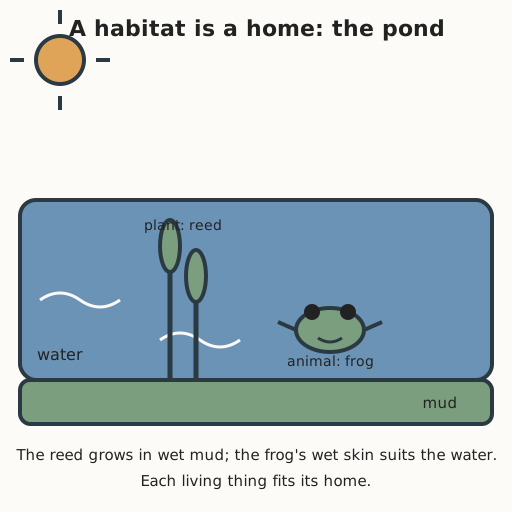
Lesson 5 — A Habitat Is a Home for Living Things
Summary
A habitat is a living thing’s home — the place where it finds food, water, and shelter. Learners describe a habitat (a pond, a desert, a forest, a seashore, or a real patch of ground outside) and name one plant and one animal that live there and why each suits it: a reed grows in wet mud and a frog’s wet skin suits the water; a cactus stores water and suits the dry desert. Homes differ all over the world, and each one fits the living things that live in it.
Objectives
- Describe a habitat and name one plant and one animal that live there and why it suits them. (D10.S3.02.01)
Connection
Think of your own home — the place where you sleep, eat, and are safe. Every living thing has a home too. A frog’s home is the wet pond; a cactus’s home is the dry desert; a squirrel’s home is the forest. That home is a habitat — and each living thing suits its home: the frog’s wet skin suits the water, and the cactus stores water so it suits the dryness.
Materials
- Habitat picture cards (pond, desert, forest, seashore, savanna)
- Plant and animal cards to match (a reed and a frog; a cactus and a lizard; a tree and a squirrel)
- Paper and crayons
Preparation
- Choose one habitat everyone can observe or look at closely (a real place outside, or a clear picture).
- Set out the plant-and-animal cards to match to each habitat.
- Prepare to ask the guiding question: “Who lives here, and why does this home suit them?”
Facilitator note
This lesson is written to the learner (“you”). Learners met a habitat earlier this year in another unit; this lesson deepens the idea by asking why each living thing suits its home — the first gentle step toward how living things fit their places. Keep it concrete before abstract: begin with the learner’s own home, then widen to the homes of other living things. Model one habitat aloud — “this pond has water and mud; the reed grows in the wet mud, and the frog’s wet skin suits the water” — then let learners try. Use habitats from many biomes (pond, desert, forest, seashore, savanna) so no single landscape or climate is the default, and learners in Lagos, Lima, or Lahore can find a home that looks like the one they know. A light ethical thread: a habitat is not ours to spoil — caring for a home means caring for its living things (this returns in Lessons 7–8). Honor every body: describe each card in words for a learner who is blind or has low vision; a non-speaking learner points to the plant and the animal and to a picture for “water” or “dry” to show why each suits.
Procedure
- Gather and remember (5 min). You have met habitats before — a living thing’s home. Today we ask a bigger question: why does each living thing suit its home?
- Meet a habitat (15 min). Look at one habitat together — a pond, a forest, or a real patch of ground outside. Say what you see: water? soil? plants? shade? Then name one plant and one animal that live there: “The reed lives here. The frog lives here.” Say why each suits it: “The reed grows in wet mud. The frog’s wet skin suits the water.”
- Match living things to homes (10 min). With the cards, match each plant and animal to its habitat. Tell a partner why it suits: “The cactus suits the desert because it stores water.”
- Draw one habitat (12 min). Draw one habitat with its plant and animal, and write or say one “it suits because…” sentence for each.
- Close (3 min). A habitat is a home, and every living thing suits its home. Different homes, all over the world — each one just right for the ones who live there.
Differentiation
- Support: Describe one habitat with one plant and one animal, using the frame “The ___ lives here, and it suits this home because ___.”
- Blind/low vision: Describe a habitat you can hear and touch (a pond you can listen to, moss you can feel) with a partner naming each part and why it suits.
- Deaf/hard of hearing / non-speaking: Point to the plant and animal in the picture and to a card for “water” or “dry” to show why each suits; sign the living things’ names.
- Motor differences: Point to the plant and animal and direct a partner’s hands to draw the habitat while the learner says or signals why each suits.
- Extension: Compare two habitats — a desert and a pond — and tell why their living things differ, and how each suits its own home.
Assessment
- Formative (observation): Can the learner describe a habitat and name one plant and one animal that live there, and say why one of them suits the home?
- Artifact (portfolio): The labeled “one habitat” drawing with a “why it suits” sentence.
Home connection
At home or outside, pick one small habitat — a tree, a puddle, a patch of grass — and watch it quietly. Tell a grown-up one plant and one animal you found, and why each suits that home.
Resources
- BBC Bitesize (KS1 Science), “What is a habitat?” — a place where living things find food, water, and shelter, and where they are suited to live, with examples from many places. https://www.bbc.co.uk/bitesize/topics/zx882hv