Lesson 04 — True Information or Selling?
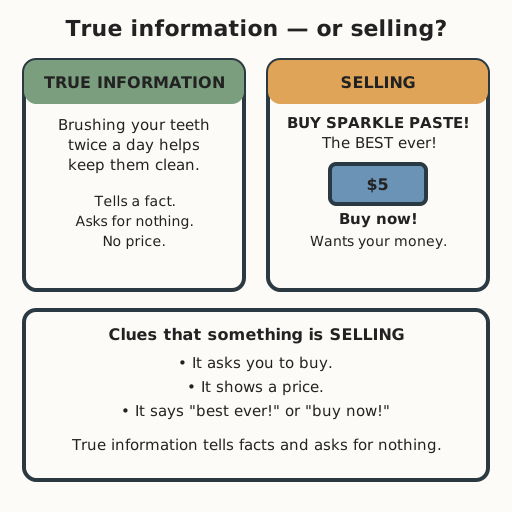
Learners tell whether a simple message is trying to give true information or to sell something, using clues: selling asks you to buy, shows a price, and says "best ever!" or "buy now!", while true information tells facts and asks for nothing. They learn that selling is not bad — but noticing it is powerful.
Objectives
Objectives
- D10.S2.02.02 Tell whether a simple message is trying to give you true information or to sell you something.
Essential question
Is this message giving me true information, or trying to sell me something?
Key vocabulary
Materials
Standard materials
- Message cards (true info and selling) · 1 set Pairs of messages — a true-information message (a fact, no price) and a selling message (asks you to buy, shows a price, says "best ever")
- Paper and crayons · per learner For drawing one true-information message and one selling message
Low-tech / no-cost
- Spoken messages and a listening ear Say one true-information sentence and one selling sentence aloud; signal which is which and give one clue; no printed cards needed
- Voice and body Act out a message that sells (point to a price, say "buy now!") and one that tells a fact (no price); let a partner guess which is which
Enriched / lab & device
- Real or pictured ads and information signs to compare · 2–3 A simple printed ad or label with a price, beside an information sign with a fact and no price
- A "clue" chart to make together · 1 A class chart of selling clues — buy, price, "best ever," "buy now"
Works in different contexts
- large-group Hold each message up big; the whole group calls out "true information!" or "selling!" and one learner names the clue
- self-directed A learner sorts message cards into true-information and selling piles and writes or says one clue for each choice
- outdoor-only Look for a message outside — a sign on a shop, a label on a packet — and say whether it is true information or selling and give one clue
- multi-age Older learners read the messages aloud and coach younger ones in naming one clue for "selling"
- level-grouped Learners who finish early explain why a grown-up buys things they need even when a message sells; others sort one message
Lesson 4 — True Information or Selling?
Summary
Learners tell whether a simple message is trying to give true information or to sell something. They use clues: a selling message asks you to buy, shows a price, and says “best ever!” or “buy now!”; a true-information message tells a fact and asks for nothing. They learn that selling is not bad — grown-ups buy things they need — but noticing when a message wants our money is a power everyone can have.
Objectives
- Tell whether a simple message is trying to give you true information or to sell you something. (D10.S2.02.02)
Connection
Think of a message you saw today — a sign in a shop, a label on a packet, a picture on a screen. Some messages tell you a true fact: “Brushing your teeth twice a day helps keep them clean.” Other messages want you to buy: “BUY Sparkle Paste — the BEST ever! Only five coins!” One gives information; the other is selling. We can tell them apart by their clues.
Materials
- Message cards (pairs of a true-information message and a selling message)
- Paper and crayons
Preparation
- Prepare or write message pairs: a true-information message (a fact, no price) and a selling message (asks to buy, shows a price, says “best ever”).
- Prepare the clue list: asks you to buy · shows a price · “best ever!” · “buy now!”
- Set out paper and crayons.
Facilitator note
This lesson is written to the learner (“you”). Keep it fair and warm: selling is not bad, and noticing it is not suspicion. People buy food, soap, and shoes, and sellers help them find these things. The skill is simply to notice when a message wants our money rather than only telling us a fact. That skill matters everywhere, and it protects families with little to spend just as much as anyone else — knowing the clue is a kind of fairness. Hold the curriculum’s stance: media is met with judgment, not fear. Use simple, everyday examples with no wealth assumption — a market stall, a street sign, a label on rice or soap — so every learner recognizes a selling message from their own life. Distinguish evidence from values: “this message shows a price” is a fact; “selling is bad” is a value judgment we do not make. Honor every body: read each message aloud for a learner who is blind or has low vision, and let them name the clue by voice; a non-speaking learner points to “buy,” “price,” or “fact” on a clue chart. A learner who is Deaf or hard of hearing can read the printed messages and sign “buy” or “fact” to answer.
Procedure
- Gather (5 min). Some messages tell you a fact; some want you to buy. How can you tell them apart?
- Meet the clues (10 min). A message that is selling asks you to buy, shows a price, and may say “best ever!” or “buy now!” A message of true information tells a fact and asks for nothing.
- Sort the messages (10 min). For each message card, say which it is and give one clue: “This is selling because it shows a price.” Or: “This is true information because it tells a fact and asks for nothing.”
- Make one of each (12 min). Write or draw one true-information message (a fact you know is true) and one selling message (about something you would like to sell), with a price and a “buy” word. Label each: true information or selling.
- Close (3 min). Selling is not bad — but noticing it is a power. A careful reader sees the price and the “buy now!” and says: “This is selling. Do I need this, or am I just being asked to buy?”
Differentiation
- Support: Sort one pair and name one clue together aloud, using the clue chart.
- Blind/low vision: Hear each message read aloud and name the clue by voice (price, buy, or fact).
- Deaf/hard of hearing / non-speaking: Read the printed messages and point to “buy,” “price,” or “fact” on a clue chart to answer.
- Motor differences: Direct a partner’s hands to write and draw while the learner says or points to which message is true information and which is selling.
- Extension: Tell why a family might buy something even when the message is selling (they truly need it), and name one clue that helped you see it was selling.
Assessment
- Formative (observation): Can the learner tell whether a simple message is giving true information or selling, and give one clue?
- Artifact (portfolio): The “true information” and “selling” message pair, labeled.
Home connection
At home, find one message on a packet, a sign, or a screen. Tell a grown-up whether it is true information or selling, and give one clue. Ask the grown-up how they decide when something is worth buying.
Resources
- Common Sense Media (Common Sense Education), “News & Media Literacy” — recognizing the difference between information and persuasion, including the clues that a message is trying to sell. https://www.commonsense.org/education/digital-citizenship/topic/news-and-media-literacy