Lesson 07 — Water and Energy — Use and Save
Learners name one way people use water or energy — for a drink, for washing, for light, for cooking — and one way to save some of it: turning off the tap, turning off the light, using just enough. They actually do one saving action and say why it helps, learning that saving is care and agency, not guilt, and that in water-scarce places every drop saved truly matters.
Objectives
Objectives
- D10.S4.02.01 Name one way people use water or energy and one way to save some of it.
Essential question
How do people use water and energy, and what is one way to save some?
Key vocabulary
Materials
Standard materials
- Use-and-save picture cards · 1 set Using water (a drink, washing) and saving water (turning off the tap); using energy (a light, cooking) and saving energy (turning off the light, walking)
- Paper and crayons · per learner For a "use and save" promise card
Low-tech / no-cost
- Hands, a tap, and a light Turn off a running tap and a light that is not needed; say the use and the saving; no printed cards needed
- Voice and body Act out using water or energy (drinking, lighting a room) and saving it (turning it off, walking instead of riding), and say which helps and why
Enriched / lab & device
- A "use and save" challenge card set · 1 set One card per idea — turn off the tap, turn off the light, walk instead of ride, take just enough water — to pick and try
- A class "use and save" chart · 1 To record every learner's chosen use, its saving, and the reason it helps
Works in different contexts
- large-group Choose one shared saving action to do together (turn off a tap or a light) and say together why it helps; each learner then draws their own promise
- self-directed A learner names one way they use water or energy and one way to save some, then does the saving and says why it helps
- outdoor-only Carry water in a jug using just enough, or use the sun's light instead of a lamp; name the use, the saving, and why it helps
- multi-age Older learners demonstrate the saving actions and coach younger ones in saying the "why" for each
- level-grouped Learners who finish early explain why saving water matters most where water is scarce; others name one use and one saving
Lesson 7 — Water and Energy — Use and Save
Summary
Learners name one way people use water or energy — for a drink, for washing, for light, for cooking — and one way to save some of it: turning off the tap, turning off the light, using just enough. They actually do one saving action and say why it helps, learning that saving is care and agency, not guilt, and that in places where water is scarce, every drop saved truly matters.
Objectives
- Name one way people use water or energy and one way to save some of it. (D10.S4.02.01)
Connection
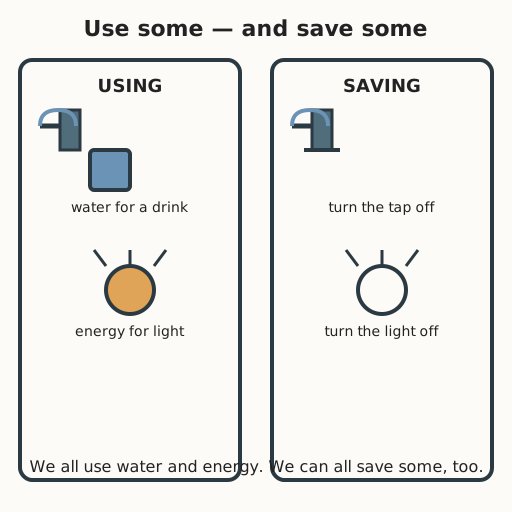
Think of a tap running while no one uses it, or a light left on in an empty room. That is using more than we need. Now think of turning the tap off, or the light off. That is saving. We all use water and energy every day — to drink, to wash, to see, to cook — and we can all save some, too. In places where water is hard to come by, every drop saved truly matters.
Materials
- Use-and-save picture cards (using water or energy, and saving it)
- Paper and crayons for a “use and save” promise card
Preparation
- Choose one or two safe, simple saving actions learners can really do: turn off a tap, turn off a light, or take just a little water.
- Set out the use-and-save picture cards.
- Prepare to ask: “How do we use it? How can we save some?”
Facilitator note
This lesson is written to the learner (“you”). Make the action real, not symbolic — learners should actually turn off a tap or a light, or pour just enough water. Keep the tone hopeful, never shaming: saving is care and agency, not guilt, and no act is too small. This is especially true where water is scarce — in such places, “wasting less water” may be the single most important act, and it is just as real as any other; adapt the examples to the learners’ own lives (a precious jug of water used carefully, a lamp used only when needed, a walk instead of a ride). Never frame any family as wasteful; honor the care people already show. State plainly that many people around the world still lack safely managed drinking water (see Resources), and that saving water is an act of fairness to them. Distinguish evidence from values: “turning off the tap saves water” is a fact; “we should save water” is a value we hold because we care for all life — say it that way. Honor every body: for a learner with motor differences, the choosing and the saying are the act — they may direct a partner’s hands to turn off the tap while saying why it helps; adapt the tool (a long-handled tap, a light switch within reach). A learner who is blind or has low vision can feel the tap turned, hear the water stop, and touch the light switch; a non-speaking learner points to the action and to a picture for “saves.”
Procedure
- Gather (5 min). What are two things every home uses every day? (Water and energy.) Name one way your home uses water, and one way it uses energy.
- Meet uses and savings (10 min). Look at the cards. We use water for a drink and for washing; we use energy for light and for cooking. For each, name a way to save some: “We turn the tap off when we are done.” “We turn the light off when we leave the room.” “We use just enough.”
- Choose and do one saving (15 min). Pick one saving action you can really do right now, and do it. If your body makes the doing hard, choose the action and guide a partner’s hands while you say why it helps. Feel what it is like to use just enough.
- Make a “use and save” promise (10 min). Draw a promise card: one way you use water or energy, and one way you will save some of it, and why it helps.
- Close (5 min). One person saving helps a little; many people saving helps a lot. Saving is a way of caring — for water, for energy, for everyone and everything that shares our Earth home.
Differentiation
- Support: Do one saving action together hand-over-hand and say the “why” together aloud.
- Motor differences: Choose the action, direct a partner’s hands, and say why it helps; the choosing and the saying are the act of care. Adapt the tool too (a long-handled tap, a light switch within reach).
- Blind/low vision: Feel the tap turn and hear the water stop, or touch the light switch; a partner names the action and its reason.
- Deaf/hard of hearing / non-speaking: Show each use and saving with sign, pictures, and acting; the learner signs or points to the action and to a picture for “saves.”
- Extension: Name a second way to save water or energy at home or in the neighborhood, and tell who or what it helps.
Assessment
- Formative (observation): Did the learner name one way people use water or energy and one way to save some of it, and do the saving with a reason?
- Artifact (portfolio): The “use and save” promise card.
Home connection
Take your promise card home. Do the saving action with a grown-up — turn off a tap, turn off a light, or take just enough water — and tell them why it helps our shared Earth home.
Resources
- WHO/UNICEF Joint Monitoring Programme (JMP) for Water Supply, Sanitation and Hygiene — worldwide, about 1 in 4 people still lack safely managed drinking water, supporting the claim that saving water is an act of fairness. https://washdata.org/