Lesson 08 — Where Does Litter Go?
Learners follow what happens to a piece of litter. Dropped on the ground, rain can wash it into a river and out to the sea, where animals may mistake it for food. Put in the right place — a bin — it can be reused, recycled, or composted. They learn that putting litter in the right place keeps water, soil, and animals safe, and that this small act of care is one anyone can do.
Objectives
Objectives
- D10.S4.02.02 Follow what happens to a piece of litter and explain why putting it in the right place matters.
Essential question
What happens to a piece of litter, and why does putting it in the right place matter?
Key vocabulary
Materials
Standard materials
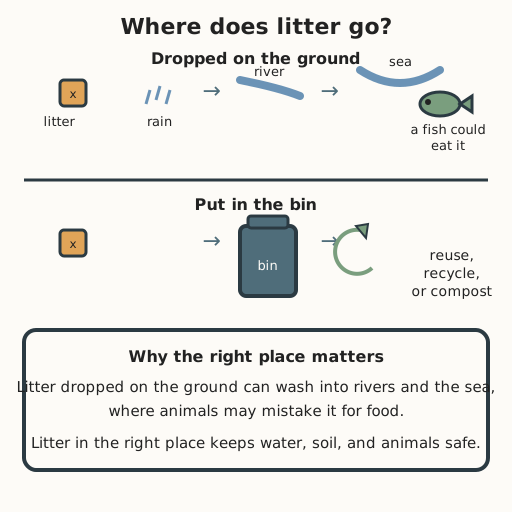
- Litter-path picture cards · 1 set Two paths — litter dropped on the ground washing into a river and the sea, versus litter put in a bin and reused, recycled, or composted
- A small piece of clean litter and a bin · 1 each A clean paper scrap learners can actually carry to the right place
- Paper and crayons · per learner For drawing the two paths of a piece of litter
Low-tech / no-cost
- A real piece of litter and a real bin or basket Carry a piece of litter to the bin and say why the right place matters; no printed cards needed
- Voice and body Act out a piece of litter being dropped, washed by rain, and reaching the sea, then act it being carried to the bin; say which keeps living things safe
Enriched / lab & device
- A "two paths" story strip per pair · 1 per pair A fold-out strip showing the dropped path and the bin path, to order and retell
- A short video or photo set of litter reaching the sea · 1 Optional and gentle — one clip or photo showing how litter can wash into rivers and the sea
Works in different contexts
- large-group Lay the two paths out big and the whole group moves a paper "litter" along each path, saying what happens at each step
- self-directed A learner orders the litter-path cards alone and writes or says why the right place matters
- outdoor-only Find a piece of litter outside and carry it to the right place; then trace the path it would have taken if it had stayed on the ground
- multi-age Older learners read the path cards and coach younger ones in retelling both paths and why the right place matters
- level-grouped Learners who finish early explain how rain carries litter to the sea; others trace one path
Lesson 8 — Where Does Litter Go?
Summary
Learners follow what happens to a piece of litter. Dropped on the ground, rain can wash it into a river and out to the sea, where animals may mistake it for food. Put in the right place — a bin — it can be reused, recycled, or composted. Learners learn that putting litter in the right place keeps water, soil, and animals safe, and that this small act of care is one anyone can do.
Objectives
- Follow what happens to a piece of litter and explain why putting it in the right place matters. (D10.S4.02.02)
Connection
Think of a sweet wrapper or a paper scrap dropped on the ground. It does not stay there. Rain can wash it into a gutter, then a river, then the sea, where a fish might mistake it for food. The same piece, put in a bin, can be carried away and reused, recycled, or composted. The right place for litter keeps water, soil, and animals safe — and putting it there is something anyone can do.
Materials
- Litter-path picture cards (the dropped path and the bin path)
- A small piece of clean litter and a bin
- Paper and crayons
Preparation
- Prepare the two-path picture cards: (1) dropped on the ground → rain → river → sea → an animal that could eat it; (2) put in the bin → reused, recycled, or composted.
- Have a small piece of clean litter and a bin ready for the real action.
- Prepare to ask: “Where does it go from here, and what happens along the way?”
Facilitator note
This lesson is written to the learner (“you”). Keep it hopeful and full of agency, never fearful or shaming: litter is a problem every child can help with, and the message is “I can put it in the right place,” not “the Earth is ruined.” Follow the litter faithfully: rain washes litter into gutters, rivers, and the sea; some kinds (especially plastic) last a very long time and can be eaten by animals that mistake it for food (see Resources). But the right place — a bin — lets it be reused, recycled, or composted, and keeps living things safe. Distinguish evidence from values: “rain can wash litter into the sea” is a fact; “we should put litter in the right place” is a value we hold because we care for living things — say it that way. No wealth assumption: a bin, a basket, or a cloth bag all count as the right place, and in some places people reuse or compost nearly everything already. Honor every body: for a learner with motor differences, the choosing and the pointing to the right place are the act, and they may direct a partner’s hands to carry the litter; a learner who is blind or has low vision can feel the litter and the bin and follow the path by listening to the story; a non-speaking learner points to each step of the path in order.
Procedure
- Gather (5 min). What happens to a piece of litter after it is dropped? Pause and wonder. Does it stay put, or does it travel?
- Follow the dropped path (10 min). Trace the first path: litter dropped on the ground → rain washes it along → into a river → out to the sea → an animal may mistake it for food. Say each step as you move the paper litter along.
- Follow the bin path (10 min). Now trace the second path: litter in the bin → carried away → reused, recycled, or composted. Say each step.
- Say why it matters (10 min). Finish the sentence: “Putting litter in the right place matters because ___.” (It keeps water, soil, and animals safe.) Then actually carry a piece of litter to the right place.
- Draw the two paths (10 min). Draw the dropped path and the bin path for one piece of litter, with arrows, and label why the right place matters.
- Close (3 min). A piece of litter can travel far and harm living things — or, in the right place, it can be turned into something useful again. Putting litter in the right place is a small act of care that anyone can do.
Differentiation
- Support: Trace one path step by step together and say one reason the right place matters.
- Blind/low vision: Feel the litter and the bin, and follow the path by listening to the story told step by step; retell it by voice.
- Deaf/hard of hearing / non-speaking: Move the paper litter along each path and point to each step in order; a partner says the steps aloud.
- Motor differences: Direct a partner’s hands to move the litter and draw the paths while the learner says or points to each step.
- Extension: Name one thing at home that your family reuses or composts, and tell how that keeps litter out of the wrong place.
Assessment
- Formative (observation): Can the learner follow what happens to a piece of litter on both paths and explain why putting it in the right place matters?
- Artifact (portfolio): The “two paths” drawing with arrows and a “why it matters” label.
Home connection
At home, watch where a piece of litter goes. With a grown-up, carry one piece to the right place — a bin, a basket, or a compost pile — and tell them why the right place keeps water, soil, and animals safe.
Resources
- National Geographic Kids, “Plastic Pollution” — plastic litter can take hundreds of years to break down and can wash into rivers and the ocean, where animals may mistake it for food, supporting the dropped-path account. https://kids.nationalgeographic.com/science/article/plastic-pollution