Lesson 01 — Feelings That Look Alike
Learners return to the year's trickiest naming task — telling two feelings that look alike apart. They compare mad and frustrated, and sad and disappointed, and learn to use the body's clues (tight vs. stuck, heavy vs. let down) to name each one precisely.
Objectives
Objectives
- D01.S1.02.01 Use feeling words to tell the difference between similar emotions, such as mad and frustrated or sad and disappointed.
Essential question
How can I tell two feelings that look alike apart — such as mad and frustrated, or sad and disappointed?
Key vocabulary
Materials
Standard materials
- Feeling cards for the four "cousin" feelings (mad, frustrated, sad, disappointed) · 1 set Two similar pairs, carried forward from the year's opening unit
- Chart paper and markers · 1 set For a "telling them apart" chart with body clues
Low-tech / no-cost
- Faces and bodies Learners act out each feeling so others can spot the body clue; no cards needed
- Voice and stories Tell a moment for each feeling and let learners name it from the story alone
Enriched / lab & device
- The class "feelings wall" from Unit 1 Revisit the year's word bank and sort the cousin feelings side by side
- Camera or tablet · 1 per group Photograph two looks of the same "kind" of feeling to compare
Works in different contexts
- large-group Hold each card high and read the body clue aloud; the whole group acts out the feeling before naming its cousin
- self-directed A learner studies each pair alone, acts out both in a mirror, and names a time they felt each
- outdoor-only Find two natural "looks" of the same kind — a tall stiff tree (mad) and a bent sapling (frustrated) — and name the difference
- multi-age Older learners act out a pair for younger ones to guess, then coach the younger learner to tell the two apart by body clue
- level-grouped Learners ready to extend sort a fuller set of cousin feelings (mad/frustrated, sad/disappointed, scared/nervous) by clue
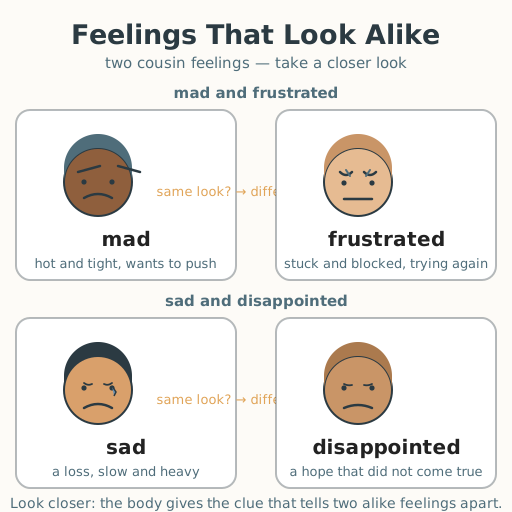
Lesson 1 — Feelings That Look Alike
Summary
Learners return to the year’s hardest naming task: feelings that look alike. They compare two “cousin” pairs — mad and frustrated, sad and disappointed — and learn to tell each one apart by its body clue and by the situation that made it. This closes the year’s feeling work by celebrating how precise their feeling language has become.
Objectives
- Use feeling words to tell the difference between similar emotions, such as mad and frustrated or sad and disappointed. (D01.S1.02.01)
Connection
Some feelings look almost the same, like cousins in a family — but they are not the same. When a tower you built falls down, you might feel mad (hot and tight, wanting to push) or frustrated (stuck, blocked, wanting to try again). When a friend cannot come to play, you might feel sad (a loss, heavy and slow) or disappointed (you had hoped and it did not happen). All year you have been growing the words and body clues to tell these cousins apart. Today you put that power to use.
Materials
- Feeling cards for the four cousin feelings (mad, frustrated, sad, disappointed)
- Chart paper and markers
- The class “feelings wall” (optional)
Preparation
- Gather or draw the four cousin-feeling cards, carried forward from the year’s opening unit.
- Set out chart paper to record body clues for each pair.
- Arrange a circle for acting out and guessing.
Facilitator note
This lesson is written to the learner (“you”) so it works in a classroom and for a self-directed learner. It is a spiral-back: the year opened by learning to tell mad from frustrated and sad from disappointed, and now we gather that skill with confidence. The deepest commitment here is that a feeling is never wrong — only a guess about someone else’s feeling can miss, and these two feelings look alike on purpose, so a careful guess is a kind guess. Honor whatever a learner names, even if it is a different word; wonder together about which clue led them there. Feeling words live differently in every language and culture: invite a learner to share a home-word for one of these feelings, and notice how some languages keep two feelings apart that others fold together. For a learner who is blind or has low vision, describe the body-sense of each pair aloud (mad = hot and tight; frustrated = stuck and blocked; sad = heavy and slow; disappointed = a let-down in the chest) so the difference can be felt. A learner who does not use a speaking voice shows the feeling with face and body and a partner names it; a learner who is Deaf or hard of hearing reads and shows the difference through face, body, and sign.
Procedure
- Gather (5 min). Remember the start of the year. You met two pairs of feelings that look alike: mad and frustrated, sad and disappointed. Say each pair aloud and make each face. They look a little the same — like cousins.
- Find the body clue (15 min). For each feeling, find where it lives in the body and what the situation was. Mad is hot and tight — it wants to push. Frustrated is stuck and blocked — it wants to try again. Sad is heavy and slow — something was lost. Disappointed is a let-down in the chest — you had hoped, and it did not happen. Write each clue on the chart.
- Guess the cousin (10 min). A partner acts out one feeling without words, and you guess which cousin it is — mad or frustrated, sad or disappointed — then swap. If you are not sure, ask: “Is it mad (wanting to push) or frustrated (wanting to try again)?”
- Name a real moment (10 min). Think of a time you felt one of these feelings this year. Say the situation with the frame “I felt ___ when ___,” and tell how you knew which cousin it was.
- Close (5 min). Your feeling words got sharper all year. Now you can name a feeling so precisely that a friend feels truly understood. That is something to be proud of.
Differentiation
- Support: Show just one pair at a time; use faces and bodies, not written words.
- Support (non-speaking): Point to a card or make the face; a partner names the cousin and the clue.
- Support (Deaf/hard-of-hearing): Show and read the difference through faces, bodies, and signs; pair each word with a visual cue.
- Support (blind/low-vision): Describe the body-sense of each feeling aloud and let a partner name it, or name it and let the partner show it.
- Extension: Sort a fuller set of cousin feelings (scared and nervous, happy and excited) by their body clues.
Assessment
- Formative (observation): Can the learner name mad, frustrated, sad, or disappointed, give its body clue, and tell it apart from its cousin?
Home connection
Teach someone at home the difference between two cousin feelings — mad and frustrated, or sad and disappointed — and tell them how you tell them apart.
Resources
- CASEL SEL Framework (foundational competencies): https://casel.org/fundamentals-of-sel/