Lesson 01 — Feelings Change Over Time
Learners discover that a feeling does not stay still — it can grow, shrink, or turn into a different feeling over time. They trace one real feeling change on a "feeling path" and learn that noticing the change helps them remember that big feelings do not last forever.
Objectives
Objectives
- D01.S1.03.01 Describe how a feeling can change over time and name when they feel more than one feeling at once.
Essential question
How does a feeling change over time?
Key vocabulary
Materials
Standard materials
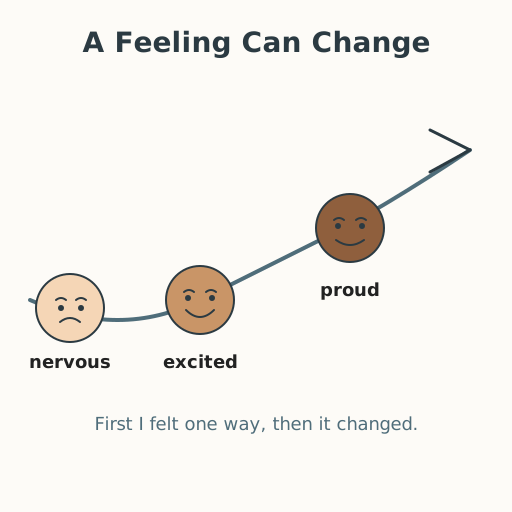
- Feeling path chart · 1 A winding line with three stops showing one feeling changing (nervous to excited to proud)
- Blank feeling path page · 1 per learner An empty winding line with three stops for the learner to fill with their own feeling change
- Crayons and pencils · per learner
Low-tech / no-cost
- A line drawn in the sand or on the ground Walk the feeling path with your body, stopping at each change
- Voice and body Tell the feeling change aloud and act out each stop; no page needed
Enriched / lab & device
- A laminated 'feeling path' strip with a sliding marker · 1 per learner A reusable path the learner can slide to show where a feeling is right now
- A small timer or bell · 1 To notice how a feeling shifts across a real short span of time
Works in different contexts
- large-group Draw one big feeling path together on the board, then learners fill their own pages in small groups
- multi-age Older learners tell a longer feeling-change story while younger learners point to the stop where the feeling changed
- self-directed A learner draws or writes their own feeling path for one real moment and reads it back to check the order
- level-grouped Learners ready to extend add a fourth stop and name what caused each change
- outdoor-only Walk a real path with three stops and act out the feeling at each stop; find a natural object that matches each feeling
Lesson 1 — Feelings Change Over Time
Summary
Learners discover that a feeling is not stuck in place. A feeling can grow bigger, shrink smaller, or change into a different feeling over time. They trace one real feeling change on a “feeling path” — a winding line with three stops — and learn that noticing the change helps them remember that even a very big feeling does not last forever.
Objectives
- Describe how a feeling can change over time. (D01.S1.03.01)
Connection
Think of the first day of school. In the morning your stomach was fluttery and your hands were cold — you felt nervous. By lunch you were laughing with a friend — the nervousness had shrunk, and you felt excited. By the time you walked home you felt proud of yourself for doing it. One day, three feelings, one after the other. In a fishing village, a child waits out a storm afraid, then feels relieved when the boat comes home, then glad at the meal together. Everywhere in the world, feelings move like weather — they arrive, they shift, and they pass.
Materials
- Feeling path chart
- Blank feeling path page
- Crayons and pencils
Preparation
- Print or draw the feeling path chart (three stops: nervous → excited → proud).
- Copy a blank feeling path page for each learner.
- Arrange a circle for gathering and a quiet space for drawing.
Facilitator note
This lesson is written to the learner (“you”). The heart of it is a simple, true idea:
feelings are temporary. Teach the worked example (nervous → excited → proud) aloud and
with your body first, then let each learner trace their own change. Some learners will
choose a change that is not “neat” (mad → madder → calmer, or a feeling that stayed a
long time); honor every shape a feeling takes. Never tell a learner a feeling “should”
have changed by now — the point is noticing, not rushing. If a learner names a very
heavy change (grief, fear), stay calm, name the feeling with them, and move gently to
the next step; see docs/facilitation.md on holding difficult topics.
Procedure
- Gather (5 min). Last year you learned to name look-alike feelings and to notice where a feeling lives in your body. Today you learn something new about feelings: they change over time. They are not stuck.
- Meet a worked example (10 min). Look at the feeling path. It starts at nervous — wavy eyebrows, fluttery stomach. Then the line climbs to excited — a big smile, a bouncy body. Then it lands on proud — a soft smile, a warm chest. One feeling changed into another, bit by bit. A feeling can also grow (a little worry becomes a big worry) or shrink (a big mad becomes a small mad) or fade (excitement settles into calm).
- Trace your own path (15 min). Think of one real moment from your life where a feeling changed. It might be before and after a game, a test, a visit, or a hard goodbye. Draw or write your three stops on your path: how you felt first, how it changed in the middle, how you felt last. Use the feeling words you know — nervous, excited, proud, mad, sad, calm, and more.
- Share one change (10 min). With a partner, tell your path: “First I felt ___, then it changed to ___, and last I felt ___.” Notice how every path is different — that is normal and good.
- Close (5 min). Feelings are like weather: they come, they shift, they pass. When a big feeling comes, you can remember: this will change. You are not your feeling; you are the one watching it move.
Differentiation
- Support: Offer a ready-made set of three feeling faces to place on the path instead of writing words; scribe the feeling names the learner says.
- Extension: Add a fourth stop and name what caused each change (“it changed because my friend showed up”).
Assessment
- Formative (observation): Can the learner describe one feeling that changed over time, naming at least two stops in order (first… then… last)?
Home connection
Ask someone at home about a time their feeling changed — nervous before something, then different after — and tell them one of yours.
Resources
- CASEL SEL Framework (self-awareness competency): https://casel.org/fundamentals-of-sel/