Lesson 02 — More Than One Feeling at Once
Learners discover that two feelings can live inside them at the same time — happy and sad, excited and nervous — and that both are true. Using overlapping circles and a "both/and" frame, they practice naming two feelings at once, which deepens their emotional vocabulary beyond one word at a time.
Objectives
Objectives
- D01.S1.03.01 Describe how a feeling can change over time and name when they feel more than one feeling at once.
Essential question
What does it mean to feel more than one feeling at once?
Key vocabulary
Materials
Standard materials
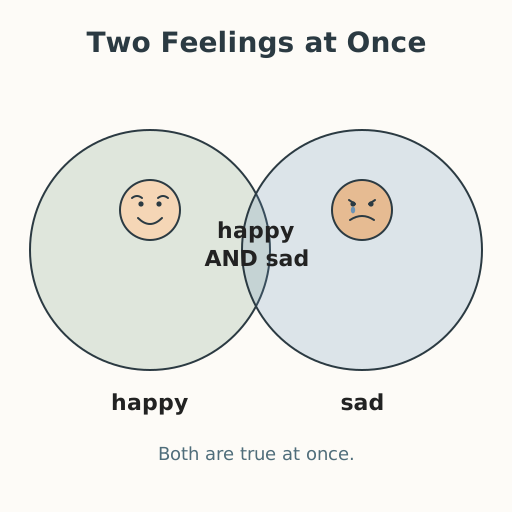
- Two-overlapping-circles chart · 1 A happy circle and a sad circle that overlap, with a shared middle labeled "happy AND sad"
- Both/and page · 1 per learner Two labeled circles for the learner to fill with two feelings and a shared moment in the middle
- Scenario cards · 1 set Everyday moments where two feelings are true at once
Low-tech / no-cost
- Two hands, one voice Hold up one hand for each feeling and bring them together to show "both at once"; no paper needed
- Two stones or leaves Place one object for each feeling side by side to show they can sit together
Enriched / lab & device
- A reusable 'both/and' board with moveable tokens · 1 per pair A board where learners slide one token per feeling into a shared middle
- A short storybook or video with a mixed-feeling moment · 1 To hear a character feeling two things at once, then name both
Works in different contexts
- large-group Act out the overlapping circles with two learners holding hoops and standing in the overlap for "both at once"
- multi-age Older learners write both feelings as a sentence ("I feel ___ AND ___") while younger learners hold up two fingers, one per feeling
- self-directed A learner fills the both/and page alone and says the two feelings out loud to check both are named
- level-grouped Learners ready to extend name three feelings at once and the moment that held all three
- outdoor-only Stand in two chalk circles that overlap and step into the overlap to feel "both at once"; name the two feelings aloud
Lesson 2 — More Than One Feeling at Once
Summary
Learners discover that two feelings can live inside them at the same time — happy and sad, excited and nervous. Both are true. Using two overlapping circles and a “both/and” frame, they practice naming two feelings at once, growing their feeling vocabulary past one word at a time.
Objectives
- Name when they feel more than one feeling at once. (D01.S1.03.01)
Connection
A family moves to a new town. On the last night in the old home, a child feels excited for the new adventure and sad to leave their friends. Both at the same time. A child holds a brand-new baby sibling: proud to be the big one and a little left out now that everyone fusses over the baby. A festival day ends: happy from the music and sweets and a bit tired and let-down that it is over. Feelings are not always one at a time — sometimes two (or more) sit inside you together, and both are true.
Materials
- Two-overlapping-circles chart
- Both/and page
- Scenario cards
Preparation
- Print or draw the overlapping-circles chart (happy / sad / “both” in the middle).
- Copy a both/and page for each learner.
- Prepare scenario cards with mixed-feeling moments.
Facilitator note
This lesson is written to the learner (“you”). The key move is the little word and: “I feel happy and sad.” Normalize mixed feelings as ordinary and healthy — this is what the unit is named for. Never tell a learner that a mixed feeling is “confusing” or that they should “pick one.” Model the overlapping circles with your own body and voice first, then let learners build their own. Some learners will feel only one thing about a scenario; that is fine — invite, never force, a second feeling. Honor every family’s moments of change (a move, a new sibling, a goodbye) as real, not as “right” examples.
Procedure
- Gather (5 min). Yesterday you saw that a feeling can change over time. Today you learn something even more surprising: you can feel more than one feeling at once.
- Meet the overlapping circles (10 min). Look at the chart. One circle is happy, one circle is sad — and where they overlap, both are true at the same time: happy AND sad. That is a mixed feeling. You can feel excited AND nervous before a big day, proud AND a little shy when everyone looks at you, glad AND sad on the last day of a visit.
- Try the word “and” (10 min). Hear a moment: “Your best friend is moving away, but you are happy they get to see the sea.” Say it both ways: “I feel sad and happy.” The word and holds two feelings side by side, and neither one is wrong.
- Build your own both/and (10 min). On your page, write or draw two feelings in the two circles. In the middle, write the moment where both are true. Try more than one pair if you like.
- Close (5 min). You are big enough to hold more than one feeling. When two feelings come at once, you do not have to choose — you can name them both. That is a superpower.
Differentiation
- Support: Use picture cards of single feelings and let the learner pick two to place in the overlap; scribe the sentence “I feel ___ and ___.”
- Extension: Name three feelings at once and the moment that held all three.
Assessment
- Formative (observation): Can the learner name two feelings that were true at once, using the frame “I feel ___ and ___”?
Home connection
At home, share a moment when you felt two things at once, and ask someone to share one of theirs.
Resources
- CASEL SEL Framework (self-awareness competency): https://casel.org/fundamentals-of-sel/