Lesson 04 — The Same Moment, Different Feelings
Learners take the first real step of perspective-taking: the same situation can make different people feel differently, because people have different lives, wants, and memories. They practice explaining why three different people might react three different ways to one shared moment, and learn that no feeling is the "right" one.
Objectives
Objectives
- D01.S1.03.02 Explain how the same situation can make different people feel differently.
Essential question
How can the same situation make different people feel differently?
Key vocabulary
Materials
Standard materials
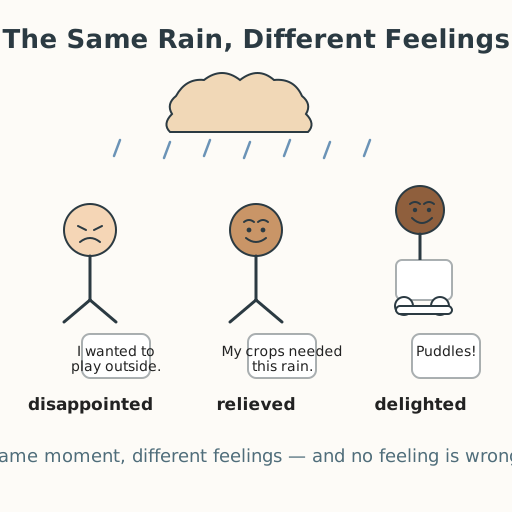
- Same-moment poster · 1 One rain scene with three different reactions (disappointed, relieved, delighted)
- Same-moment scenario cards · 1 set Situations (rain, a move, a new rule, a shared treat) with three different people's reactions to sort and explain
- Chart paper and markers · 1 set
Low-tech / no-cost
- Voice and body Act out one situation and three reactions aloud; no poster or cards needed
- Three found objects One object to stand for each different reaction to the same moment
Enriched / lab & device
- A 'same moment' photo or video clip · 1 per group A real scene where different people react differently, discussed together
- A reusable sorting board · 1 per pair A board with one situation and three feeling slots to fill and explain
Works in different contexts
- large-group Show the poster high; call on the group to name each person's feeling and why it differs
- multi-age Older learners explain "why" each person feels differently while younger learners point to the faces
- self-directed A learner reads each scenario, names each person's feeling, and writes or says why it might differ
- level-grouped Learners ready to extend name two *different* feelings one person might have about the same moment (a mixed feeling)
- outdoor-only Use the weather itself — feel how the same wind or rain feels different to each learner, and say why
Lesson 4 — The Same Moment, Different Feelings
Summary
Learners take the first real step of perspective-taking: the same situation can make different people feel differently, because people have different lives, wants, and memories. They practice explaining why three different people might react three different ways to one shared moment, and they learn that no feeling is the “right” one.
Objectives
- Explain how the same situation can make different people feel differently. (D01.S1.03.02)
Connection
Rain falls on the village. The child who wanted to play outside feels disappointed. The farmer whose crops were thirsty feels relieved. The little one who loves to splash feels delighted. Same rain, three feelings. Or think of a long trip: one person is excited to see a new place, another is sad to leave home, another is nervous about the unfamiliar road. The moment is shared, but the feeling is each person’s own — because each person brings a different life to the same moment.
Materials
- Same-moment poster
- Same-moment scenario cards
- Chart paper and markers
Preparation
- Print or draw the same-moment poster (rain: disappointed / relieved / delighted).
- Prepare scenario cards with one situation and three different people’s reactions.
- Write the thinking question large: “Why might this person feel this way?”
Facilitator note
This lesson is written to the learner (“you”). It plants the seed of perspective-taking that grows in later units (“Caring, Perspective & Belonging”). The important rule: no feeling is the “correct” one. When a learner says why someone feels a certain way, accept their reasoning even if it differs from yours, and wonder together. Gently separate evidence from guessing (“we are imagining why — we cannot know for sure”). Keep the examples respectful of every child’s life (a move, rain, a new rule, sharing) and avoid stereotyping who feels what. This is also an egalitarian moment: every feeling gets to be heard, not just the loudest one.
Procedure
- Gather (5 min). You know your own feelings can change and mix. Now look outward: does everyone feel the same thing you do, in the same moment? Often, no — and that is worth understanding.
- Meet the rain moment (10 min). Look at the poster. Three people, one rain. One is disappointed — they wanted to play. One is relieved — the crops needed it. One is delighted — puddles! Same rain, three feelings. Why? Because each person wants something different and lives a different life. Their feelings are all real; none is wrong.
- Explain the “why” (15 min). Take a scenario card: one situation, three people. For each person, name the feeling and then explain why: “They feel ___ because ___.” Try another card. The thinking question is: why might this person feel this way?
- Pair-share (10 min). Think of a real shared moment — a rainstorm, a rule change, a shared treat, a move. Tell a partner how you felt, then guess how someone else might have felt and why. Listen without saying “you’re wrong.”
- Close (5 min). The same moment can hold many different feelings. Understanding that is how you begin to understand other people — and to be kind to them.
Differentiation
- Support: Work with two reactions instead of three; offer feeling word cards to place on the poster while explaining.
- Extension: Name one person who might feel two things at once about the same moment, using “and.”
Assessment
- Formative (observation): Can the learner explain why two different people might feel differently about the same situation?
- Peer: During pair-share, partners check each other’s “why” by asking “why might they feel that way?”
Home connection
Ask someone at home about a shared moment you both remember, and compare how each of you felt — then wonder together why it differed.
Resources
- CASEL SEL Framework (social awareness competency): https://casel.org/fundamentals-of-sel/