Lesson 05 — My Life Story, In Order
Learners tell the story of their own life so far in time order. Using a "life line" with numbered stops — born, a first memory, something I learned, a big change, now — they practice sequencing their own history, building the self-concept and chronological thinking that later grades deepen.
Objectives
Objectives
- D01.S2.03.01 Tell a simple story of their own life so far, in order, including important people and places.
Essential question
What is the story of my life so far, told in order?
Key vocabulary
Materials
Standard materials
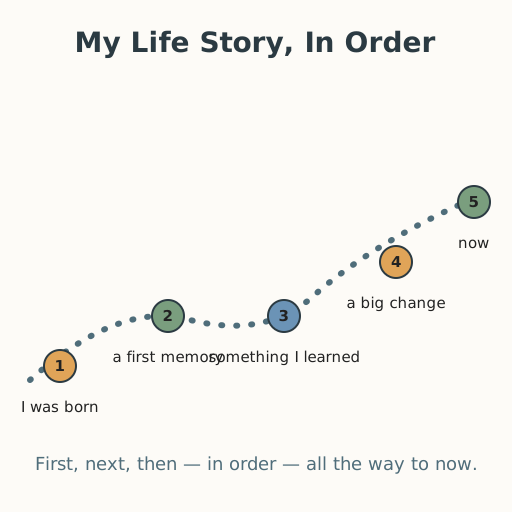
- Life-line chart · 1 A winding road with five numbered stops (born, a first memory, something I learned, a big change, now)
- Blank life-line page · 1 per learner An empty road with five stops for the learner's own story in order
- Crayons and pencils · per learner
Low-tech / no-cost
- A line on the ground Walk the life line, stepping from one stop to the next in order and telling each part aloud
- Five stones in a row Touch one stone for each stop of the story, first to last
Enriched / lab & device
- A 'My Life Story' booklet · 1 per learner A multi-page booklet with one stop per page, kept in the portfolio and added to across the unit
- A photo or object from home · 1 per learner A real keepsake to place on the life line at its correct stop
Works in different contexts
- large-group Build one shared example life line together, then learners make their own in small groups and share one stop
- multi-age Older learners scribe a younger learner's story in order, then read it back to check the sequence
- self-directed A learner fills the life line alone and reads the stops back in order to self-check
- level-grouped Learners ready to extend add a sixth stop and say what they hope comes next
- outdoor-only Lay five stones or leaves in a line and walk from the first to the last, telling one part of the story at each
Lesson 5 — My Life Story, In Order
Summary
Learners tell the story of their own life so far in time order. Using a “life line” with numbered stops — born, a first memory, something I learned, a big change, now — they practice sequencing their own history. This builds self-concept and the chronological thinking that later grades deepen into fuller personal narratives.
Objectives
- Tell a simple story of their own life so far, in order. (D01.S2.03.01)
Connection
Your life is a story, and like any story it has an order: a beginning, a middle, and a now. You were born — that is the first page. Then came first memories, then things you learned (to walk, to speak, to ride, to read), then a big change (a move, a new sibling, a new school), and then now. Telling it in order — first, next, then — is how you make sense of where you have been. Every person’s story is different, and every story matters.
Materials
- Life-line chart
- Blank life-line page
- Crayons and pencils
Preparation
- Print or draw the life-line chart (five numbered stops).
- Copy a blank life-line page for each learner.
- Arrange a circle and a quiet space for drawing.
Facilitator note
This lesson is written to the learner (“you”). The skill is sequencing — putting
events in order — not producing a “complete” or dramatic biography. Some learners’ lives
have hard chapters (a move, a loss, a separation); honor them gently and let the learner
choose what to share (see docs/facilitation.md). Use the worked example (your own or a
shared one) before releasing learners to their own. Every family’s shape and every
child’s pace is normal here — there is no “correct” set of five stops. If a learner
cannot remember or does not know an early stop, that is fine: they may say “I don’t
know yet” or ask someone at home.
Procedure
- Gather (5 min). So far you have been reading your feelings. Now you become the author of your own story. Every story is told in order — and so is yours.
- Meet the life line (10 min). Look at the road with five stops. 1 — I was born. 2 — a first memory. 3 — something I learned. 4 — a big change. 5 — now. These go in order, like a story read from the first page to the last.
- Hear a worked example (10 min). Listen to a life line told in order: “First I was born in a small town. Next, my first memory is holding my grandmother’s hand. Then I learned to ride a bicycle. Then a big change — we moved near the sea. Now I am here, telling you.” Notice the order words: first, next, then, now.
- Make your own life line (15 min). On your page, draw or write one thing at each of the five stops, in order. You may use the stops as they are, or change them to fit your life. If a stop is hard, say “I don’t know yet.”
- Share one stop (5 min). Tell a partner your story from stop 1 to stop 5, or share just one stop you are proud of. Listen to theirs — every life line is different, and that is exactly right.
Differentiation
- Support: Use three stops instead of five; offer picture prompts (a baby, a school, a house, a bicycle) to place in order.
- Extension: Add a sixth stop and say what you hope comes next.
Assessment
- Formative (observation): Can the learner tell their life story with events in time order, using order words (first, next, then, now)?
- Artifact (portfolio): The blank life-line page.
Home connection
Ask someone at home to help you fill in an early stop you are not sure about, and add it to your life line.
Resources
- CASEL SEL Framework (self-awareness competency): https://casel.org/fundamentals-of-sel/